

 Some of the links on this site may be affiliate links. ICOBench may receive advertising commissions when users visit recommended platforms via our affiliate links, at no additional cost to you. All recommendations are based on a comprehensive review process.

Following the latest Cardano news, the Cardano Foundation joined the Blockchains track of Mastercard’s Crypto Partner Program on September 15, but claims circulating among traders that ADA itself will “join” the program by September 27 aren’t backed by any official announcement.
The difference matters. The Foundation’s participation means it will work with Mastercard and other payments and stablecoin companies on cross-border transfers, B2B transactions and settlement. It is not a confirmed ADA integration, and no ADA-based payment product has been announced. Traders betting on a Mastercard listing by a specific date are relying on an unverified timeline, not a corporate commitment.
Connecting Cardano with the future of global payments.
The Cardano Foundation has joined Mastercard’s Crypto Partner Program.
As part of its Blockchains track, we’ll engage with Mastercard and other participants working across payments and stablecoins on areas including… pic.twitter.com/eeZ6K2UrPY
— Cardano Foundation (@Cardano_CF) September 15, 2026
Don’t Miss: ICOBench Experts Call the Next 1000x Crypto Coins for 2027
Cardano-Mastercard: What the Listing Confirms and What It Doesn’t
The scope of Mastercard’s crypto program for Cardano remains unstated even in the source material driving this narrative, meaning the practical effect on ADA usage or settlement volume is undefined. This mirrors a pattern already visible with Cardano’s reported inclusion in a diversified crypto fund, where fund-level exposure was conflated with direct demand for the token.
The blockchain track that the Foundation reportedly joined is generally understood to center on collaboration around cross-border money movement, B2B transactions, and stablecoin-adjacent settlement rails. So not a live consumer payment product denominated in ADA. No evidence currently supports an ADA-branded Mastercard card, direct merchant acceptance, or ADA-based settlement infrastructure.
Sign Up With MergeX And Trade CryptoCardano News: Why ADA Traders Face Clarification Risk
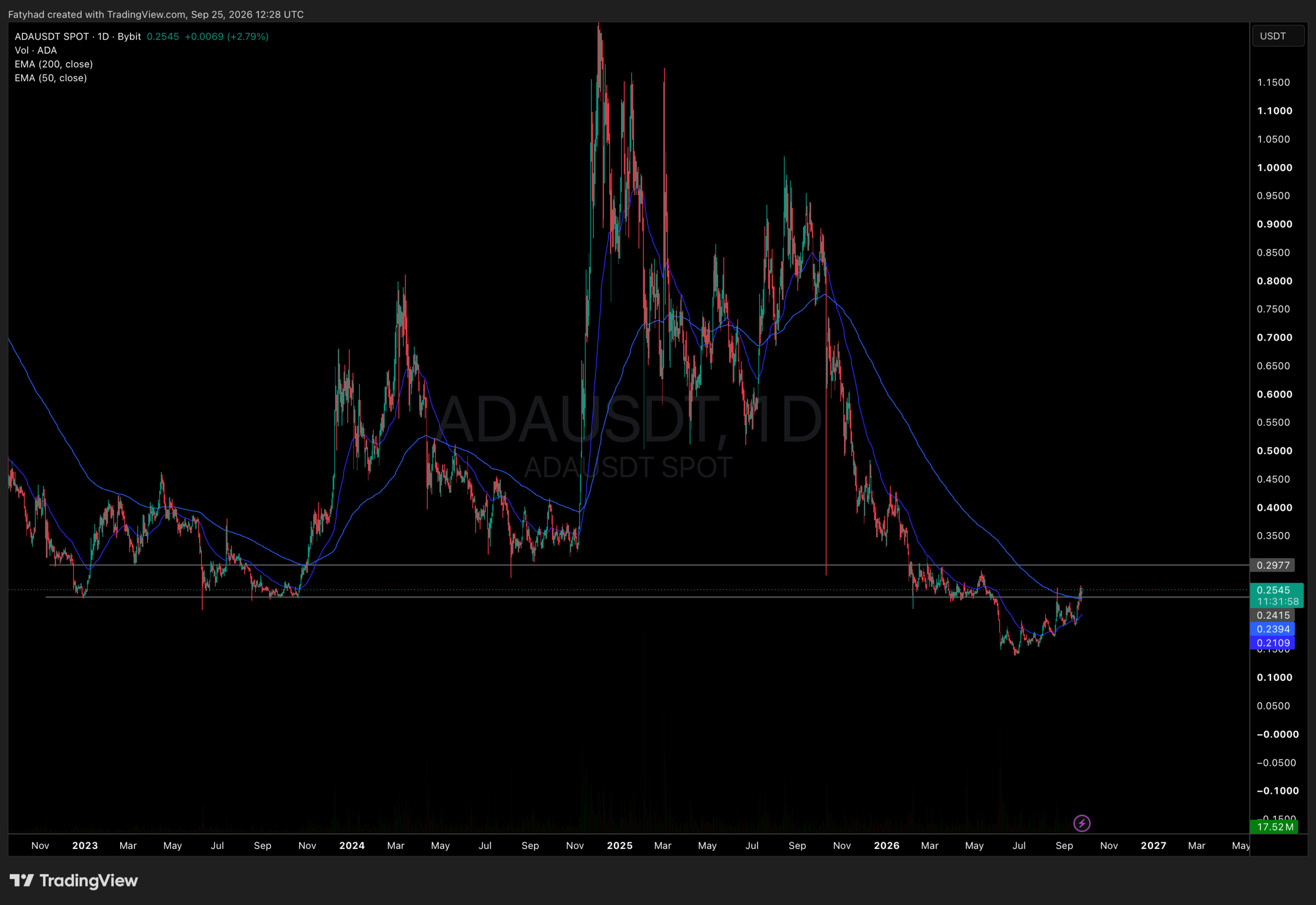
The gap between a calendar listing and an official Mastercard confirmation creates real headline risk, and ADA’s chart leaves little room for disappointment. The token trades near $0.2545 on the daily chart, up about 2.8% on the day, after climbing from its June–July lows around $0.14–$0.15.
It has just pushed above its 200-day exponential moving average (EMA) near $0.239 and reclaimed the $0.2415 level, a zone that acted as support through much of 2022–2023 and broke down earlier this year. The 50-day EMA, near $0.211, is rising underneath, which points to improving short-term momentum.
That makes September 27 a technical test as much as a news event. If the date passes without a formal Mastercard statement matching the listing’s language, a sell-the-news reaction could push ADA back below the $0.24 zone, where the 200-day EMA and former support meet. Losing that area would likely bring the 50-day EMA around $0.21 into focus. If buyers hold the breakout, the next major resistance sits near $0.2977, the ceiling of ADA’s range from February to May.
Institutional-adjacent headlines tend to compress Foundation-level participation into blanket claims of token integration, and this listing follows that pattern. Recent Cardano news shows genuine development momentum across the broader ecosystem, including work highlighted around a recent pre-accelerator cohort of Cardano-based teams. But ecosystem activity and a confirmed Mastercard payment rail for ADA are not the same claim, and traders conflating the two are taking on unpriced risk.
Cardano News: What to Watch After September 27
Time for $ADA to run again?👀 pic.twitter.com/dGT0xPxkjY
— DexHunter 🏹 (@DexHunterIO) September 24, 2026
The clearest resolution would be a formal statement from Mastercard or the Cardano Foundation clarifying the actual scope of the relationship, including whether ADA, a Cardano-based stablecoin, or neither is intended for consumer or merchant payments.
Traders should also watch Mastercard’s published digital-asset settlement materials for any explicit addition of Cardano alongside networks like Ethereum, Solana, or Base, and for announcements of specific cross-border or B2B pilots tied to the Blockchains track.
Until that confirmation arrives, the September 27 date remains a speculative marker rather than a catalyst traders can underwrite with confidence.