

 Some of the links on this site may be affiliate links. ICOBench may receive advertising commissions when users visit recommended platforms via our affiliate links, at no additional cost to you. All recommendations are based on a comprehensive review process.
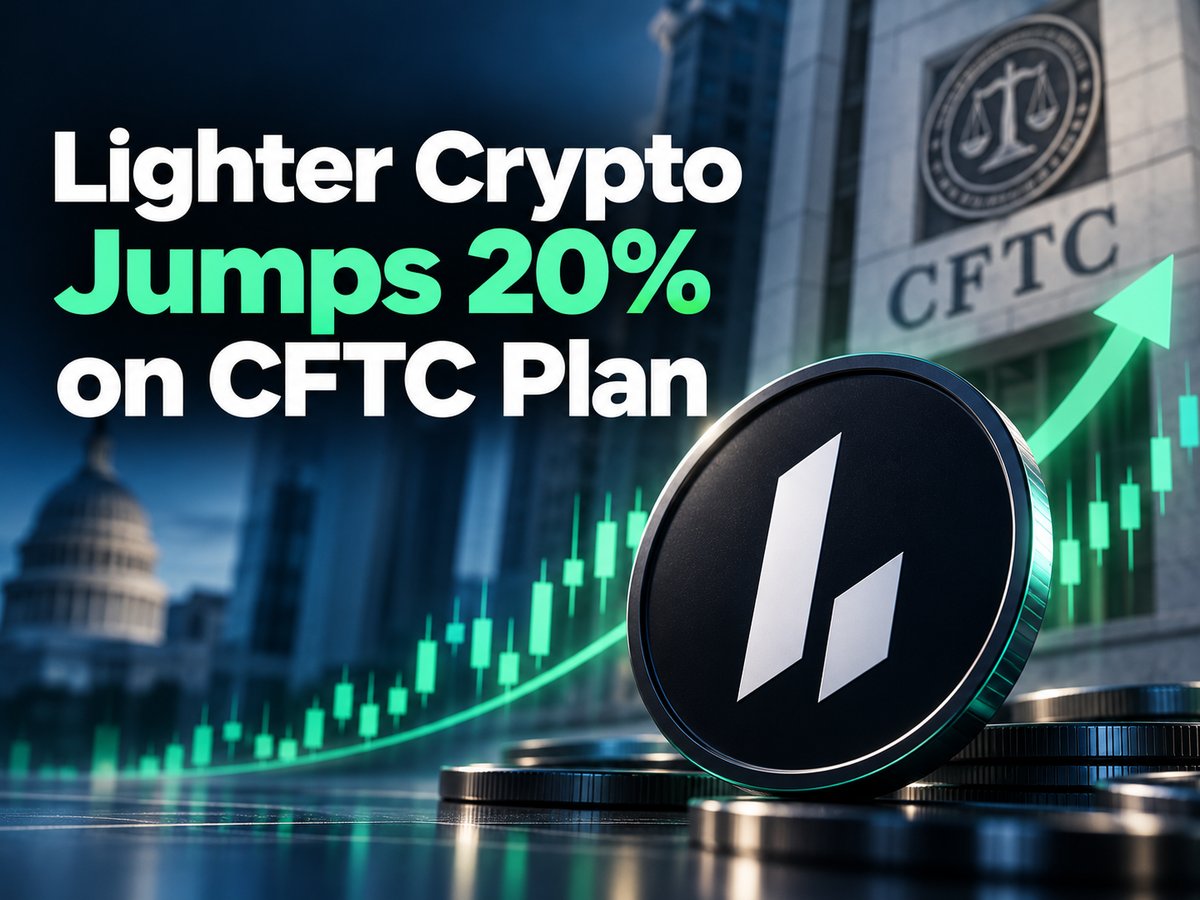
Lighter, the zero-fee crypto derivatives exchange, said on its third-quarter investor call on Wednesday, October 21, that it will apply for a U.S. CFTC license in November: a step toward offering its trading through Robinhood’s U.S. app. Lighter crypto jumped 20% to $3.90 within hours. A Delphi Digital endorsement the day before added fuel.
LIT has cooled to $3.69, still up 8.5% in 24 hours and 25% in a week. It also sits 53% below its $7.86 record from December.
So what is Lighter, how does it stack up against Hyperliquid. Can the rally reach $4?
$LIT is up 20% to $3.90 today.
Here's why:
🟢 Delphi Digital named LIT one of its core picks in a new report on speculative trading, citing its zero retail fees and distribution through Robinhood Wallet.
🟢 Lighter plans to file for a CFTC derivatives license in November,… pic.twitter.com/YqGK23WGib
— CoinGecko (@coingecko) October 21, 2026
Don’t Miss: ETF Experts Predict The Next Crypto to Explode in 2026
Why Is Lighter Crypto Surging?
Two headlines landed together. On the investor call, founder Vladimir Novakovski said Lighter will file with the Commodity Futures Trading Commission next month, aiming to become the first on-chain perpetuals exchange the U.S. regulator approves.
🚨LIGHTER TO APPLY FOR U.S. LICENSE NEXT MONTH, EYES ROBINHOOD U.S. INTEGRATION!
On the Q3 Investor Update call, Vlad said Lighter plans to apply for a U.S. license next month.
Once approved, the company expects to integrate into Robinhood’s U.S. offering, expanding access… pic.twitter.com/ebuDuqFYm0
— Crypto Banter (@crypto_banter) October 21, 2026
Once approved, Lighter expects to plug into Robinhood’s U.S. offering. Today, Robinhood Wallet users can trade Lighter’s perpetuals only outside the U.S., and Robinhood Ventures is one of Lighter’s backers.
Delphi Digital also named LIT one of its core picks in a new report on speculative trading, citing its zero retail fees and its Robinhood distribution. A license is still only a plan, though. Lighter hasn’t filed yet, and approval can take many months.
Don’t Miss: The Secret Meme Coins Smart Money Are Stacking For Next Year
What Is Lighter, and How Is It Different From Hyperliquid?
Lighter is a decentralized exchange for perpetual futures, contracts that let traders bet on prices with leverage and no expiry date. It runs as its own rollup on Ethereum, using zero-knowledge proofs to show each trade was matched fairly, and it charges regular traders no fees at all.
Hyperliquid, the market leader, takes the opposite route. It runs its own blockchain, charges takers 0.045% per trade, and sends about 99% of fees into buying back HYPE. Aster, the other big rival, holds $1.33 billion in open interest, ahead of Lighter.
| Lighter | Hyperliquid | |
|---|---|---|
| Built on | Its own zk-rollup on Ethereum | Its own blockchain |
| Retail trading fees | Zero | 0.015% maker / 0.045% taker |
| Where fees go | Buybacks and burns of LIT | About 99% to HYPE buybacks |
| Open interest | $773 million (5.6% share) | $7.91 billion (57% share) |
| 24h volume | $3.10 billion | $10.42 billion |
Source: fee schedules; open interest and volume from Castle Labs, October 22
Hyperliquid is ten times bigger by open interest, and the business models differ too. Lighter makes its money from premium accounts for high-speed traders (it pay small fees for faster execution) and from Robinhood’s order flow, where the two split revenue 50/50.
A U.S. license would give it something Hyperliquid doesn’t have.
Lighter Price Analysis: Can LIT Break $4?
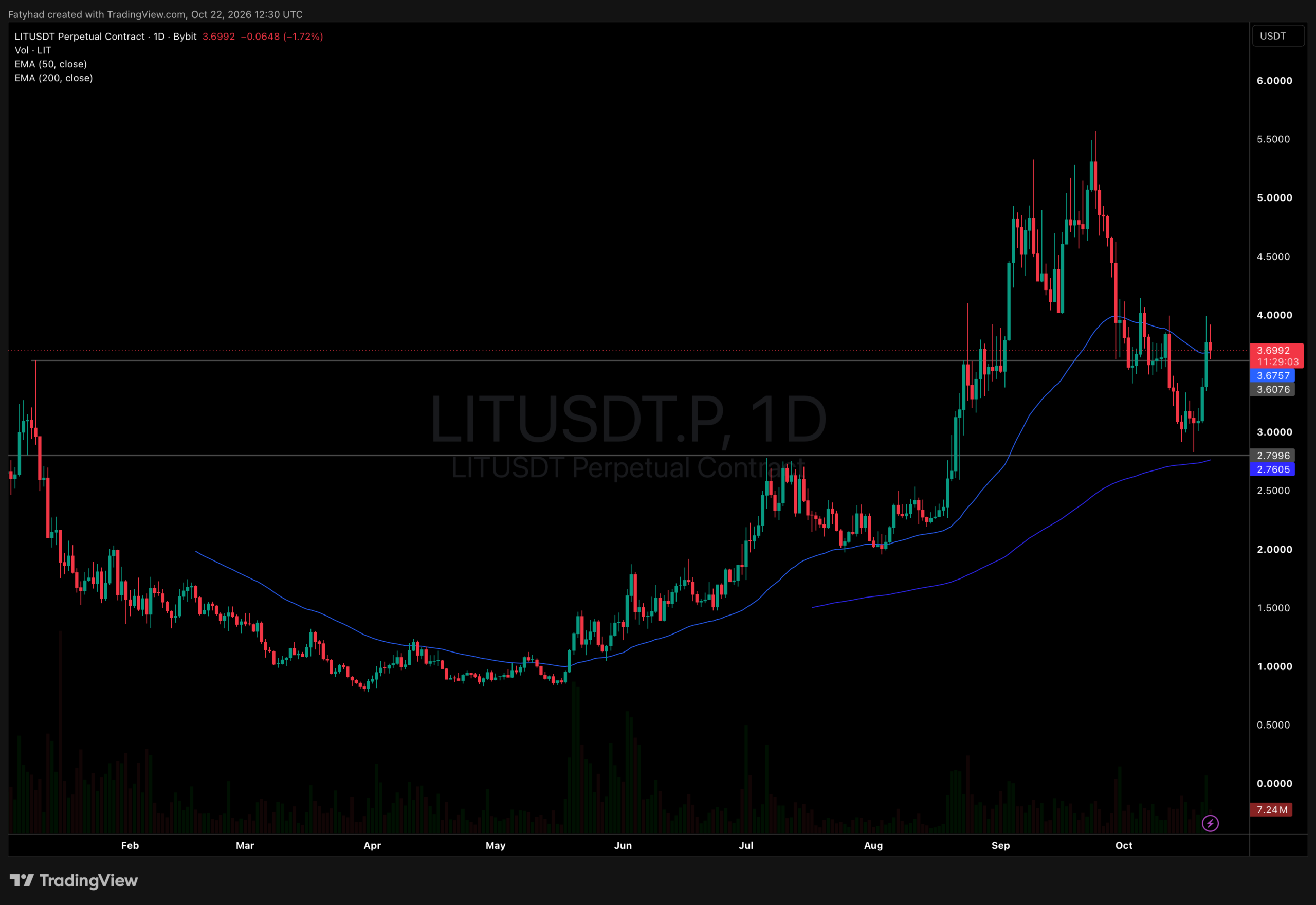
LIT is holding above its 50-day EMA at $3.67 on the daily chart after Wednesday’s spike, and the 200-day EMA sits far lower at $2.76. The bounce from the October 18 low of $2.83 now measures 41% to Wednesday’s top.
The first hurdle is $3.78, where the 4-hour 200 EMA caps the price. Above that, $3.99 to $4.14 is the real wall: Wednesday’s high of $3.99 matches the October 11 top, with the October 5 high at $4.14 just above.
The first support is $3.60 to $3.67, today’s low and the 50-day EMA. Below it, $2.8 to 3.00 is the key floor, where Wednesday’s rally began.
A daily close above $4.14 would clear October’s highs and open a run toward September’s levels near $5. A close below $3.42 would hand back most of the license rally and bring the $2.83 low back into view.
The Lighter crypto story now runs on a calendar. November’s filing is the next date, and the CFTC’s answer will decide whether LIT gets its U.S. door.
EXPLORE: Drift Protocol Robber Pushes Another $61M of ETH Into Tornado Cash