


 Some of the links on this site may be affiliate links. ICOBench may receive advertising commissions when users visit recommended platforms via our affiliate links, at no additional cost to you. All recommendations are based on a comprehensive review process.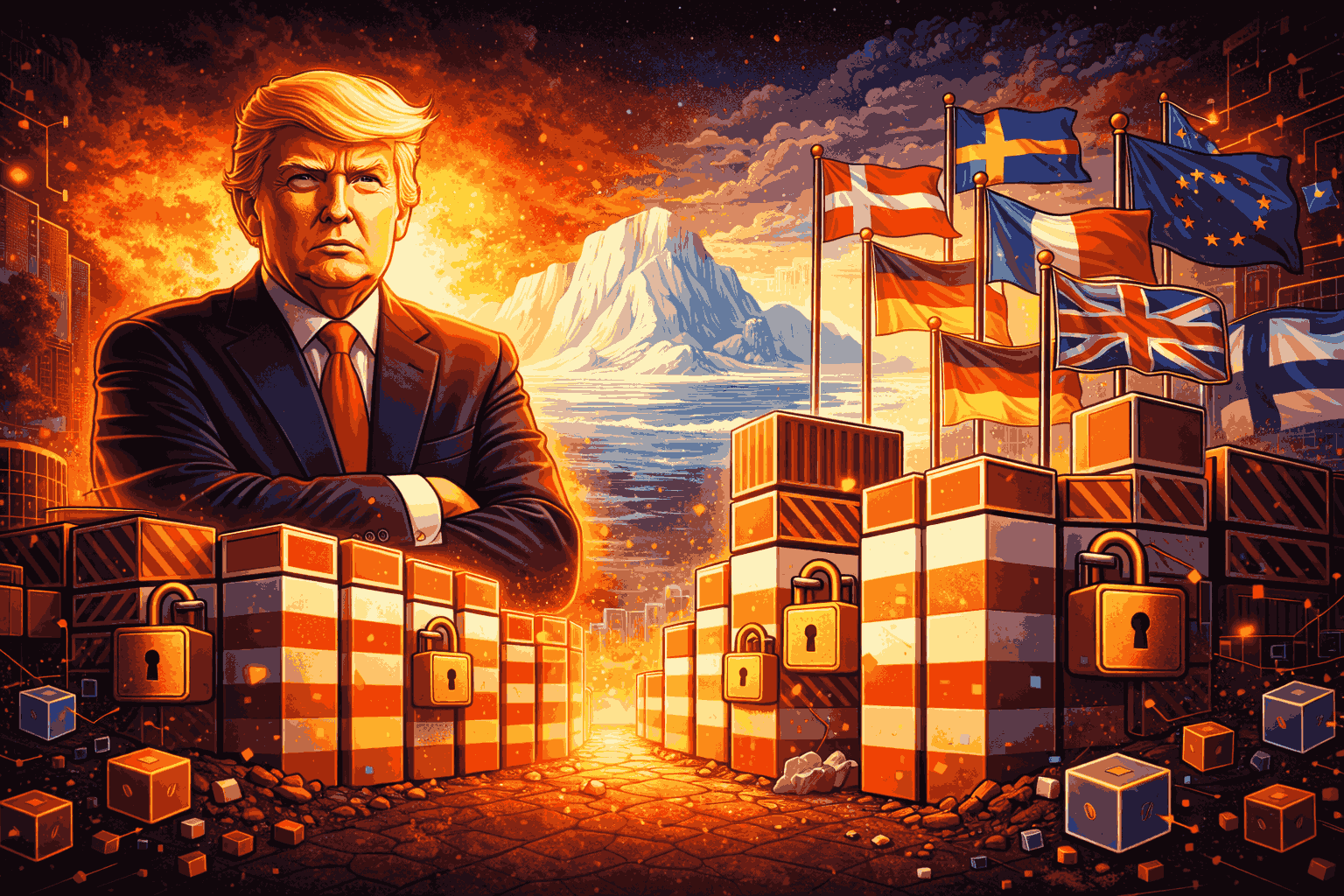
Former U.S. President Donald Trump announced on the 18th that the United States will impose new tariffs on imports from eight European countries starting February 1, 2026, as part of a strategy to strengthen Washington’s negotiating position in talks over Greenland.
1/7
Trump’s Greenland gambit just escalated—tariffs on Europe! 🚨 President drops bombshell: 10% duties on Denmark + 7 allies (Norway, Sweden, France, Germany, UK, Netherlands, Finland) from Feb 1 ’26, rising to 25% June 1. Until “deal for complete purchase of Greenland.” Buckle… pic.twitter.com/Ue0l8ZaTC2— Moon Man (@Imy191Man) January 17, 2026
According to the announcement, a 10% tariff will be applied to imports from Denmark, Norway, Sweden, France, Germany, the United Kingdom, the Netherlands, and Finland. Trump warned that if no agreement is reached, the tariff rate will increase to 25% from June 1, 2026, and will remain in place until negotiations conclude.
Tariffs Used as Pressure Tool in Greenland Negotiations
Posting on his social media platform Truth Social, Trump described the measures as a response to what he called the “unjustified deployment of European troops to Greenland.” He framed the tariffs as a countermeasure designed to pressure European governments into concessions.
Market observers note that the move could heighten global uncertainty and reinforce risk-off sentiment among investors. As a result, demand for perceived safe-haven assets such as Bitcoin (BTC) and select U.S. equities may increase.
Rising Geopolitical Tensions Over Greenland
Greenland is an autonomous territory within the Kingdom of Denmark, and Trump has repeatedly expressed interest in acquiring it, citing its strategic importance and natural resources.
Trump has argued that European military involvement in Greenland poses a threat to global security, warning that without U.S. control, China or Russia could gain influence in the Arctic region. He has also claimed that Denmark lacks the capability to adequately defend Greenland, further escalating tensions between Washington and European capitals.
The announcement comes amid already strained U.S.–EU relations. On the 15th, Vice President J.D. Vance and Secretary of State Marco Rubio met with Danish officials, but talks failed to produce meaningful de-escalation.
Protests have since erupted in Copenhagen, while European leaders caution that Trump’s approach risks undermining NATO unity. All eight countries targeted by the tariffs are NATO members, raising concerns about broader alliance stability.
Legal experts also point out that the European Union functions as a single market, potentially complicating the application of tariffs against individual member states. The EU has already been subject to 15% U.S. tariffs since 2025, and the new measures could further strain transatlantic trade relations.
Market Implications and Investor Response
The growing dispute over Arctic resources and geopolitical influence is increasingly spilling into economic policy, with trade becoming a key battleground.
Against this backdrop of global instability, some investors are reportedly turning to long-term cryptocurrency holdings as part of broader risk-hedging strategies, reflecting rising concerns over geopolitical shocks and policy unpredictability.