


 Some of the links on this site may be affiliate links. ICOBench may receive advertising commissions when users visit recommended platforms via our affiliate links, at no additional cost to you. All recommendations are based on a comprehensive review process.
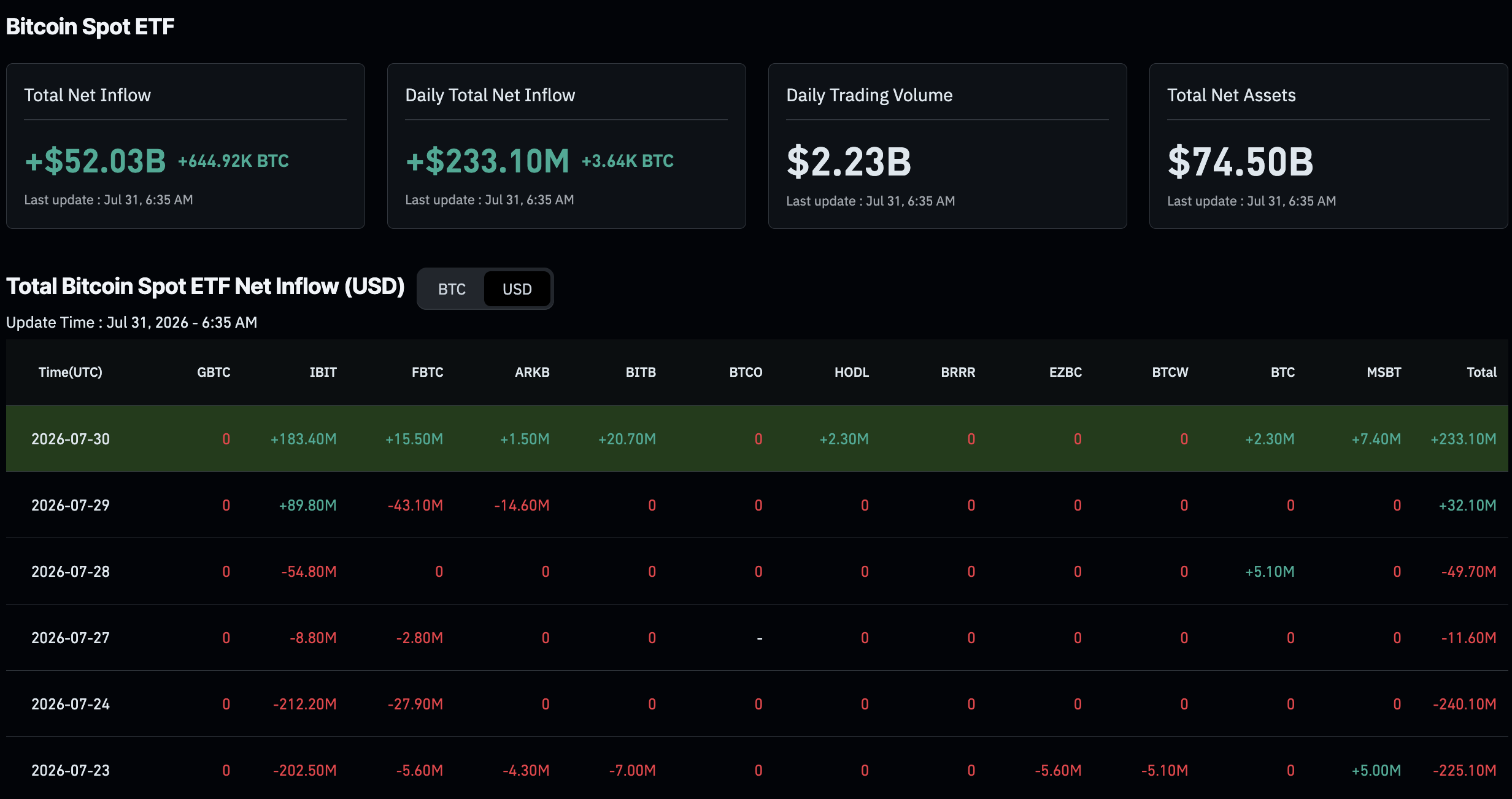
US spot Bitcoin ETF products are closing July 2026 with approximately $205M in net inflows, the smallest monthly total on record since the products launched in January 2024, according to SoSoValue data on July 30, 2026.
The figure arrives after two historically brutal months: $2.43Bn in net outflows in May and $4.52Bn in June, the largest single-month redemption in Bitcoin ETF history. BTC price sat at $63,900 as of today (July 31), holding above key support but offering no directional conviction.
The open question the market must now resolve is whether July’s near-zero flow environment represents an institutional pause before re-engagement, or the opening chapter of a structural cooling in Bitcoin ETF demand that leaves BTC price exposed heading into August.
Bitcoin ETFs just turned back positive.
After a week of mixed flows, spot Bitcoin ETFs saw +3.64K BTC in inflows today.
BlackRock led with +2.87K BTC added through IBIT.
Fidelity added +242 BTC, and Bitwise added another +324 BTC.
GBTC also had no outflows today.
The… pic.twitter.com/ZYhCzz0wL1
— That Martini Guy ₿ (@MartiniGuyYT) July 31, 2026
Bitcoin ETF Inflows: What the Record-Low $205M July Total Actually Reveals About Institutional Positioning
In July, Bitcoin ETF inflows totaled only $205M, contrasting sharply with April’s $1.97Bn, indicating a decline in institutional demand.
The outflows of $6.95Bn in May and June showed active de-risking, while July’s near-zero figure suggests a halt in fresh capital without significant exits. Daily buying pressure from ETF activities has diminished.
Fund-level rotation was noted, with Fidelity FBTC seeing a single-day intake of $165.96M on July 2, while BlackRock IBIT experienced a $40M outflow. By July 6, IBIT rebounded, indicating concentrated demand.
In contrast, Ethereum ETFs performed better with $342.85M in inflows for July, almost matching April’s figures, highlighting the institutional demand for ETH.
XRP ETFs recorded modest inflows of $13.61M, and Solana ETFs saw $13.82M. This disparity aligns with ETH’s price strength, as demonstrated by an +11% rise in the ETH/BTC pair on Binance during July.
BTC Price Vulnerability: What the Withdrawal of ETF Bid Support Actually Reveals About August’s Risk Profile
Without consistent BTC inflows from ETF creation, Bitcoin’s price is more sensitive to macro and regulatory developments.
In August, this vulnerability became evident following the Federal Reserve’s hawkish stance, which kept rates steady while suggesting potential tightening.
As a result, the 30-year Treasury yield hit its highest level since 2007, making yield-bearing assets more attractive than non-yielding ones like BTC.
Analysts highlight $63,300, the 200-week moving average, as crucial support for BTC’s near-term price direction.
If BTC holds this level, it indicates strength; falling below $62,500 could lead to a drop to $60,000, demonstrating BTC’s dependency on technical indicators amid reduced ETF flows.
Regulatory uncertainty, particularly regarding the CLARITY Act, also affects market sentiment. While bipartisan negotiations attempt to revise the act’s provisions, the lack of a confirmed vote before the August recess keeps institutional investors cautious.
Meanwhile, the growth of RWA tokenization offers yield-bearing alternatives that compete for institutional capital, further influencing BTC ETF allocations.