Some of the links on this site may be affiliate links. ICOBench may receive advertising commissions when users visit recommended platforms via our affiliate links, at no additional cost to you. All recommendations are based on a comprehensive review process.
The importance of AI in crypto trading is clearer than ever today, as we approach the end of a week marked by both conflict-driven uncertainty and positive industry catalysts. As Bitcoin recovered strongly despite the Iran situation, President Trump voiced support for pro-crypto legislation on stablecoins and market structure reform, and Wall Street rushed back into the crypto game. As a result, traders have been forced to deal with an overwhelming convergence of geopolitical news, ETF inflow data, and on-chain signals.
AI-powered tools like Grok have risen to the challenge, offering lightning-fast sentiment analysis, predictive modeling of price reactions to Middle East developments, and automated risk management that far outpaces human capabilities. These systems are now central to identifying opportunities in real time during events that would otherwise leave traditional analysts playing catch-up.
Considering the above, we decided to test Grok’s capabilities and have it predict the prices of XRP, Solana, and Cardano for the end of 2026. To make things more difficult, we also threw Bitcoin Hyper (HYPER) into the mix. The latter project’s Bitcoin Layer 2 could be one of the most disruptive technologies in the Web3 space this year, potentially setting HYPER up for 20x gains according to Grok’s analysis.
XRP (XRP)
XRP’s main bullish catalyst, the legal victory achieved by Ripple over the U.S. Securities and Exchange Commission last August, has mostly played out on the XRP chart at this point. However, Grok went deeper than most AIs, and began examining XRP’s ETF inflow data (cumulative total net inflows of $1.25 billion), as well as details about Ripple’s bank partnerships.
Integrations with major players like Deutsche Bank, Société Générale, and DTCC/NSCC integrations are live, driving real cross-border volume through Ripple’s On-Demand Liquidity service, as well as tokenization on the XRPL. Grok added a reminder to include “RLUSD stablecoin traction and the CLARITY Act delivering final U.S. clarity,” after which “XRP becomes the clear bridge asset for trillions in traditional finance flows.”
The AI also pointed out that “technically, XRP has built a rock-solid base around $1.37–$1.40 after last year’s highs, with accumulation patterns, rising on-chain metrics, and whale buying signaling the next leg up.” This points to an end-of-2026 price of approximately $3.20 for XRP.
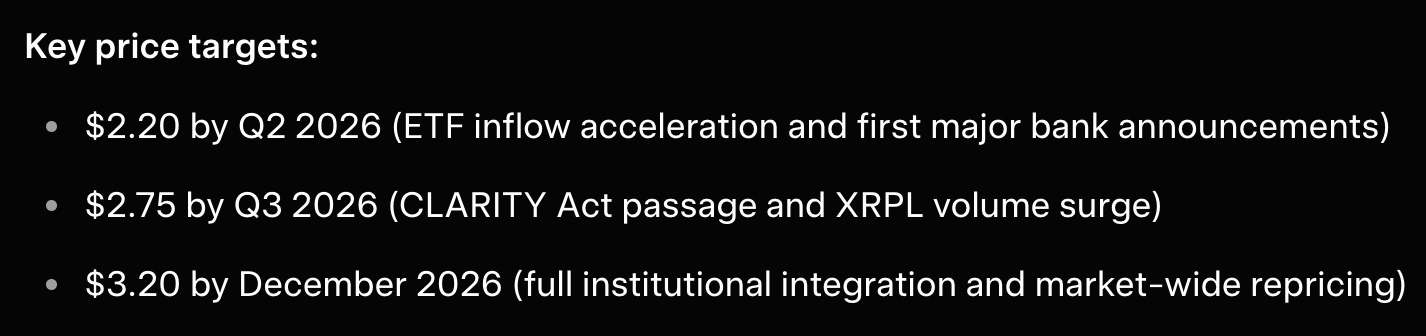
From Grok’s perspective, “in this macro environment of liquidity and altcoin rotation, the fundamentals are simply too strong to keep the price suppressed. When adoption news drops, we see sharp moves higher – and this cycle will repeat until the market reprices XRP for its true utility.”
Solana (SOL)
“Solana is primed for a massive breakout and will hit $300 by the end of 2026,” according to Grok, “because spot SOL ETFs launched late last year are already pulling in hundreds of millions in inflows with zero slowdown.” This means “locking up supply while Firedancer goes live, scaling toward 1 million TPS, and Alpenglow delivers near-instant finality.”
In Grok’s view, this “completely eliminates past network concerns and turns Solana into the undisputed king of speed, cost, and scalability for exploding DeFi TVL, meme coin frenzies on Pump.fun, stablecoin adoption, and institutional tokenization use cases.”
With developers flooding the ecosystem and real volume surging daily, Grok stated that “SOL is the clear high-beta winner in this liquidity cycle and altcoin rotation.”
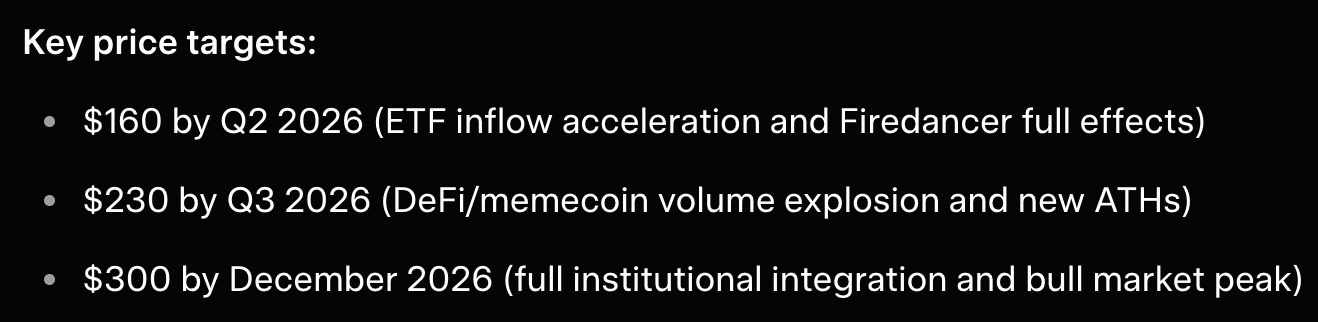
As the SOL chart “has formed support at $85–$90 after the recent shakeout, with aggressive whale purchases and ETF support buying the dip,” Grok also asserted that “this is the accumulation pattern before the next parabolic move.”
Cardano (ADA)
The Cardano project’s fundamentals have been undergoing historic shifts over the last couple of years – and for Grok, “Cardano will reach $1.50 by the end of this year because the Voltaire governance upgrade is now fully live, giving ADA holders real on-chain voting power that’s already driving ecosystem decisions and attracting serious developer capital.”
The AI highlighted “Hydra scaling layers,” which are “delivering over 1,000 TPS in production,” while “real-world adoption in Africa and Asia is exploding through government-backed identity and supply-chain projects.” Additionally, “DeFi TVL plus stablecoin activity on the chain have surged 400% in the last six months. This cycle’s macro liquidity and shifts into undervalued, fundamentally strong altcoins is finally repricing Cardano as the most secure and decentralized smart-contract platform, turning years of patient building into explosive utility-driven demand.”
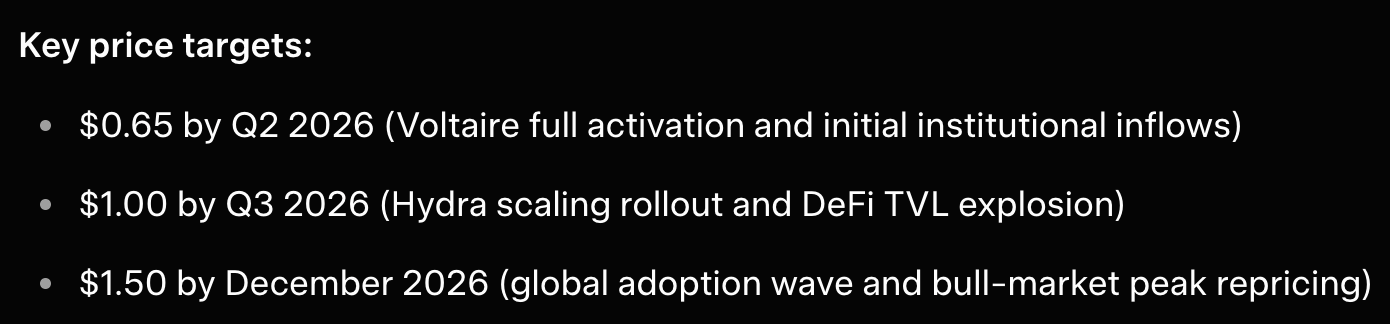
Grok also highlighted “ADA whale accumulation spiking, staking ratios at record highs, and on-chain data confirming the bottom is in.” From here, “every time upgrade news hits, we could see the same sharp reversal pattern to reward Cardano’s fundamentals.”
Bitcoin Hyper (HYPER)
According to Grok, “Bitcoin Hyper will 20x in 2026 because it is the first true Bitcoin Layer 2 network, built with the Solana Virtual Machine for lightning-fast smart contract execution and near-instant finality while inheriting full Bitcoin-grade security through its decentralized Canonical Bridge, ZK proofs, and periodic state anchoring to BTC’s Layer 1.”
Grok continued by explaining how “this finally solves Bitcoin’s speed and cost limitations, unlocking real on-chain utility for wrapped BTC payments, DeFi protocols, staking, dApps, and meme coins without compromising trustless settlement.”
The AI flagged up positive points like how “the HYPER token serves as the L2’s native gas token, powers staking rewards (37% APY), enables governance, and drives ecosystem incentives.” Grok also noted HYPER’s presale fundraising total (almost $32 million) and its upcoming mainnet rollout as reasons for the token’s price to increase rapidly post-launch.
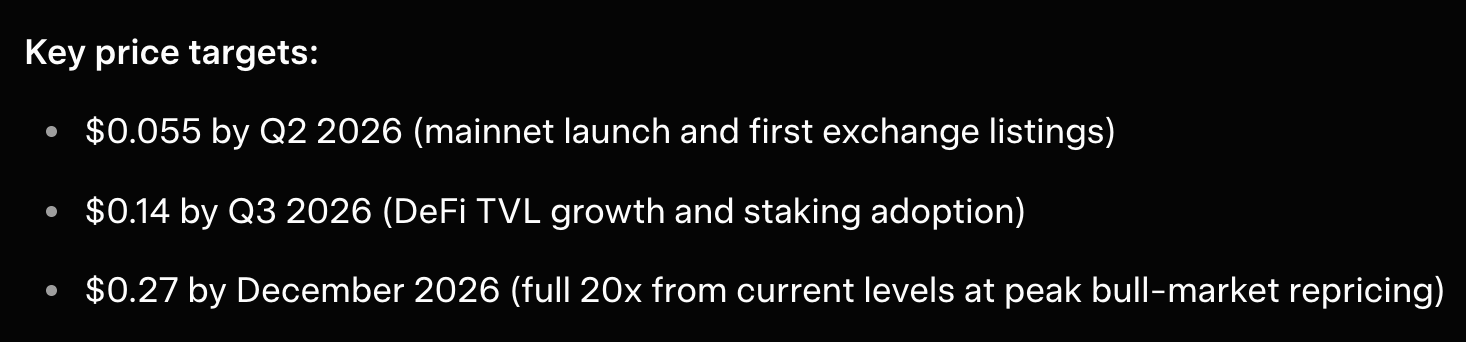
Finally, Grok claimed that HYPER is “perfectly timed for the 2026 liquidity wave and institutional rotation into Bitcoin-native infrastructure. The roadmap to full decentralization and ecosystem expansion in Q2 2026 creates built-in catalysts that will force the market to accommodate HYPER at scale once listings hit and activity surges.”