

 Some of the links on this site may be affiliate links. ICOBench may receive advertising commissions when users visit recommended platforms via our affiliate links, at no additional cost to you. All recommendations are based on a comprehensive review process.
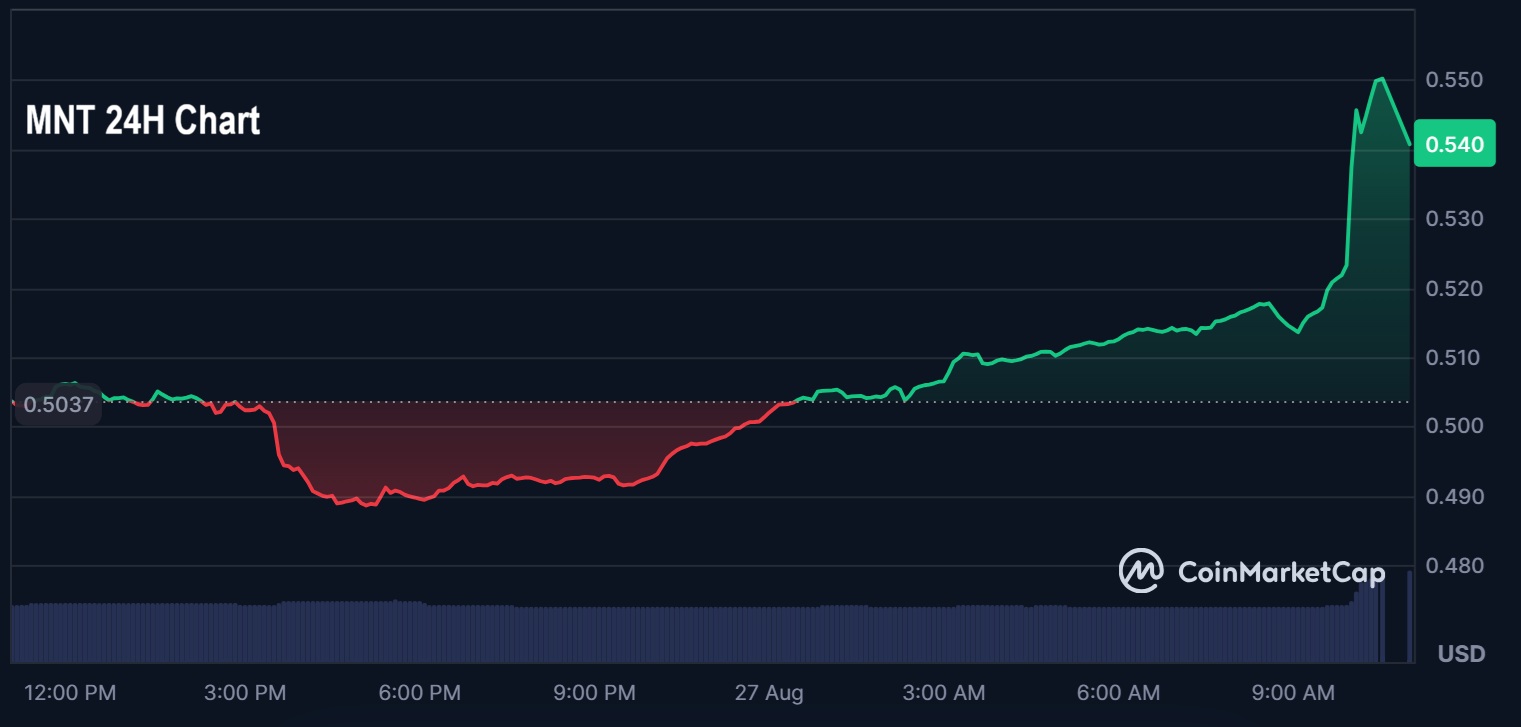
Crypto infrastructure tokens are moving again, and Mantle is one of the stronger performers, climbing 8.53% over the past 24 hours to $0.5499 and outpacing both Bitcoin and Ethereum on the day. BTC is trading at $79,854 after an 11.11% weekly gain, while Ethereum has risen 10.57% over seven days to $2,534.
The MNT move arrives as Mantle expands well beyond its original role as an Ethereum Layer 2. On August 25, the network opened Mantle Vault more widely to DeFi users after the product accumulated more than $200 million in assets under management through Bybit. Mantle says its real-world asset TVL has also jumped from $22 million to $257 million over the past year.
There is another interesting development underneath those numbers: Mantle increasingly wants capital to move between ecosystems rather than remain trapped inside Ethereum. Its Super Portal already connects MNT between Ethereum and Solana, with the infrastructure migrating to Chainlink CCIP in July.
That makes the latest Mantle growth particularly relevant to LiquidChain (LIQUID), a new Layer 3 project that takes multichain infrastructure one step further by connecting liquidity across Bitcoin, Ethereum, and Solana. Its early presale is catching analyst attention, having now raised $950,000, with LIQUID priced at $0.0149.
Mantle’s Expansion Shows Crypto Is Becoming More Multichain
Ethereum Layer 2s originally had a fairly straightforward job: make Ethereum cheaper and faster.
That job is getting broader – networks now compete for users, stablecoins, tokenized assets, DeFi liquidity, and connections with entirely different blockchain ecosystems.
Mantle is a good example, with more than $200 million under management, while the network reports more than $755 million in DeFi TVL. Meanwhile, its Super Portal provides MNT with a bridge between Ethereum and Solana, rather than keeping the token confined to a single ecosystem.
But, in general, crypto’s largest pools of capital still live in very different places – Bitcoin dominates the market by value, Ethereum remains the center of much of DeFi and stablecoin activity, and Solana has built a huge audience around fast trading.
Yet developers still tend to build around individual chains, and liquidity remains fragmented across them, so LiquidChain is being designed to address that problem from the start.
LiquidChain Targets Bitcoin, Ethereum, and Solana at Once
Rather than creating another network focused on a single blockchain, LiquidChain is developing a Layer 3 execution and liquidity layer spanning three of crypto’s biggest ecosystems.
The basic pitch is much easier to understand than the underlying architecture: developers should be able to build once and access users and liquidity across Bitcoin, Ethereum, and Solana, instead of maintaining separate applications and pools on each chain. For users, it shouldn’t matter where liquidity lives.

LIQUID’s technical design uses a high-performance SVM-based environment alongside cross-chain proofs and messaging. Effectively, Bitcoin, Ethereum, and Solana activity is represented within the system, allowing applications to coordinate liquidity across the three networks, without bridges or wrapped assets.
For DeFi, the advantage is deeper liquidity – an application limited to one blockchain can only efficiently reach the assets and users available there. LiquidChain wants Bitcoin capital, Ethereum DeFi liquidity, and Solana’s faster execution within a single underlying protocol.
The project describes this as a deploy-once, reach-everyone model for developers building dApps, meme coins, prediction markets, and other on-chain products, which is a more ambitious target than simply building another bridge.
The Future is Increasingly Multichain
LiquidChain describes the L3 as the infrastructure beneath applications, with cross-chain coordination handled at the protocol level rather than forcing every developer to solve the same problem independently.
Investors have now committed $950,000 to the LIQUID presale, with tokens currently available at $0.0149.
The Order doesn’t ask twice. 👁️⟁
When the signal comes, you answer.https://t.co/vqvBcdSQYC pic.twitter.com/z4Oc2AUBpi
— LiquidChain (@getliquidchain) August 27, 2026
LIQUID can also be staked during the presale, with rewards currently offering 1,197% APY. The project has undergone security reviews by SpyWolf and CertiK, covering another important part of the infrastructure before the network is put into wider use.
Mantle’s 8% daily move does not mean every Layer 2 or infrastructure token is suddenly headed higher, but it does show where major crypto networks are spending their time: DeFi, deeper liquidity, and connections that extend beyond a single blockchain.
With Bitcoin and Ethereum both up more than 10% this week and LIQUID approaching its first $1 million in presale funding, the project is entering the market as demand for connected crypto infrastructure becomes increasingly difficult to ignore.
LiquidChain takes the multichain idea and places it at the center of the protocol.