Some of the links on this site may be affiliate links. ICOBench may receive advertising commissions when users visit recommended platforms via our affiliate links, at no additional cost to you. All recommendations are based on a comprehensive review process.
The digital asset market is signaling high conviction among serious buyers even as most large-caps hit the pause button. The total crypto market cap now stands at $2.67 trillion, roughly flat over the last 24 hours, while the Fear and Greed gauge sits at 81, representing extreme greed. Bitcoin is changing hands at $79,400, down 0.3% on the day but up 2.1% on the week, with a $1.59 trillion market cap – and spot BTC ETF flows are providing vital support, having added $242.24 million yesterday.
Further down the market cap leaderboard, Monero has put in a strong performance by holding 14% in weekly gains and a 4.2% gain today, with bulls apparently determined to break the $500 resistance point. With XMR already at $470, this target represents a relatively small jump, and top analysts are predicting even higher targets of $800 or more by the end of Q4.
These optimistic developments have left room for early-stage capital to make bolder bets – and the best altcoins emerging from the latest volatility include Chainlink (LINK), Bitcoin Hyper (HYPER), and LiquidChain (LIQUID). Each is tied to a concrete bottleneck: oracle and tokenization plumbing, Bitcoin’s limited throughput, and fragmented liquidity across the world’s three largest blockchains.
Chainlink (LINK)
Chainlink (LINK) is the default oracle network for on-chain markets, supplying price feeds, cross-chain messaging, and compliance tooling to DeFi protocols and tokenized-asset platforms. LINK is the unit used to pay for those services and secure the network, and is now trading around $11.80, giving Chainlink a market cap of roughly $8.8 billion.
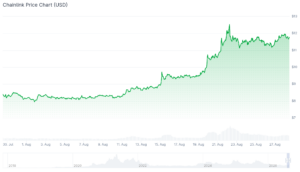
LINK’s most recent catalysts include Charles Schwab’s plans to add LINK (alongside Solana and Avalanche) to its retail crypto platform in the coming months, expanding a service that already offers Bitcoin and ETH to a brokerage base of nearly 40 million accounts and more than $13 trillion in client assets. At the same time, an extended streak of inflows into LINK exchange-traded products and a widening role for Chainlink data and interoperability rails across tokenized equity venues (including Coinbase, Robinhood, xStocks, and Ondo) have also bolstered bulls’ confidence.
The fundamental case for Chainlink has not changed, as tokenized funds, stablecoin settlement, and institutional DeFi still need reliable off-chain data and a way to move value across chains without rebuilding custody each time. Chainlink’s fee design, which routes activity back into a strategic reserve of LINK, is intended to turn that usage into persistent demand – and that process looks set to continue far into the future.
Bitcoin Hyper (HYPER)
Bitcoin Hyper (HYPER) is a new high-throughput Layer 2 for Bitcoin, using a Solana Virtual Machine execution environment and a canonical bridge to enable BTC to move to a faster chain without giving up its Layer 1 settlement security. Users will deposit BTC to a monitored address; a relay program verifies block headers and transaction proofs; and equivalent BTC is then minted on the Layer 2 for near-instant transfers, staking, DeFi, and applications. Batched states are later committed back to Bitcoin, with withdrawals releasing native BTC on the Layer 1 once the proof is accepted.
Big map. Bigger plans. 🌍⚡️https://t.co/VNG0P4GuDo pic.twitter.com/ogY8bDziHm
— Bitcoin Hyper (@BTC_Hyper2) August 28, 2026
The design will directly address Bitcoin’s familiar constraints, including its speed limit (seven transactions per second), multi-minute confirmation times, and fees that spike when block space is scarce. Bitcoin Hyper will also bring programmable finance that still settles on the original chain (including payments, meme coin markets, and dApps), while gas, staking, governance, and ecosystem access run through the HYPER token.
That token is in a public presale at $0.0136853, and the raise has reached $33 million of a $33.5 million target. Buyers can stake at purchase, with a 35% APY offered during the presale window. The project’s next roadmap milestones include the L2’s mainnet (still due this quarter), and HYPER’s success proves that serious investors and builders are already lining up to get involved.
LiquidChain (LIQUID)
LiquidChain (LIQUID) is a soon-to-launch Layer 3 blockchain that will bind Bitcoin’s capital base, Ethereum’s DeFi stack, and Solana’s speed into a single network. Assets from those three Layer 1s will be represented natively on the L3 rather than wrapped in the usual custodial sense, with a Solana-class virtual machine handling execution and a trust-minimized messaging layer verifying Bitcoin UTXOs, Ethereum states, and Solana accounts so that cross-chain transactions can settle atomically.
The Order doesn’t ask twice. 👁️⟁
When the signal comes, you answer.https://t.co/vqvBcdSQYC pic.twitter.com/z4Oc2AUBpi
— LiquidChain (@getliquidchain) August 27, 2026
Fragmented pools are why the same asset can trade at different prices across different chains, and why builders still have to choose a home network before launching a market, a meme coin, or a prediction venue. LiquidChain’s answer is one deployment and one set of pools that can draw on all three ecosystems, making building and trading on the L3 as straightforward as possible.
LIQUID is available through its live presale and priced at $0.01494 per token, with $953,000 raised to date. The tokenomics outline assigns 35% of LIQUID’s 11.8 billion supply to development, 32.5% to marketing and media, 15% to business development and community work, 10% to rewards, and 7.5% to growth and listings. Staking is available at purchase, with rewards of up to 1,195% APY.
With Monero pushing toward a $500 upside test, many investors are embracing selective risk ahead of the next altcoin season – and LiquidChain offers a clear bet that Bitcoin, Ethereum, and Solana will come along for the ride.