




 Some of the links on this site may be affiliate links. ICOBench may receive advertising commissions when users visit recommended platforms via our affiliate links, at no additional cost to you. All recommendations are based on a comprehensive review process.
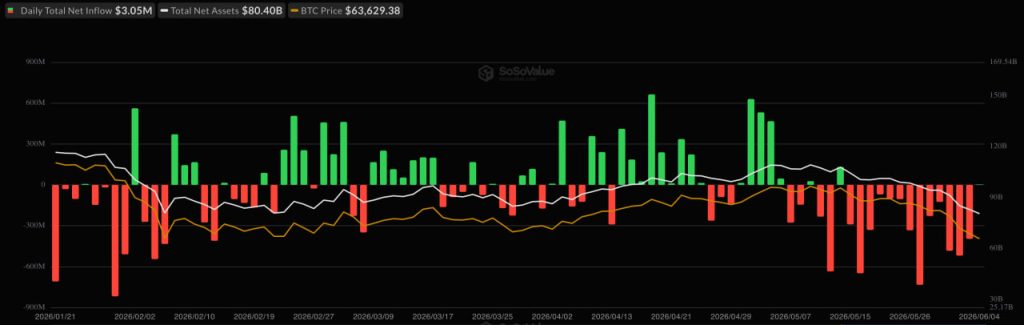
In the news today, US spot Bitcoin ETF products shed approximately 51,726 BTC in holdings over the 30 days into early June 2026, with May alone closing as the worst monthly outflow print of the year at $2.3Bn in net redemptions, a figure that followed an 11-session outflow streak totaling roughly $3.5Bn and included single-day losses from BlackRock’s IBIT and Fidelity’s FBTC that reflected broad institutional de-risking rather than isolated position adjustments.
BTC dropped to an intraday low near $61,100, down more than 6% in 24 hours, as record ETF outflows compounded derivative-side hedging pressure and structured product unwinds.
The open question the market must now resolve is whether the recent deceleration in outflows represents genuine stabilization of institutional demand, or simply the exhaustion of sellers before the next leg lower, because on current evidence, slowing outflows and a recovering BTC price are not the same thing.
DISCOVER: Best Meme Coins to Buy Right Now
Bitcoin ETF News: ETF Redemption Mechanics: What the $3.5Bn Outflow Streak Actually Reveals About Institutional Positioning
Context significantly enhances the raw outflow figures. When Authorized Participants redeem ETF shares, the issuer is required to sell underlying bitcoin on spot markets to satisfy the redemption, which means that selling pressure flows directly into the BTC order book and is not absorbed internally, which is why even moderate outflow figures produce outsized BTC price drop impact during periods of thin market liquidity.
The 11-session streak that accumulated $3.5Bn in net redemptions was not a routine portfolio rotation; it represented a structural withdrawal of the institutional bid that had functioned as a price floor through 2024 and early 2025.
IBIT flows and FBTC flows, the two largest products by AUM, drove the majority of that redemption volume, with both recording multi-session outflow runs that coincided with the broader risk-off pivot in macro markets.
JPMorgan strategist Nikolaos Panigirtzoglou has argued that the drawdown is not purely an ETF-driven phenomenon, pointing instead to a simultaneous de-risking across crypto-related equities and the unwinding of leveraged positions in MicroStrategy-linked instruments, suggesting that multiple institutional channels are tightening at the same time, not just the ETF wrapper.
That diagnosis matters because it means ETF flow stabilization alone cannot resolve the broader liquidity problem; the leverage unwind and equity de-risking need to clear independently.
The contrarian read is that outflow deceleration does carry information. CoinDesk reported that March 2026’s $1.32Bn in net ETF inflows, after four consecutive months of outflows, was framed by analysts as a stabilization signal, with ETF holdings still down approximately 7.2% from their peak. That stabilization did not ignite a new bull impulse, but it did arrest the mechanical selling pressure from redemptions, which is a necessary precondition for any recovery.
The bearish counter is that 2026 ETF inflows are structurally underperforming relative to both 2024 and 2025 on a cumulative basis, meaning the product cohort is no longer functioning as a net liquidity injector into BTC spot markets – it is, at best, liquidity-neutral during calm windows. For deeper context on the scale of institutional selling that preceded this stabilization, the $4Bn+ ETF outflow sequence documented earlier this cycle remains essential framing.
EXPLORE: Next Crypto to Explode in 2026