




 Some of the links on this site may be affiliate links. ICOBench may receive advertising commissions when users visit recommended platforms via our affiliate links, at no additional cost to you. All recommendations are based on a comprehensive review process.
 Yield farming is a DeFi strategy that allows you to earn crypto rewards by putting your digital assets into liquidity pools, lending platforms, or smart contracts. Instead of leaving your assets idle, you lock them into protocols that pay you interest, often in the form of more crypto.
This process supports decentralized exchanges and lending apps, and in return, you collect APY-based yields. Many platforms now offer beginner-friendly ways to start. If you’re holding tokens and want to generate passive income, understanding yield farming is a crucial next step.
✔️Yield farming turns idle crypto into passive income by lending or adding liquidity to DeFi protocols. ✔️Returns come from trading fees, platform rewards, or lending interest, often expressed as APR or APY. ✔️Risks like impermanent loss and smart contract bugs are real, so choosing audited platforms is critical. ✔️Beginner strategies like single-asset staking or stablecoin pools offer safer entry points than leveraged farms.Yield Farming: Key Insights
What Is Yield Farming?
Yield farming is a strategy that allows yield farmers to earn rewards by locking up their digital assets in DeFi protocols. These rewards often come in the form of new tokens, trading fees, or interest, and they’re paid out based on how much and how long yield farmers contribute liquidity to a platform.
For example, when you deposit ETH and USDC into a liquidity pool on Uniswap, you’re helping others swap between those token by locking up your cryptocurrency assets in the protocol.
In return, you receive LP tokens (liquidity provider tokens), which are a type of deposit tokens that represent your share of the pool. These LP tokens can then be staked in a separate farm to earn extra rewards, such as Uniswap’s native token UNI or a new project’s token if it’s an incentivized farm. Additional tokens could be earned as rewards for staking occasionally.
Key Concept: Liquidity Provision
At the center of yield farming is liquidity provision, contributing liquidity by supplying your short crypto assets to a decentralized exchange (DEX) or lending platform so others can trade or borrow them. You’re not giving away your crypto but temporarily locking it into a smart contract that keeps track of your share.
Let’s break it down with an example:
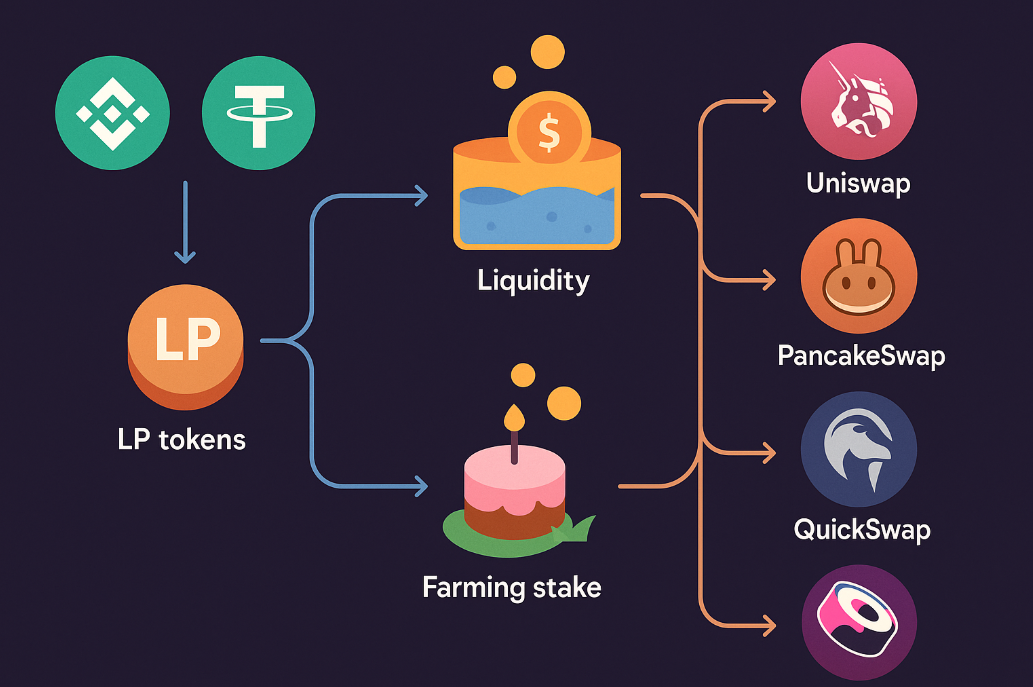
You want to farm on PancakeSwap, which operates on the BNB Chain. You decide to provide liquidity to the BNB–USDT trading pair. To do this, you need to supply equal values of BNB and USDT into the liquidity pool, though many platforms also allow you to use other assets for liquidity provision.
Once deposited, here’s what happens:
- You receive LP tokens (e.g., BNB–USDT LP) which represent your stake in the pool.
- Every time someone swaps between BNB and USDT, a small trading fee (usually 0.2%–0.3%) is collected.
- A portion of those fees goes to you, proportional to your share of the pool.
- You can stake your LP tokens in a “farm” to earn extra rewards – often paid in CAKE or another native token. These rewards are part of the liquidity incentives that motivate users to provide liquidity.
Providing liquidity is what powers DEXs like:
- Uniswap (Ethereum): ETH-based trading pairs
- PancakeSwap (BNB Chain): Fast, low-fee yield farming
- Trader Joe (Avalanche): AVAX ecosystem liquidity
- QuickSwap (Polygon): Yield farming with low gas costs
- SushiSwap (multi-chain): Advanced farming incentives across chains
💡 Important Note: Once you’re in a pool, your assets can shift in value due to price movement, a concept called impermanent loss.
Earning Yields in Crypto
Once you’ve provided liquidity, the next question is: how do you earn from it? Yield farming allows users to earn passive income in several ways, depending on the platform and strategy. These earnings are usually calculated using APR (Annual Percentage Rate) or APY (Annual Percentage Yield). Here’s how it works.
Main Sources of Yield:
- 1. Trading Fees:
Every time someone uses the pool to swap tokens, they pay a small fee (usually 0.2%–0.3%). That fee is split among liquidity providers. On Uniswap, these are the only rewards – you earn based purely on volume and your pool share. - 2. Native Token Rewards (Farming Bonuses):
Platforms like PancakeSwap and Beefy Finance offer bonus rewards to incentivize farming. For example:- BNB–BUSD LPs may earn CAKE tokens on top of their trading fees. These rewards are typically paid out periodically.
- Yearn vaults auto-harvest and reinvest these tokens to boost returns.
- 3. Lending Interest:
On protocols like Aave or Compound, users deposit assets like DAI or USDC to earn interest from borrowers. The rates change based on supply and demand, but are often higher than bank savings. - 4. Incentive Programs:
New projects often run “liquidity mining” campaigns where you earn bonus tokens just for farming their pool. These can offer high returns but usually drop off fast after launch hype fades.
When choosing pools, users often seek the highest yield or highest yields to maximize their returns, but these can come with higher risks.
Understanding APR vs APY:
- APR shows the raw yearly rate (not compounded).
- APY includes compounding effects if rewards are reinvested regularly.
For example:
- A pool offering 80% APR means you’ll earn 80% of your deposit amount per year.
- If you compound rewards daily, the APY might rise to 125% or more, depending on the frequency.
💡 Pro Tip: Always check if your platform auto-compounds rewards (like Yearn, Beefy) or requires manual claiming and reinvesting, which adds gas fees.
Yields in crypto can change quickly. Always look at the TVL (Total Value Locked) and historical performance, not just flashy APY numbers. Also, consider staking rewards as another way to earn yield, though these are paid in the same cryptocurrency and can be affected by market volatility.
How Does Yield Farming Work?
Yield farming might sound complex, but once you understand the process, it follows a clear structure. It’s about putting your crypto into a smart contract, earning returns, and sometimes stacking those returns with bonus incentives. Many DeFi protocols offer yield farming opportunities, each with different models and incentives.
Let’s break down the step-by-step process:
- Choose a Defi platform and pool
You select a DeFi protocol like PancakeSwap, Uniswap, or Beefy Finance, then pick a liquidity pool – for example, USDT–ETH. - Deposit equal values of two tokens
To join a liquidity pool, you’ll need both tokens in a 50:50 ratio. If ETH is $2,000 and USDT is stable at $1, you’d supply 1 ETH + 2,000 USDT. - Receive LP tokens
Once deposited, the smart contract gives you LP tokens, which represent your share of the pool. - Stake your LP tokens in a yield farm
You can then take these LP tokens and stake them in a farming pool (usually on the same platform) to earn additional rewards, like CAKE, UNI, or a new project token. - Claim and reinvest rewards
Rewards accumulate in real time. You can claim manually or use platforms like Beefy, which auto-compound your rewards back into the pool.
Let’s say you want to farm with BNB and USDT on PancakeSwap:
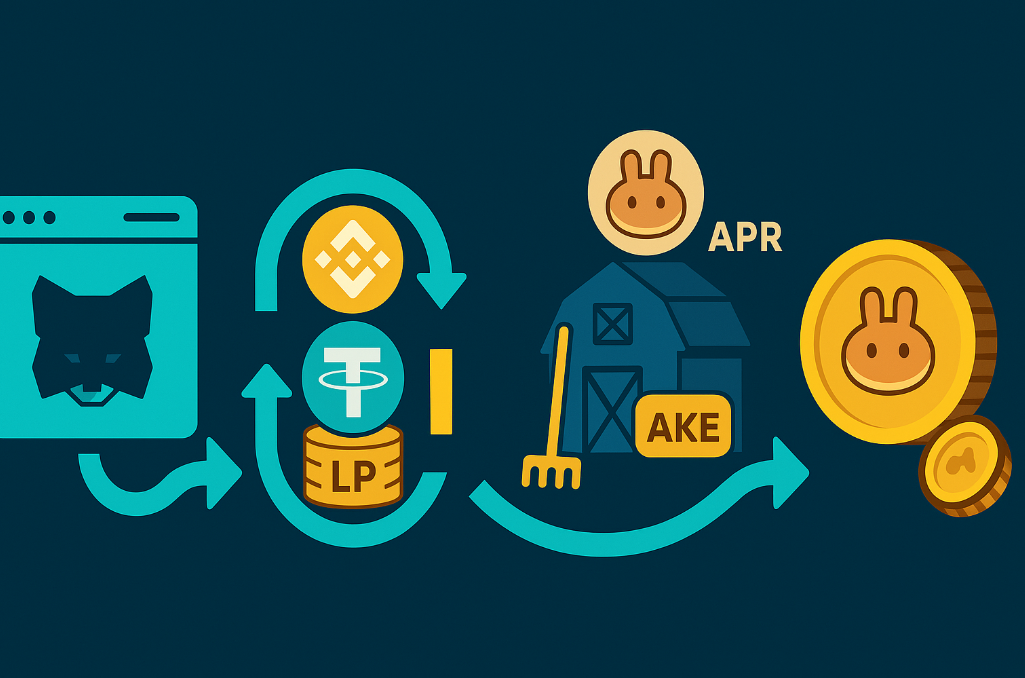
- You connect your wallet (e.g., MetaMask or Trust Wallet) to PancakeSwap.
- You add 1 BNB (~$240) and 240 USDT to the BNB–USDT pool.
- You receive LP tokens worth ~$480 total.
- You stake those LP tokens in a yield farm that pays you in CAKE with a 45% APR.
- Over time, you earn CAKE, which you can claim and reinvest or swap into other tokens.
This is how most users start – with simple, low-to-medium risk pools that offer steady returns.
Types of Yield Farming Strategies
Yield farming isn’t a one-size-fits-all approach. Your strategy will depend on your risk tolerance, capital, and technical comfort. It’s important to understand the farming risks and the risks involved in different strategies, as high rewards often come with significant uncertainties and potential losses. Below are the most common types of strategies used by both beginners and advanced DeFi users.
Single Asset Staking
This is the simplest and lowest-risk option. You stake a single token – like BNB, CAKE, or ETH – in a vault or protocol that rewards you in the same or a different token. There’s no need to pair assets or worry about impermanent loss.
For example, on Binance or PancakeSwap, you can stake CAKE to earn more CAKE. Platforms like Aave allow you to deposit USDC and earn interest directly from borrowers. It’s ideal for stablecoin holders looking for low-volatility income.
Liquidity Pool Farming
This is the most common form of yield farming and involves depositing two tokens of equal value into a liquidity pool. Once deposited, you earn a portion of the margin trading fees and often receive bonus farm tokens on top.
However, this method introduces impermanent loss, which happens when the value of one token moves significantly relative to the other. The change in token ratio can reduce your dollar-denominated returns.
To calculate potential returns:
Yield (APR) = (Total Rewards / Value of Deposited Assets) × 100
Example:
If you deposit $1,000 and earn $150 worth of tokens in a year, your APR is:
($150 / $1,000) × 100 = 15% APR
Vault Strategies & Auto-Compounding
Protocols like Beefy, AutoFarm, and Yearn Finance offer vaults that automatically harvest and reinvest your rewards, allowing users to earn passive income. This converts standard APR into compounded APY over time.
This strategy suits users who want to avoid daily claiming and gas fees. It also boosts returns through compounding, turning a 40% APR into a 60–80% APY depending on the frequency of compounding.
Formula for APY with daily compounding:
APY = (1 + APR/365)^365 − 1
So if APR is 40%, the APY becomes:
(1 + 0.40/365)^365 − 1 ≈ 49%
Leverage and Layered Strategies
Advanced users may use borrowing platforms like Alpha Homora, where you deposit LP tokens and borrow against them to reinvest into the same pool – amplifying your exposure through different investment strategies.
Leverage in crypto boosts returns but magnifies risks. A small drop in asset value could trigger liquidation, especially in volatile pairs. This strategy requires constant monitoring, a solid grasp of debt ratios, and strict risk management.
Conclusion
Yield farming is more than just a way to earn rewards – it’s how you participate in the infrastructure of decentralized finance. By supplying liquidity, staking LP tokens, or auto-compounding your rewards, you’re actively supporting decentralized exchanges and earning yield in return.
But this isn’t a plug-and-play system. You need to understand where yields come from, how to manage risks like impermanent loss, and which platforms are worth your trust.