




 Some of the links on this site may be affiliate links. ICOBench may receive advertising commissions when users visit recommended platforms via our affiliate links, at no additional cost to you. All recommendations are based on a comprehensive review process.
 How to short crypto is one of the most searched questions during bear markets, and for good reason. When prices crash, most traders panic. But experienced ones know they can still profit by betting against the trend. That’s where shorting comes in.
It flips the script: you make money when prices go down. Shorting crypto isn’t just for hedge funds anymore. But it’s not as simple as clicking “sell”, there are multiple ways to short, each with their own risks, tools, and techniques.
How to Short Crypto: Key Insights
✔️ Shorting lets you profit when prices fall, not rise.
✔️ High leverage increases gains, but also increases the risk of liquidation.
✔️ Perpetual futures are the most common way to short crypto today.
✔️ Stop-losses are essential for protecting your position from market spikes.
✔️ Funding fees apply when holding shorts for long periods.
✔️ Shorting works best in clear downtrends or during market corrections.
What Does Shorting Crypto Mean?
Shorting crypto means profiting when the price of a coin falls. You borrow a crypto asset, sell it at the current price, and aim to buy it back later at a lower price, keeping the difference as profit.
This is the opposite of traditional buying, where you only profit if the price rises. In short selling, you’re essentially saying: “I believe this coin will drop, and I want to profit when it does.”
There are several tools and platforms that allow you to short, including margin trading, perpetual futures, and even options trading for more advanced users.
How Shorting Works: Step-by-Step
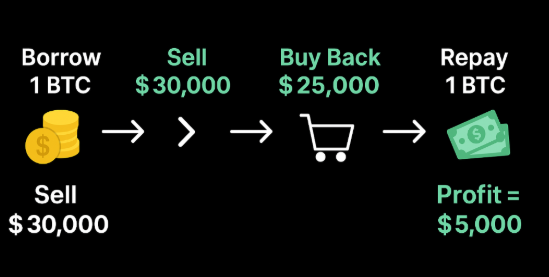
To truly understand how to short crypto, you need to know what’s happening behind the scenes, from the moment you open the trade to when you close it. Here’s a breakdown of how a typical short trade works in practice:
1. Borrow the Asset
When you short, you don’t sell your own crypto, you borrow it temporarily from the exchange or a lending pool. For example, you might borrow 1 BTC from a platform like Binance, OKX, or a DeFi margin protocol like Aave.
This borrowing is handled automatically, and you’re required to put up collateral, often in USDT or another stablecoin, to secure the loan.
If you’re using 10x leverage, your initial margin (collateral) might only be $3,000 to short $30,000 worth of BTC. This means small price movements can heavily impact your position.
2. Sell at Market Price
Once borrowed, the exchange sells the BTC on your behalf at the current market price. Let’s say BTC is trading at $30,000. You sell the borrowed 1 BTC at that price, and now you’re holding $30,000 in stablecoins, waiting for an opportunity to buy back BTC cheaper.
At this point, you owe the platform 1 BTC, not $30,000, your profit or loss depends entirely on what it costs to repurchase that 1 BTC later.
3. Wait for Price to Drop
Now you monitor the market. If the price of BTC falls, your trade is profitable. Suppose BTC drops from $30,000 to $25,000. The lower it falls, the more you stand to gain, because your stablecoins now have more buying power.
However, if the price rises instead, your position is at risk. For example, if BTC climbs to $32,000, you’d need to spend more to buy back the BTC you owe. If it continues rising and your collateral value drops too low, the platform may liquidate your position to prevent further losses.
4. Buy Back the Asset and Repay the Loan
If BTC falls to $25,000, you buy back 1 BTC using your $30,000 in stablecoins. This costs you $25,000, leaving you with a $5,000 profit. You then return the 1 BTC to the lender, closing your position.
Your net profit is:
- $30,000 (initial BTC sale)
- – $25,000 (buyback cost)
- – $300 (estimated fees, interest, and funding costs)
- = $4,700 final profit
If you had used high leverage, learning how to calculate percentage gain on your capital would be significantly larger, but so would the risk. That’s why professional traders use tight stop-losses and position sizing to manage exposure.
Pros and Cons of Shorting Crypto
Shorting crypto can be a powerful strategy, but it’s not without serious risk. Before opening your first short position, it’s important to understand the advantages and drawbacks side by side. Here’s a direct comparison:
| Pros | Cons |
| ✅ Profit in bear markets – Earn when coins are falling instead of rising | ❌ High liquidation risk – Even small upward moves can close your position |
| ✅ Flexible strategy – Short on both centralized and decentralized exchanges | ❌ Leverage adds pressure – Requires constant monitoring and discipline |
| ✅ Advanced tools available – Use derivatives to hedge or speculate precisely | ❌ Fees and funding rates – Ongoing costs can reduce or erase profits |
How to Short Crypto: Best Practices
Shorting crypto is high-risk, so following these simple best practices can help protect your capital and improve your chances of success.
- Start small – Use low leverage (2x–3x) until you’re confident
- Always use stop-losses – Set exit points to prevent liquidation
- Monitor funding rates – Especially on perpetual futures
- Don’t short strong trends – Avoid going against major bullish momentum
- Keep capital separate – Don’t mix short funds with long-term holdings
- Use alerts and automation – Price can spike while you sleep
Conclusion
Shorting crypto is more than just pressing a button, it’s about strategy, timing, and risk control. When done right, it can be a powerful way to protect profits or generate income in down markets. But shorting isn’t for everyone.
It’s fast, unforgiving, and not nearly as beginner-friendly as spot trading. Still, if you take the time to learn, start small, and manage your risk, shorting gives you a new way to trade in all market conditions, not just the bull runs.