

 Some of the links on this site may be affiliate links. ICOBench may receive advertising commissions when users visit recommended platforms via our affiliate links, at no additional cost to you. All recommendations are based on a comprehensive review process.
 In simple terms, dApps is a decentralized application that runs on a blockchain instead of being controlled by a single company. Think of dApps like the apps on your phone, but with no middleman, no single owner, and often with open access for anyone to use. In this guide, we’ll explore the dApp meaning, how they work, their benefits, and why they matter.
What Are dApps: Key Insights
✔️dApps run on blockchains, not company servers, which makes them harder to shut down and more transparent than traditional apps. ✔️Smart contracts are the engine behind dApps, automating transactions and removing the need for middlemen like banks or brokers. ✔️Users gain more control and privacy since they manage their own wallets and data instead of relying on a centralized provider. ✔️dApps bring both opportunities and challenges, they open doors for new income models, but can be complex for beginners to use. ✔️The future of dApps looks promising, with potential growth in finance, gaming, and beyond as developers solve speed and scaling issues.
What Are dApps?
What exactly makes a dApp different from a normal app? A regular app, like Instagram or Uber, is owned and controlled by one company. They decide how the app works, what rules you follow, and how your data is used. A dApp, or decentralized application, works differently. Instead of running on company servers, it runs on a blockchain network that thousands of computers share. This means no single person or company is in charge, and the rules are written into smart contracts that everyone can see.
With this setup, dApps are usually more transparent, harder to shut down, and often give users more control. For example, finance dApps allow people to trade, lend, or borrow directly from one another. If you’re curious about trading itself, it’s helpful to first understand the difference between spot vs. futures crypto as dApps often interact with both markets.
How Do dApps Work?
At first, the idea of decentralized applications can sound tricky. But if we break it into a few simple steps, you’ll see it’s not so different from apps you already use. Here’s how dApps actually work behind the scenes.
Step 1: Built on Blockchain
Every dApp is created on top of a blockchain, which is like a giant shared database. Instead of one company storing everything, thousands of computers keep a copy. This makes the system harder to hack and nearly impossible to shut down.
- Think of blockchain as the foundation of every dApp.
Step 2: Powered by Smart Contracts
A smart contract is the brain of a dApp. It’s code that automatically runs when certain conditions are met. For example, if you lend someone crypto, the smart contract ensures repayment without needing a bank. This is also how platforms for how to short crypto or lending protocols operate.
- Smart contracts replace the middleman.
Step 3: Tokens and Payments
Many dApps use their own tokens or let you trade popular coins like ETH or DOGE. For instance, you might use tokens to vote on changes or pay for in-app features. This ties dApps closely to trading on the best crypto trading platforms or even Dogecoin futures trading.
- Tokens make dApps more than just apps; they’re economies.
Step 4: Open Access for Users
Unlike regular apps that might block regions or accounts, dApps are usually open to anyone with internet and a wallet. That means whether you’re in the US, Europe, or Asia, you can access the same features without permission.
- All you need is a wallet to join in.
Why Are dApps Important?
You might be wondering why people are so excited about dApps. The truth is, they bring some powerful benefits to the table. Let’s look at five reasons why decentralized applications matter and how they’re changing the way we use technology.
📍More Control for Users
In traditional apps, the company sets the rules. With dApps, users actually hold more power because smart contracts decide how things run. For example, in a DeFi dApp, you control your own funds instead of trusting a bank or exchange.
📍Transparency You Can Trust
Every action on a dApp is recorded on the blockchain. That means anyone can verify transactions without needing to trust a single company. This level of openness makes cheating, fraud, or hidden fees much harder. Think of it like a public scoreboard that can’t be erased.
📍New Ways to Earn
dApps often let you earn in creative ways. For example, you might stake coins, provide liquidity, or even collect NFTs. People also trade directly using tools similar to how to leverage trade, giving them more earning potential than old-school apps.
📍Global and Borderless Access
With a dApp, your location doesn’t matter. Anyone with internet and a wallet can join. This has opened doors for people in countries without strong banking systems, where access to the best crypto contract trading platforms can be life-changing.
📍Innovation in Every Industry
From finance to gaming to healthcare, dApp development is opening new doors. Imagine a game where players own their characters as NFTs, or a medical system where patient records are securely shared. These fresh ideas show why dApps aren’t just hype, they’re driving real innovation.
Pros and Cons of Using dApps
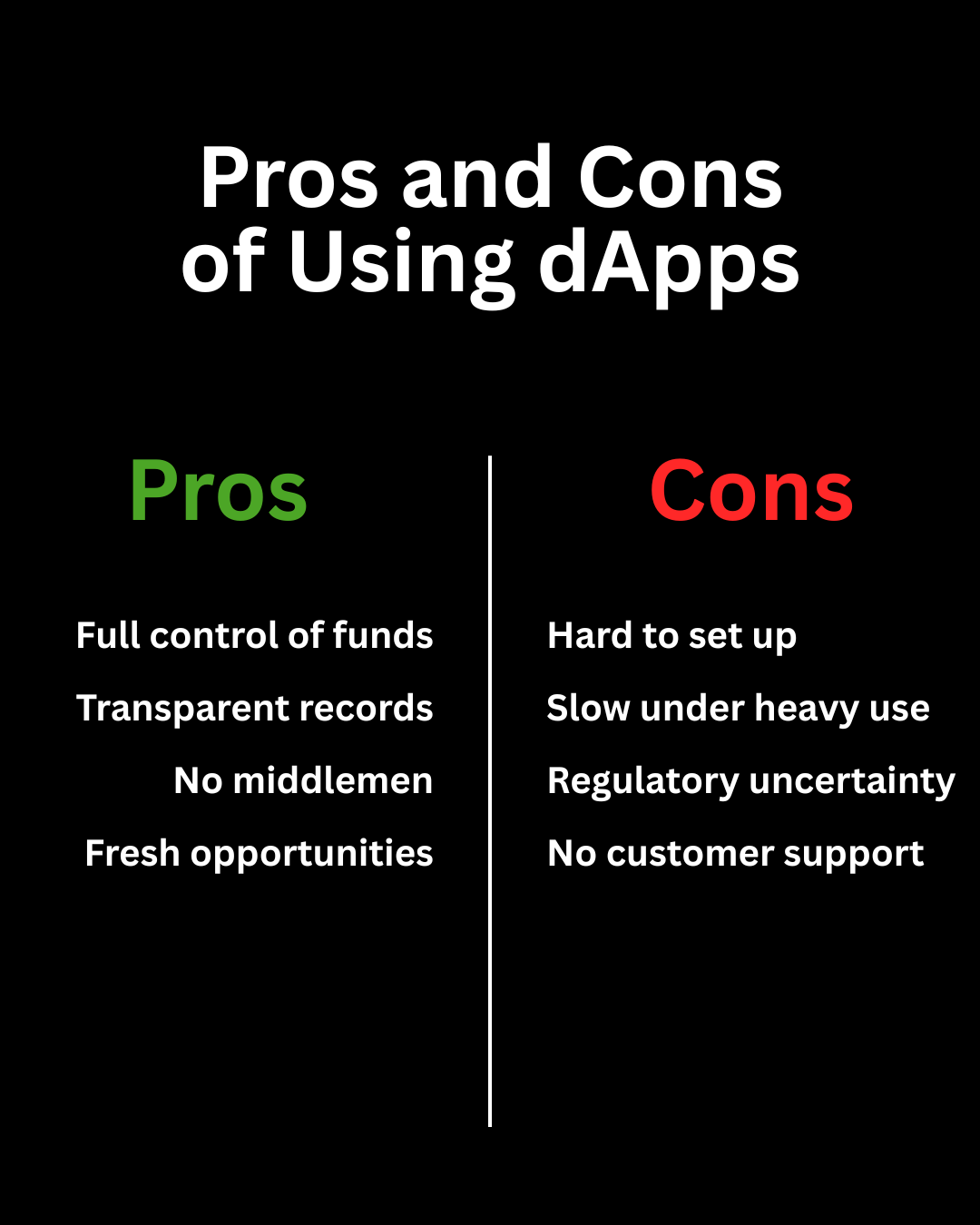
Like anything new, dApps come with both good and bad sides. To understand them better, let’s break down the advantages and disadvantages in a simple way.
Pros of dApps
DApps have some clear benefits that make them attractive to both users and developers.
- User control: You hold your own keys and funds, not a company. This makes dApps safer for personal finance.
- Transparency: Every action is recorded on-chain, reducing scams and fraud. It’s easy to double-check how things work.
- No middlemen: dApps let you connect directly with other people. That means faster and cheaper transactions, similar to using the best crypto day trading platforms.
- Innovation: From DeFi to NFTs, dApps create fresh opportunities. You can find dApp examples across gaming, art, and trading.
Cons of dApps
Of course, dApps aren’t perfect, and there are some challenges to keep in mind.
- Complex setup: New users often struggle with wallets and gas fees. This makes onboarding harder compared to traditional apps.
- Scaling issues: When too many people use a dApp at once, the network can slow down. This can frustrate users.
- Regulation risks: Governments are still figuring out how to handle dApps. Just like with crypto binary options, rules can change quickly.
- Limited support: If something breaks, you can’t call customer service. You’re often left to figure things out yourself.
Pros
Cons
Open participation from anyone with internet and a wallet
Learning curve can be steep for beginners
Built-in fairness since the rules are coded into smart contracts
Transactions can be slower and more expensive during network congestion
Communities often govern dApps instead of corporations
Security bugs in code can’t always be fixed quickly
Opportunities for new business models like play-to-earn games
Some dApps lack polish compared to mainstream apps
The Future of dApps
Where are dApps heading next? Many experts believe they’ll become as common as today’s mobile apps. The difference is that decentralized applications will focus on giving users more control, more privacy, and new ways to interact with money, games, and even social networks. Imagine logging into a social dApp where your profile isn’t owned by a company, or playing a game where you truly own the items you win.
We’re also seeing growth in financial dApps that connect with the best 100x leverage crypto trading platforms, giving advanced traders tools that never existed before. At the same time, developers are working to fix the challenges around speed, user experience, and regulation. If progress continues, the best dApps of tomorrow might not just compete with traditional apps; they could completely change how we use the internet.
Conclusion
Decentralized applications (dApps) is built to give users more freedom, fairness, and transparency than traditional apps. They’re already changing how people trade, play, and connect online, and the movement is only growing. While challenges like scaling and regulation remain, the potential of dApps is huge. From finance to gaming, they represent a new way of thinking about the internet, one where users truly have a say.