

 Some of the links on this site may be affiliate links. ICOBench may receive advertising commissions when users visit recommended platforms via our affiliate links, at no additional cost to you. All recommendations are based on a comprehensive review process.
 The world of spot vs futures crypto trading is full of bold claims and flashy wins – but knowing how the markets actually work gives you the edge. Most beginners jump straight into spot trading, buying coins directly.
But take a look under the hood of any pro trader’s dashboard, and you’ll likely see something else: futures contracts. These two approaches may sound similar, but they serve completely different purposes, offer very different risks, and can drastically change your outcome.
Spot vs Futures Crypto: Key Insights
✔️ Spot trading involves real asset ownership, allowing users to hold, transfer, or stake their crypto directly.
✔️Futures trading is contract-based, letting traders speculate on price without owning the underlying asset.
✔️Spot carries lower risk, with no leverage or liquidation, losses are limited to your initial investment.
✔️Futures introduce leverage, increasing both profit potential and exposure to sudden losses.
✔️Funding fees and margin requirements are unique to futures and can affect profitability over time.
✔️Choosing between spot and futures depends on your goals, risk tolerance, and trading experience.
What Is Spot Trading in Crypto?
Spot trading is the simplest form of crypto trading, where you buy and sell actual cryptocurrencies and take immediate ownership.
How Spot Trading Works
When you make a spot trade, you’re buying a digital asset at its current market price. That price is called the spot price, and the trade settles instantly. If you buy 1 ETH at $1,600 on a spot exchange, you now own 1 ETH. It’s yours to withdraw, hold, or use.
Spot trading usually happens on exchanges like Binance, Coinbase, Kraken, and Uniswap (for decentralized spot trading). You use fiat money (like USD or EUR) or stablecoins (like USDT or USDC) to make the trade.
Say you buy 0.01 BTC at $27,000 in spot. You hold it for a few months, and the price climbs to $35,000. You sell it – your profit is clear and based purely on the price difference.
What Are Crypto Futures?
Crypto futures are derivative contracts that allow you to speculate on the price of a cryptocurrency without actually owning it.
How Crypto Futures Work
Instead of buying the coin itself, you agree to buy or sell the asset later at a price you set now. Think of it like placing a bet on the future price of Bitcoin. These contracts are often perpetual, meaning they have no expiry date and can be opened or closed anytime.
Futures are usually traded with leverage, meaning you borrow funds to increase your position size.
You believe Ethereum will fall from $1,600 to $1,400. You open a short futures position with 10x leverage. If ETH drops as expected, your $100 position could turn into a $250 profit. But if ETH rises instead, you could lose your entire margin in seconds.
Key Differences Between Spot and Futures Trading
Understanding the difference between spot vs futures crypto trading is essential if you want to manage your risk, choose the right platform, and trade with confidence. Here’s a clear breakdown of the main points that matter.
Ownership vs Speculation
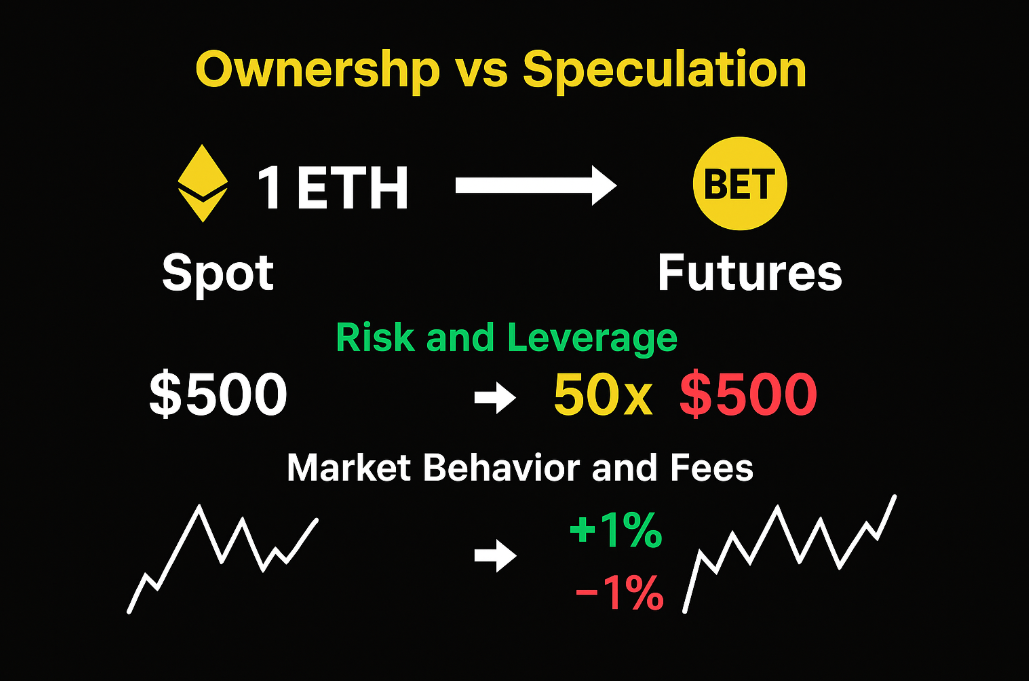
Spot trading means you’re buying the actual crypto. If you purchase 1 ETH for ETH price prediction, you own it – you can send it to a wallet, stake it, or hold it long-term. It’s yours. In futures trading, you don’t own anything.
You’re only betting on where the price goes. You can’t transfer it or use it. That’s why spot is about ownership, and futures is pure speculation. This also affects how profits are taxed and how you interact with the asset.
Risk and Leverage
Spot trades don’t use leverage, so your losses are limited to what you invest. If you put in $500, that’s the maximum you can lose. It’s straightforward. Futures trades use leverage, which means you can open much larger positions than your balance allows.
However, it comes with high risk. A small price move – just 1–2% – can liquidate your entire position if you’re using 50x or 100x leverage. That’s why futures require active risk management, while spot is safer by default.
Market Behavior and Fees
Spot prices reflect the real-time buying and selling of the asset. What you see is what you get. Futures prices can differ slightly because of funding rates and open interest. These contracts often have hidden costs, like funding fees every 8 hours, depending on your position.
Over time, these fees can eat into profits. So while spot is simpler and more transparent, futures pricing depends on market sentiment and internal mechanics that not every trader understands at first.
Pros and Cons of Spot vs Futures Crypto Trading
So should you use leverage or not? Here’s a clear side-by-side comparison of the potential benefits and risks of trading crypto with leverage.
| Pros | Cons |
| ✅ You own the actual crypto asset | ❌ No leverage in spot, so slower profit potential |
| ✅ Lower risk with no chance of liquidation (Spot) | ❌ High risk of liquidation and fast losses (Futures) |
| ✅ Transparent pricing, no funding fees (Spot) | ❌ Funding fees and margin calls add extra risk (Futures) |
| ✅ Ideal for beginners and long-term holders (Spot) | ❌ Requires full capital upfront (Spot) |
| ✅ Leverage allows larger positions with less capital (Futures) | ❌ You don’t own the underlying asset (Futures) |
| ✅ You can profit in both rising and falling markets (Futures) | ❌ No way to profit from price drops (Spot) |
| ✅ Useful for short-term strategies and hedging (Futures) | ❌ Demands constant attention and strong risk control (Futures) |
| ✅ More tools and flexibility for active traders (Futures) | ❌ Limited trading flexibility in volatile markets (Spot) |
Spot vs Futures Crypto: Best Practices
If you’re planning to trade crypto through spot or futures, follow these quick tips to stay in control.
- Define Your Goal: Use spot for holding and futures for short-term strategies.
- Start with Spot: It’s safer, simpler, and better for learning market behavior.
- Use Stop-Losses: Always protect your futures trades with clear exit points.
- Limit Your Exposure: Don’t overinvest – especially in high-leverage futures trades.
- Avoid Mixing Funds: Keep spot and futures capital separate to avoid confusion.
Conclusion
Spot is steady and tangible. Futures are fast and flexible. The trick isn’t picking one forever – it’s knowing when and how to use each. Learn them both, use them wisely, and you’ll avoid the common trap of trading blindly with no plan.