




 Some of the links on this site may be affiliate links. ICOBench may receive advertising commissions when users visit recommended platforms via our affiliate links, at no additional cost to you. All recommendations are based on a comprehensive review process.
 How to leverage trade comes down to one core idea: using borrowed capital to increase your exposure and potentially multiply your gains.
Instead of trading with only your own money, you use margin provided by a broker or platform to open larger positions. Leverage can turn small moves into big profits, but it can just as easily magnify losses.
The key is understanding how it works, when to apply it, and how to manage the risk. With the right strategy and mindset, it becomes a precision tool.
How to Leverage Trade: Key Insights
✔️Leverage multiplies both gains and losses, so it must be tied to strict risk management, not profit goals. ✔️Smart traders calculate position size based on stop loss and risk, then apply only as much leverage as needed – not more. ✔️High-probability setups, tight stops, and liquid markets are the best environments for using leverage safely. ✔️Never risk more than 1–2% of your account per trade, even when leverage is available up to 100x. ✔️Different markets require different leverage levels – Forex supports more, Crypto requires less, and Futures depend on tick size and margin rules.
What Is Leverage in Trading?
Leverage means using borrowed capital to open larger trades than your account balance would normally allow. It’s typically shown as a ratio like 5:1, 10:1, or 100:1, which tells you how many times your capital is being multiplied.
If you have $1,000 and apply 10:1 leverage, you’re controlling $10,000 worth of a position. The profit – or loss – is then calculated on the full $10,000, not just your $1,000.
Say you think Bitcoin will rise. You enter a long position with 10x leverage using $1,000 of your own funds. You now control $10,000. If BTC increases 2%, you make $200 – that’s a 20% return on your capital. But if BTC drops 2%, you lose the same $200. Leverage magnifies both reward and risk.
Basic Formula:
Leverage = Total Trade Size ÷ Your Capital
If you’re trading $50,000 using $2,500 of your own funds:
Leverage = 50,000 ÷ 2,500 = 20x
Leverage is tied to margin. The higher the leverage, the lower the margin required. At 10x leverage, the margin is 10%. If your equity drops below that, your broker may liquidate the position to prevent further loss.
How to Leverage Trade Step-by-Step
Every leverage trade should be based on a plan, not a prediction. Below is a precise step-by-step approach that professional traders use to apply leverage responsibly while maximizing their edge.
Step 1: Define Your Risk in Dollars
Start with your account size and decide what % of it you’re willing to risk on the trade. Most professionals cap this at 1–2% per trade.
Step 2: Find the Entry and Stop Loss Level
Use your strategy to determine the exact entry price and where the trade idea is invalidated (your stop loss). The distance between them determines how much room you give the trade to move.
Example: Going long ETH at $1,750 with a stop at $1,700 = 2.85% risk per trade.
Step 3: Calculate Position Size Based on Stop Loss
Take your max dollar risk and divide it by the % distance to your stop. Formula: Position Size = Dollar Risk ÷ % Stop. In the ETH trade: $60 ÷ 2.85% = $2,105 position needed.
Step 4: Apply Leverage to Match Position Size
Now compare your required position to the capital you’re putting up. If you’re using $500 to open a $2,105 trade, you’re applying 4.2x leverage.
At this level, a 2.85% drop hits your stop and loses $60 – but you’re still in control, and not risking liquidation.
When to Use Leverage (And When Not To)
Leverage is not a tool you use on every trade. It works best in high-conviction setups where the risk is tightly controlled and the probability of success is clear. Knowing when to leverage trade is just as important as knowing how.
✅ When to Use Leverage
1. High-Probability Setups
Use leverage only when you have a proven strategy or technical confirmation. For example, if a price breaks out of a strong resistance level with volume, and your strategy has a high win rate on breakouts, this may justify applying moderate leverage (3x–5x).
2. Tight Stop Losses
Leverage works best when you can define your maximum loss in advance. If your stop loss is 1.5% below entry, you can use 6x leverage to risk 9% of your capital. But if your stop is wide (5%+), even low leverage becomes dangerous.
3. Short-Term Trades (Scalping or Day Trading)
In intraday setups, price moves are small. Leverage is often used to make these small fluctuations meaningful. If you’re scalping a 0.5% move, 10x leverage can convert that into a 5% return, assuming you manage execution risk carefully.
4. Highly Liquid Markets
Only use leverage in crypto markets where you can enter and exit quickly without slippage. This includes BTC/USDT, ETH/USD, EUR/USD, or S&P500 Futures. Thin markets can lead to slippage that ruins risk-reward ratios, especially when leveraged.
5. With a Defined Risk Per Trade Rule
A good rule: Never risk more than 1–2% of your total account per trade, even when using leverage. Calculate your position size based on stop loss distance and apply leverage to reach that target – not to chase bigger trades.
❌ When Not to Use Leverage
1. During High Volatility Events
Avoid leverage before major economic releases (like NFP, CPI, or FOMC) or in the minutes before big earnings reports in stock trading. Price can spike unpredictably, triggering stop hunts or slippage that invalidates your setup.
2. Without a Stop Loss
Never use leverage without a hard stop. A 10x position dropping just 10% results in a 100% loss. Platforms like Binance, Bybit, and OANDA offer isolated margin and stop-limit features – use them.
3. When Trading Based on Emotion or Impulse
Doubling down after a loss or entering late into a trend because of FOMO is the fastest way to blow a leveraged trade. Always plan your entry, stop loss, and take profit before entering.
How to Calculate Leverage and Position Size Safely
Before entering any trade with leverage, you need to calculate how much you can afford to lose, how far your stop loss is from the entry, and what position size matches your risk. This prevents emotional decision-making and protects your capital even if the trade fails.
First, define your account risk per trade – most professionals risk 1–2% of their account on any single position.
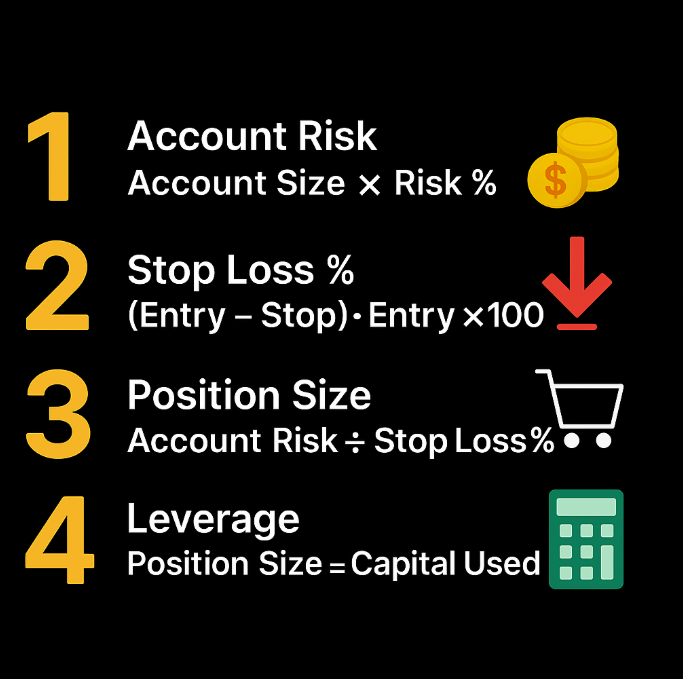
Then calculate how many dollars that is. Next, determine your stop loss distance (in % or price points). From that, you can reverse-engineer the correct position size and apply leverage accordingly.
The goal is not to use the highest leverage possible – it’s to use the right amount that aligns with your risk. Here’s how to break it down:
- Account Risk = Account Size × Risk %
If you have $5,000 and want to risk 2%, you can lose $100 on this trade. - Stop Loss % = (Entry – Stop) ÷ Entry × 100
Say you’re going long on ETH at $1,800 with a stop at $1,728. That’s a 4% stop. - Position Size = Account Risk ÷ Stop Loss %
$100 ÷ 4% = $2,500 position size. - Leverage = Position Size ÷ Capital Used
If you’re using $500 of your own capital to open a $2,500 position, your leverage is 5x.
Example: You want to long Bitcoin at $30,000 with a stop at $29,400 (2% stop). Your account is $10,000, and you risk 1% ($100).
$100 ÷ 2% = $5,000 position. To open this with $1,000 of margin, you’d use 5x leverage. If you use 10x, your required margin trading drops to $500, but your liquidation risk rises sharply if price gets volatile.
Best Leverage Levels by Market (Forex, Crypto, Futures)
Not all markets respond the same to leverage. Each asset class has its own volatility profile, liquidity structure, and typical trade sizing.
Using the same leverage across all of them is a common mistake. In general, forex markets can support higher leverage due to their stability and depth, while crypto markets require lower leverage because of extreme volatility.
Futures offer flexibility but can be unforgiving if you don’t respect contract size and tick value. Use this table to guide your leverage approach depending on the market you’re trading.
✅ Tight spreads suit high leverage ✅ Low volatility supports larger position sizing ❌ News events can cause sharp reversals ✅ Good for short-term volatility plays ❌ High funding fees can eat into profits ✅ Clean for directional bets and hedging ✅ Efficient use of capital ❌ Small moves can cause large losses if not sized correctly
Market
Pros
Cons
Forex
✅ High liquidity for fast execution
❌ Overtrading risk due to high leverage availability
Crypto
✅ Large price swings can deliver high returns with minimal leverage
❌ Extreme volatility increases liquidation risk
Futures
✅ Flexible margin requirements
❌ Tick value varies by instrument
Conclusion
Learning how to leverage trade without losing control is about precision, not aggression. It starts with calculating your risk, sizing your position correctly, and only applying as much leverage as needed – never more.
Use leverage where it makes sense: in liquid markets, with defined stop losses, and only on setups that justify it.
Avoid emotional decisions, overexposure, and high-leverage traps in volatile assets. When used correctly, leverage becomes a tool to scale performance while keeping risk tight.