



 Some of the links on this site may be affiliate links. ICOBench may receive advertising commissions when users visit recommended platforms via our affiliate links, at no additional cost to you. All recommendations are based on a comprehensive review process.
 If you’ve been around crypto for a while, you’ve probably heard the term DAO. But what is a DAO, and why does everyone keep talking about it? A DAO (Decentralized Autonomous Organization) is like an online community with its own rules, money, and decision-making, all powered by blockchain. In this guide, we’ll break it down step by step, with real examples, so you’ll fully understand how DAOs work.
What Is a DAO: Key Insights
✔️DAOs put power in the community’s hands, replacing CEOs and managers with member voting through blockchain-based smart contracts. ✔️Transparency is built-in, since every vote and transaction is stored on the blockchain for anyone to see. ✔️Participation matters, because active members shape proposals and decisions, while inactive members risk slowing progress. ✔️DAOs aren’t limited to finance, they’re used for art, gaming, charities, and online communities worldwide. ✔️Pros and cons are balanced: DAOs bring fairness and global access, but also face challenges like legal gray areas, security flaws, and voter apathy.
What Is a DAO?
A DAO (Decentralized Autonomous Organization) is a group that runs on the blockchain without needing a boss or a traditional company structure. Instead of one person making decisions, members of the DAO vote on what happens next. Think of it like an online club where everyone chips in money, proposes ideas, and then votes on them. For example, imagine a group of gamers pooling funds to buy rare items. Instead of one leader deciding what to buy, every member gets a say. That’s DAO governance in action.
DAOs fall under the world of DAO crypto, where rules are coded into smart contracts. These contracts automatically execute decisions once the community agrees. Unlike classic investing, where you rely on CEOs, here the power belongs to the people. Curious how this compares to trading styles? Check out this guide on spot vs. futures crypto.
How Does a DAO Work?
To really understand what a DAO is, it helps to see how the whole process runs from start to finish. Here’s a simple breakdown of the main steps that make a decentralized autonomous organization tick.
Step 1: Smart Contracts Form the Rules
Every DAO starts with smart contracts on the blockchain. These contracts are like digital rulebooks. They define how voting works, how funds are used, and what members can or can’t do. Unlike traditional companies, the rules are transparent and can’t be changed secretly.
Step 2: Members Pool Their Funds
A DAO needs money to operate, so members contribute crypto into a shared wallet. This might be for investing, launching projects, or even trading. The difference is that no single person owns the wallet. The community controls it, which makes it safer and more transparent.
Step 3: Proposals Are Made
Once funds are collected, members can make proposals. These proposals can be anything from investing in a new project to changing how voting works. For traders, it’s similar to suggesting new strategies on the best crypto trading platforms. Each proposal is visible to everyone in the DAO.
Step 4: Voting Takes Place
This is where DAO governance shines. Members vote using tokens, and the more tokens you hold, the bigger your vote. Imagine it like shareholders in a company, except decisions are faster and recorded on the blockchain. No CEO needed, just the community deciding together.
Step 5: Execution Through Code
Once a proposal passes, the smart contract executes the decision automatically. No human intervention is needed. This could mean sending funds to a project, updating the DAO rules, or even starting a new initiative. It’s like pressing “go” on how to leverage trade, but for an entire organization.
Why Do DAOs Matter?
DAOs aren’t just a new type of organization as they represent a shift in how people coordinate and make decisions online. They bring something new to the crypto world: fairness, transparency, and community-driven decision-making. Here’s why that matters:
🚩Power in the Hands of the Community
Unlike traditional companies, a decentralized autonomous organization gives decision-making power directly to its members. Imagine if your favorite sports club or online community actually let you vote on how money gets spent. That’s the big shift DAOs are pushing forward.
🚩Transparency and Trust
All the rules, votes, and transactions are recorded on the blockchain. This makes DAOs way more transparent than regular businesses. You don’t have to “trust” a CEO or a board; you can verify everything yourself. Just like checking results on the best crypto contract trading platforms, everything is open.
🚩New Ways to Invest and Collaborate
DAOs open doors to projects that wouldn’t exist otherwise. For example, groups of investors can fund startups, artists, or even manage pooled assets for crypto binary options. This creates opportunities for anyone with an internet connection, not just the wealthy elite.
🚩Flexible for Traders Too
For traders, DAOs can also be useful. Imagine voting on changes to a platform you use daily, like the best crypto day trading platforms or even the best 100x leverage crypto trading platforms. Instead of waiting for a company update, the community decides, and smart contracts make it happen.
Pros and Cons of DAOs
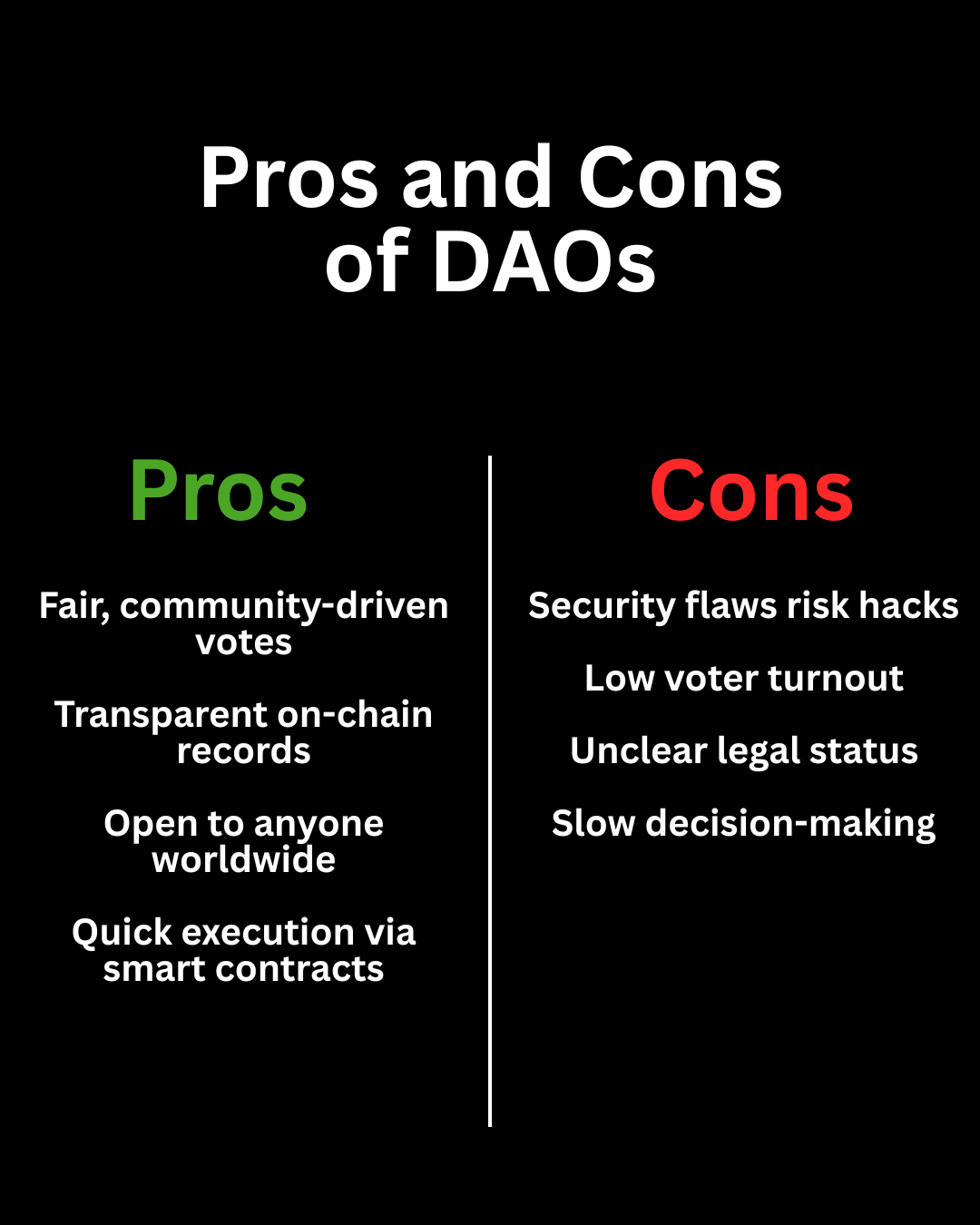
Like any system, DAOs have strengths and weaknesses. To fully understand what a DAO is, it’s important to look at both sides before deciding if they’re the future of online organizations.
Pros of DAOs
DAOs come with unique benefits that make them appealing in the DAO crypto world.
- Community-driven decisions mean everyone gets a voice. This creates a sense of fairness and avoids one person having too much control.
Transparency builds trust because all transactions are visible on the blockchain. Nothing is hidden or edited behind closed doors. - Global access lets anyone with internet join in. You don’t need to live in a certain country or work in a certain office.
- Fast execution thanks to smart contracts. Once a decision passes, it’s carried out immediately, much like trading on how to short crypto.
Cons of DAOs
Even though DAOs are exciting, they still face some challenges.
- Security risks are a big concern. If the smart contract has a flaw, hackers can take advantage of it.
- Voter apathy can hurt growth. Many members don’t participate, which means only a few voices end up deciding.
- Legal uncertainty makes things tricky. Most countries don’t yet have clear laws about how DAOs should operate.
- Slower decisions can happen with too many members. Unlike a CEO making a quick choice, the DAO must wait for votes to finish.
Aspect
Pros (Strengths)
Cons (Challenges)
Decision-making
Community-driven, giving everyone a say and creating fairness.
Can be slow if too many members need to vote.
Transparency
Everything is recorded on the blockchain, so nothing is hidden.
Mistakes or flaws are permanent once recorded.
Accessibility
Open to anyone worldwide, no matter where they live.
Lack of clear legal frameworks in many countries can cause issues.
Efficiency
Smart contracts execute decisions quickly without middlemen.
Security risks exist if smart contracts are poorly written or hacked.
Conclusion
DAOs are changing the way people think about organizations. Instead of relying on leaders or companies, these groups use blockchain, smart contracts, and community voting to get things done. While they still face challenges like legal issues and security risks, the idea of giving everyone a voice is powerful. If you’ve ever wondered what is a DAO, the answer is simple: it’s the future of collaboration, owned and shaped by the people who join it.