




 Some of the links on this site may be affiliate links. ICOBench may receive advertising commissions when users visit recommended platforms via our affiliate links, at no additional cost to you. All recommendations are based on a comprehensive review process.
In US government crypto news, blockchain data from Arkham Intelligence confirmed on Monday that federal wallets moved approximately $288M in seized crypto to Coinbase US Prime over roughly half a day.
This included 2,875 BTC ($178M) from the Ryan Farace ‘xanaxman’ dark-web drug case, 925.512 BTC ($57M) linked to defunct exchange BTC-e, and 30,007 ETH ($53.09M) connected to Brian Krewson.
US government has deposited $288,000,000 in $BTC and $ETH to Coinbase.
Selling? pic.twitter.com/YOUfOkcIIA
— Ted (@TedPillows) July 14, 2026
This news dropped as BTC was priced at $63,500 and ETH at $1,780 at the time of transfer. The movements surface a direct tension with Trump’s March 2025 executive order EO 14233, which designated seized Bitcoin for the Strategic Bitcoin Reserve and said it should not be sold.
The open question the market must now resolve is whether these transfers represent custodial consolidation under the SBR framework or the first confirmed staging of a fresh BTC liquidation.
On-Chain Mechanics: What the $288M Transfer to Coinbase US Prime Actually Reveals About Government Supply Overhang
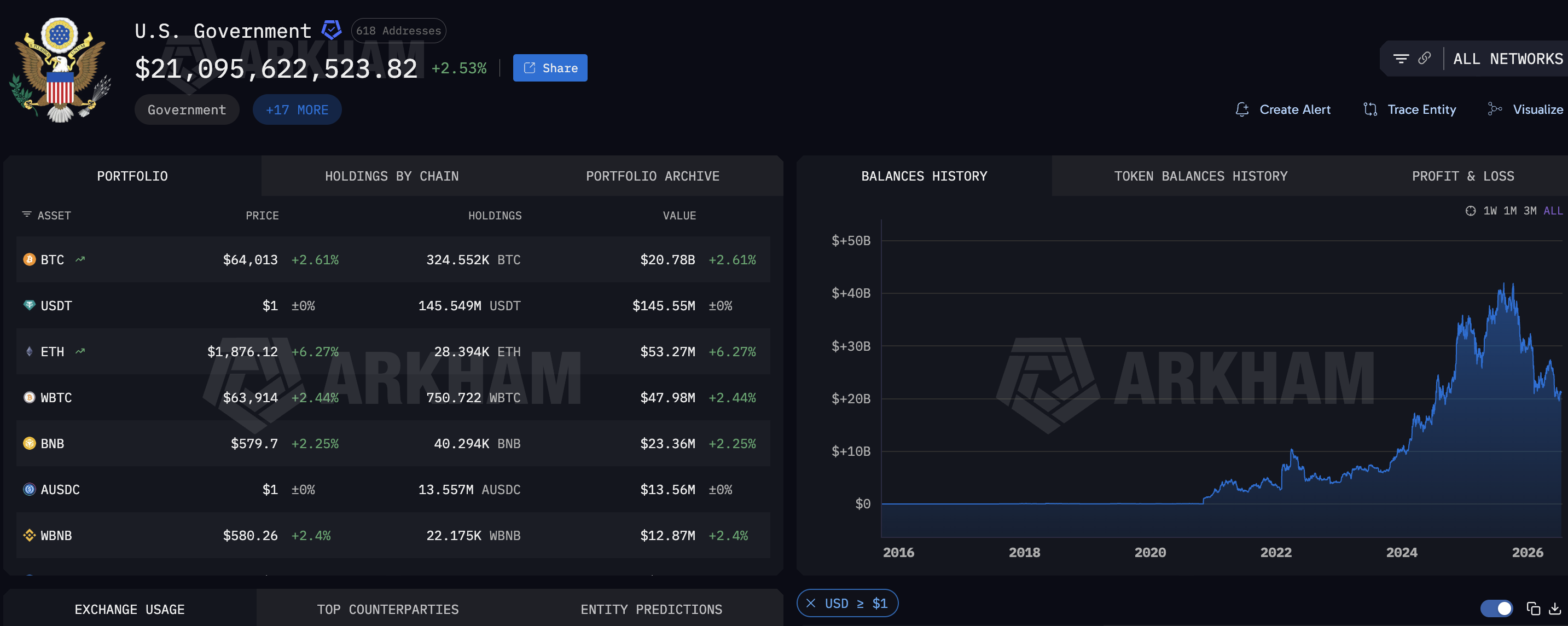
Context significantly enhances the raw figure. The $288M in question represents a rounding error relative to the US government’s total crypto holdings of approximately $20.65Bn, a stack that includes 324,552 BTC, 28,394 ETH, and 145.549M USDT, per Arkham Intelligence.
The BTC transfers both followed an identical two-hop structure: from a seized-asset wallet to a fresh intermediary address, then the full balance was forwarded minutes later to a Coinbase US Prime deposit wallet.
Both intermediary wallets were completely emptied after the forward. The ETH transfer from the Krewson wallet skipped that intermediate step entirely, going directly to a Coinbase Prime deposit address, a routing difference that carries distinct implications for each asset class.
A separate 140.214 BTC move between government Coinbase Prime addresses and a Coinbase cold wallet was also recorded on-chain but classified as internal shuffling, appearing on both the inflow and outflow side.
The structural divergence between BTC hops and direct ETH deposits is the critical forensic detail that traders monitoring government-wallet flows should carry forward.
EXPLORE: Best Memecoins Presales to Watch in July
Three Seizures, Two Routing Patterns: The Farace, BTC-e, and Krewson Case Flows and What the Wallet Logic Signals
The Farace transfer involves 2,875 BTC ($178M) linked to Ryan Farace from the ‘xanaxman’ drug case. The funds moved to an intermediary wallet before being fully deposited into Coinbase Prime, which then zeroed out.
Similarly, wallets from the defunct BTC-e exchange transferred 925.512 BTC ($57M) to Coinbase Prime in the same manner, indicating a coordinated operation.
In contrast, Brian Krewson’s transfer of 30,007 ETH ($53.09M) directly went to a Coinbase Prime deposit without an intermediary, signaling a more aggressive exchange move.
This transfer adds clear supply pressure on the ETH market, although subsequent actions remain uncertain and the Ethereum price has yet to be affected by the move.
EO 14233 and the Strategic Bitcoin Reserve: What Trump’s March 2025 Order Actually Says
every major BULLISH crypto action under Trump
– EO 14178 – Strengthening American Leadership in Digital Financial Technology
– EO 14233 – Strategic Bitcoin Reserve and U.S. Digital Asset Stockpile
– Project Crypto (SEC)
– SEC Crypto Task Force
– SEC Stablecoins Statement
– SEC…— borovik (@3orovik) August 4, 2025
The order is an executive order issued in March 2025 by President Donald Trump that designated seized bitcoin for the country’s Strategic Bitcoin Reserve and directed that it not be sold.
The interpretive gap, however, is meaningful. Coinbase Prime serves as both a custodial platform and a pre-liquidation staging venue, while also handling custody, financing, and staging.
Moving seized BTC to Coinbase US Prime is therefore consistent with either SBR custody consolidation or pre-sale staging, and the transfer alone does not confirm a violation of the order’s no-sell mandate.
The ETH position is legally distinct. The transfers themselves show routing differences (ETH went directly to a Coinbase US Prime deposit address while the BTC required intermediary wallets), which reads as operationally deliberate rather than coincidental, even if the downstream action remains unconfirmed.