

 Some of the links on this site may be affiliate links. ICOBench may receive advertising commissions when users visit recommended platforms via our affiliate links, at no additional cost to you. All recommendations are based on a comprehensive review process.
Finance has always organized itself around clocks – exchanges open, trading sessions end, settlement follows, and another region eventually wakes up to begin again.
Blockchain changed that expectation, though: crypto markets never developed a closing bell, and traditional finance is now moving noticeably closer to the same model.
DTCC extended U.S. equity clearing to a 24×5 schedule in June, while its forthcoming tokenization infrastructure is designed to support benefits such as extended trading hours, faster settlement, and greater asset mobility.
Nasdaq pushed the idea further this week by establishing Digital Liquidity Networks, a new organization combining tokenization technology with liquidity platforms as financial activity increasingly extends beyond conventional exchanges.
Markets that stay open longer create a less glamorous problem: capital must also be available when someone wants to trade. Tokenization can make an asset transferable around the clock, but it does not magically place deep liquidity beside it.
That is why LiquidChain (LIQUID) is gaining attention, with an incoming Layer 3 offering infrastructure intended to make liquidity from Bitcoin, Ethereum, and Solana usable through a common environment.
LIQUID costs $0.0148, has raised $940,000 in presale so far, and offers 1,200% APY.
How LiquidChain Makes the Network Matter Less
Layer 1s established the major blockchain economies, while Layer 2s largely emerged to make individual ecosystems faster, cheaper, or better able to handle more activity. LiquidChain starts with a later problem: what happens once several of those economies become too important to ignore?
Its answer is a Layer 3 built around shared execution – LiquidChain uses cross-chain proofs and messaging to verify activity on Bitcoin, Ethereum, and Solana, while a high-performance virtual machine handles transactions involving their assets.
Because as crypto gets bigger, an always-on financial system becomes cumbersome if users constantly have to think about where liquidity resides, which representation of an asset they need, or which network they must traverse first.
Writing the next layer into existence. 🪶https://t.co/vqvBcdSQYC pic.twitter.com/nOCpXbl30D
— LiquidChain (@getliquidchain) August 14, 2026
LiquidChain’s longer-term ambition is to push all that worry away from the experience – a product built above it can draw on a broader pool of available capital while the protocol handles the fact that the underlying assets originated in different ecosystems.
This is also why Layer 3 has a different job from simply producing another faster chain. Speed is useful, but another isolated high-speed market still leaves finance fragmented. Hence, LiquidChain is making the boundaries themselves less consequential.
Its design includes unified liquidity pools in which assets from the supported networks are verifiably represented on the Layer 3 without relying on conventional wrapping for every interaction. The project pairs that with what it describes as Solana-class execution performance for more demanding DeFi activity.
In short, dip into any and all of the three major crypto liquidity pools – even better, just consider them as one.
Can LIQUID Be the Best Crypto to Buy for Always-On Finance?
The opportunity becomes clearer when traditional finance begins to adopt the same operating assumptions as crypto.
DTCC says tokenization can enable 24/7 access, new trading models, and improved collateral mobility. Its tokenization service has already been demonstrated for U.S. securities and is designed to enable assets to move between traditional and tokenized forms.
Even collateral is becoming continuous, with DTCC developing a shared Collateral AppChain intended to operate across market participants and networks, and a Q4 2026 production launch is planned. Its design explicitly contemplates assets issued on different public or private networks.
While not directly connected to LiquidChain, it does show why the project’s underlying bet feels correct in 2026.
Once assets can move at almost any hour, liquidity becomes more valuable when it is similarly mobile – a market open at 3 a.m. is not especially useful if the capital required to trade efficiently is trapped somewhere else.
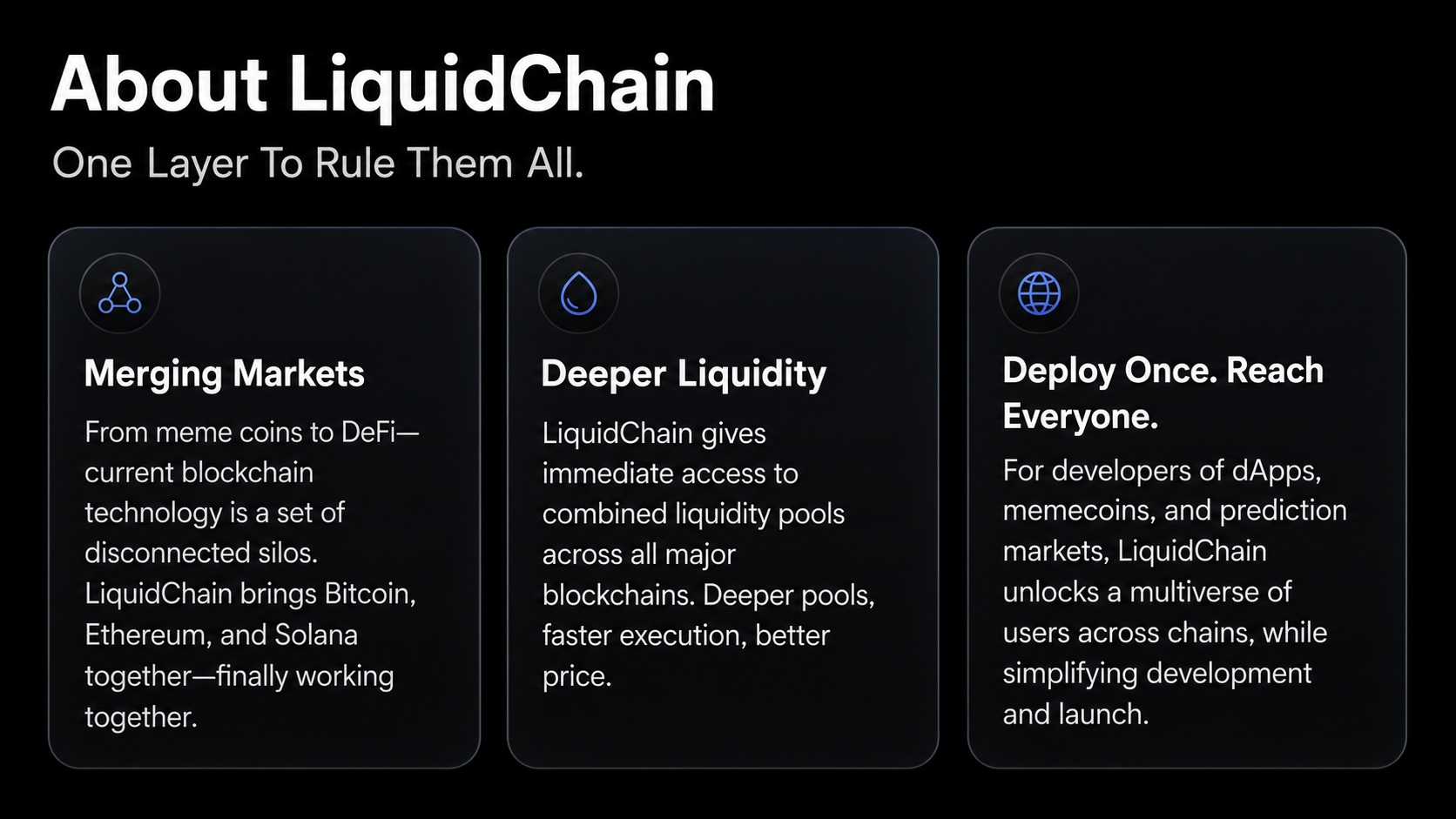
LiquidChain is approaching that issue inside crypto first: Bitcoin, Ethereum, and Solana already operate continuously, yet their liquidity does not behave as a single pool of capital. The Layer 3 is attempting to reduce that separation without requiring the underlying chains to become alike.
That gives LIQUID a potentially explosive 2026 and 2027 journey, with the project not needing to predict which Layer 1 wins. It can benefit from a world in which several continue growing, and financial activity becomes increasingly indifferent to conventional opening hours.
The $938,000 presale remains early, considering the scale of that ambition, and we note that its 1,200% staking yield will drop as more early holders join and stake. Still, LIQUID, as a token, will serve as gas on the protocol, where the token will find its true value.
Money Has Already Forgotten What Time It Is
The closing bell made sense when markets depended on buildings, human intermediaries, and batches of paperwork.
Digital assets do not have those constraints, and traditional infrastructure is beginning to adjust accordingly: U.S. clearing hours are extending, tokenized assets are being designed for faster movement, and Nasdaq is explicitly building around markets that exist beyond traditional venues.
The next question may not be whether an asset can be traded at any hour, but whether enough capital can reach it when the trade happens. LiquidChain is being built for that second question.