Some of the links on this site may be affiliate links. ICOBench may receive advertising commissions when users visit recommended platforms via our affiliate links, at no additional cost to you. All recommendations are based on a comprehensive review process.
Financial markets are steadily moving towards where crypto has been for years: building assets that exist, settle, and move directly on blockchain infrastructure.
TradFi took a step further on August 13, as Canton Network announced a proof-of-concept to bring Japanese government bond transactions on-chain.
The project brings the prospect of real-time, 24/7 settlement and is similar to other experiments that have already expanded in Europe and the U.S.
While Bitcoin trades at $63,264.73 today, almost unchanged over the past 24 hours and down 1.73% for the week, the more consequential story may be unfolding below the surface. DTCC is preparing its own tokenization service for an October launch, following its successful processing of tokenized U.S. securities across multiple blockchain environments in July.
But the project explicitly identifies interoperability and liquidity mobility as part of the infrastructure required for tokenized markets to scale.
That creates a timely backdrop for LiquidChain (LIQUID), a Layer 3 protocol built to connect liquidity across Bitcoin, Ethereum, and Solana, which could remove many of the pain points as TradFi steps onto the blockchain.
How LiquidChain Connects a Multichain Economy
Putting everything on-chain does not automatically put everything in the same market, which is LiquidChain’s starting point. Bitcoin, Ethereum, and Solana already support very different pools of capital and applications. A user usually ends up trapped on one chain or needs to step into wrapped assets or use bridges.
A developer, meanwhile, has to deal with three separate networks, liquidity pools, and execution environments.
Ethereum. Solana. Bitcoin.
Different worlds. United. 👁⟁ pic.twitter.com/Rc12mn0zTp
— LiquidChain (@getliquidchain) August 9, 2026
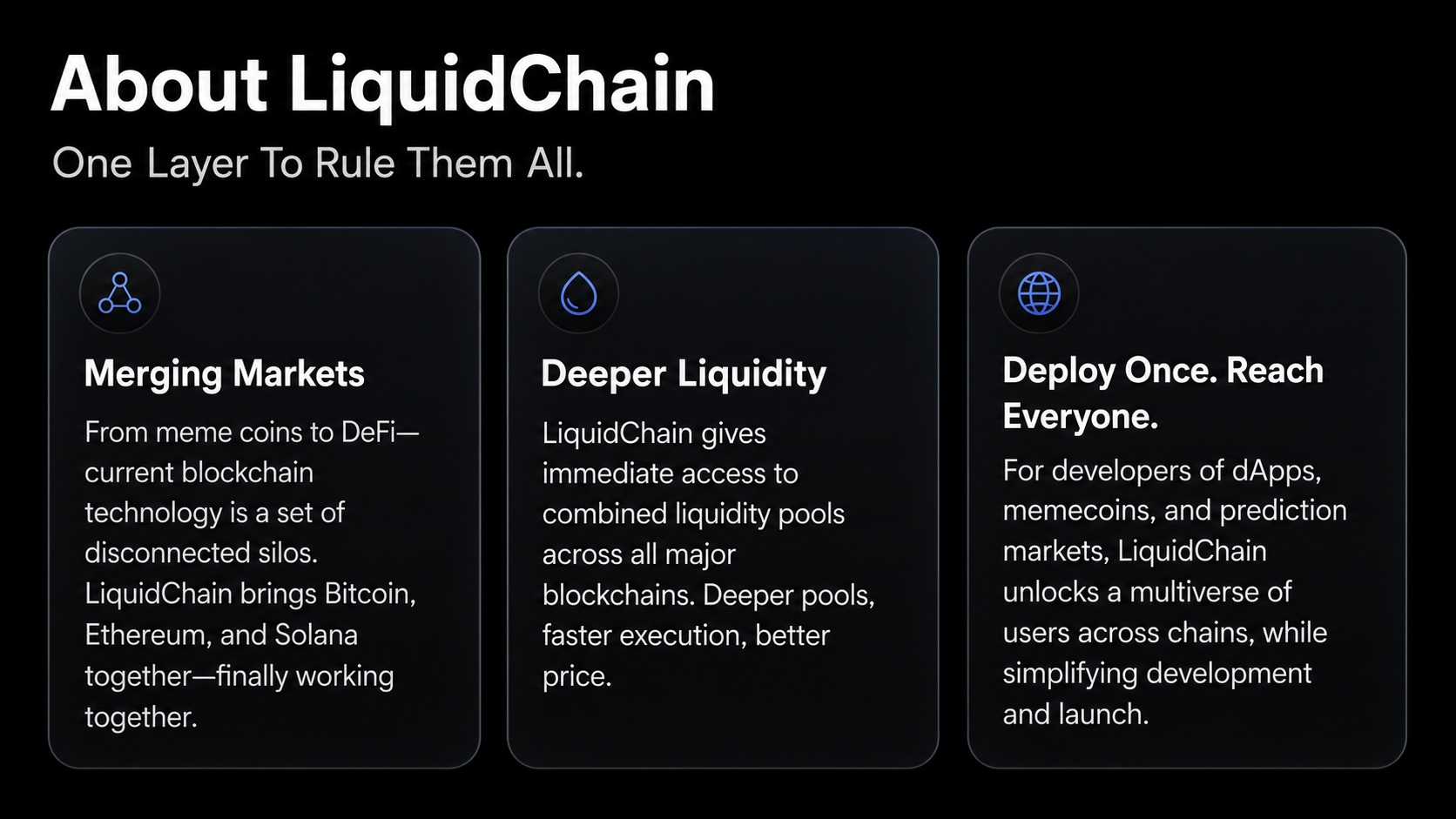
So LiquidChain is designed as a shared Layer 3 across those ecosystems, describing itself as an execution layer that brings together Bitcoin’s capital, Ethereum’s DeFi depth, and Solana’s speed. Applications built through LiquidChain are intended to access connected liquidity across the three rather than operating as isolated versions on individual chains.
It’s an almost obvious move – a tokenized Treasury, stock or bond may technically exist on-chain, yet that does not guarantee it has a deep market around it. Research published this year examining tokenized Treasuries, gold, and private-credit products found substantial differences in actual secondary-market liquidity and concluded that tokenization and liquidity should be treated as separate outcomes.
LiquidChain addresses the crypto-native version of that problem by verifying Bitcoin UTXOs, Ethereum state, and Solana accounts, while coordinating cross-chain activity through a single execution environment. Transactions involving several networks are intended to settle atomically – either all parts succeed, or the transaction fails rather than leaving one leg stranded.
For developers, the ambition is simpler than that machinery sounds. Build an application once and give it access to users and liquidity drawn from several established blockchain economies.
There is a useful parallel in traditional finance. DTCC says tokenization at scale requires infrastructure capable of connecting traditional and digital markets, and its own strategy is explicitly multichain. In May, it announced plans to connect its tokenization service to Stellar while continuing to support other networks.
Neither development is related to LiquidChain, but they reinforce the same idea: the future does not necessarily converge on a single blockchain.
Could LIQUID Be the Next Crypto to Explode?
That possibility gives LiquidChain a larger opportunity than simply moving today’s crypto assets between networks.
Wall Street is now testing what happens when bonds, stocks, Treasury instruments, and collateral become blockchain-native. DTCC’s July trial involved more than 30 traditional and digital market participants and used tokenized securities across both its Besu environment and the Canton Network. Its upcoming service is intended to support liquidity mobility between traditional and digital markets.
MUFG’s announcement pushes the same idea into Japanese government debt. JGBs are widely used as collateral, and the group says bringing repo transactions on-chain could improve both funding and capital efficiency through continuous settlement.
As more assets become digital, fragmentation can get much worse before it gets better: stocks may exist on one network, tokenized government securities on another, and crypto-native liquidity somewhere else again.
So, for investors looking for the next crypto to explode, LIQUID has a growth case tied to something larger than the current cycle. The project does not need Bitcoin, Ethereum, and Solana to merge – it only needs them to remain important enough that applications benefit from reaching all three.
The $937,000 raised at a current price of $0.0149 places LiquidChain in an early-stage position. Its 1,206% staking APY gives presale holders a strong early incentive, though yield alone cannot sustain demand indefinitely. The more important test comes when developers start to see whether connected liquidity actually improves the applications they can build.
CertiK and SpyWolf have audited the project contracts, and if LiquidChain can turn its architecture into deeper markets, the addressable opportunity grows with every ecosystem it connects.
The Future May Have More Chains, Not Fewer
Crypto once spent enormous energy trying to predict which blockchain would eventually win.
Institutional finance is beginning to make that question seem less important, but the world may end up tokenizing almost everything without agreeing on a single place for those tokens to live.
That creates a different kind of infrastructure race where the winners may not be the networks that persuade every asset to move onto them – they may be the protocols that make those separate markets easier to use together. LiquidChain is building for that version of the future.