Some of the links on this site may be affiliate links. ICOBench may receive advertising commissions when users visit recommended platforms via our affiliate links, at no additional cost to you. All recommendations are based on a comprehensive review process.
Capital in crypto no longer lives in one place. Bitcoin continues to act as a store of value. Ethereum remains the backbone of DeFi. With Solana, you can expect faster execution and lower costs. Over time, liquidity has spread across all three, not because users want fragmentation, but because each network offers something different.
The challenge is that infrastructure has struggled to keep up with this reality. Moving capital between chains still depends on bridges, wrapped assets, and manual routing decisions. As liquidity grows larger and more active, these inefficiencies become more visible.
This backdrop explains why LiquidChain ($LIQUID) has entered the conversation, framing its crypto presale around infrastructure rather than short-term narratives.
How Capital Is Spreading Across Chains
Crypto capital follows opportunity. When Bitcoin holders seek yield, they look beyond the Bitcoin network. When Ethereum fees rise, activity shifts toward faster execution environments. When new ecosystems offer better performance or incentives, liquidity responds quickly.
This constant movement has created a multi-chain market in practice, even if the underlying systems were never designed to operate as one. Liquidity pools become siloed. Price discovery fragments. Execution slows when value needs to move across networks. For larger participants, these inefficiencies translate into higher costs and operational friction.
As capital spreads further, coordination becomes the real bottleneck.
LiquidChain’s Infrastructure-Led Solution
LiquidChain approaches this problem at the settlement and execution layer. Instead of launching another standalone blockchain, it positions itself as a Layer-3 liquidity and settlement layer that sits above existing networks. The aim is to allow capital from Bitcoin, Ethereum, and Solana to interact through a unified execution framework.

Rather than asking users to constantly bridge assets, LiquidChain is designed to coordinate liquidity across ecosystems. Bitcoin value can access broader DeFi activity without abandoning its security assumptions. Ethereum liquidity can interact beyond its own environment without relying on a patchwork of tools. Solana users can connect high-speed execution with deeper and more distributed capital pools.
This design treats liquidity as a shared resource instead of a chain-specific constraint. By focusing on settlement, verification, and execution, LiquidChain targets the friction that naturally increases as capital spreads across multiple networks.
The ongoing crypto presale illustrates this infrastructure-first thesis. Entry pricing follows a scheduled structure, encouraging early participation without implying guaranteed outcomes. Staking and ecosystem incentives are positioned as mechanisms for long-term network participation.
Tokenomics and Presale Structure in Context
Tokenomics add another layer of context to the LiquidChain model. The total supply is fixed at 11,800,000,100 $LIQUID, with allocations structured to support development, ecosystem growth, rewards, and operational needs.
Development accounts for the largest share at 35%, reflecting the technical scope of building and maintaining a Layer-3 liquidity and execution layer. LiquidLabs holds 32.5%, allocated toward global marketing efforts, paid and organic media, and broader ecosystem expansion. AquaVault receives 15%, designated for business development and community-focused initiatives.
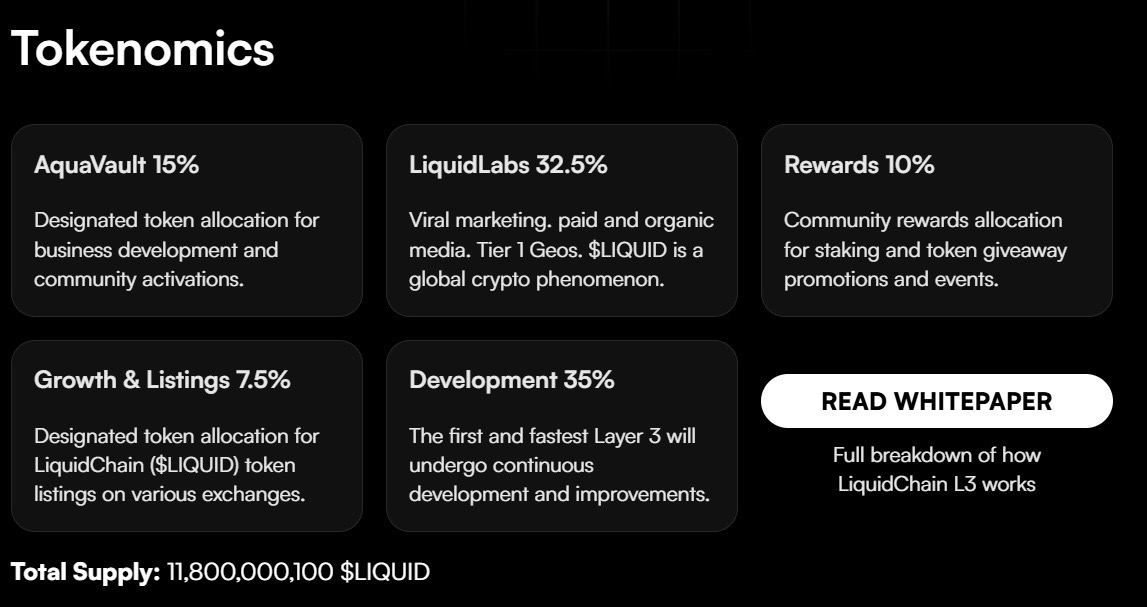
Rewards make up 10% of the supply, supporting staking programs and community incentives without relying on unlimited issuance. The remaining 7.5% is allocated to growth and listings, aimed at improving market access and exchange availability over time.
This distribution shows a focus on long-term network sustainability rather than front-loaded token release, aligning the presale with the broader infrastructure roadmap.
$LIQUID Utility as Capital Continues to Fragment
The utility of $LIQUID is closely tied to how the network functions. The token is positioned to support participation within the LiquidChain ecosystem, including execution, settlement processes, and incentive alignment across users and developers.
As a Layer-3 liquidity layer, the protocol depends on coordinated incentives to maintain performance, security, and ecosystem growth. That places $LIQUID at the center of network activity rather than treating it as a passive asset detached from usage.
As capital continues to spread across Bitcoin, Ethereum, and Solana, infrastructure that helps unify execution becomes more relevant. LiquidChain’s focus on liquidity coordination positions $LIQUID within that broader shift rather than tying it to a single ecosystem cycle.
Why LiquidChain Is a Crypto to Watch
Capital fragmentation is not a temporary phase in crypto. It is a structural outcome of a multi-chain market. As more value moves across networks, the need for efficient coordination grows alongside it.
LiquidChain is attempting to address this challenge by building a Layer-3 liquidity and settlement layer designed for Bitcoin, Ethereum, and Solana users. Its crypto presale reflects early interest in that approach, while $LIQUID’s utility remains closely tied to execution and network participation rather than speculation alone.
Whether adoption scales will depend on delivery and real-world usage. Even so, as capital continues to spread across chains, projects that aim to unify liquidity and execution may become increasingly difficult to overlook.
Explore LiquidChain and its ongoing crypto presale:
Presale: https://liquidchain.com/
Social: https://x.com/getliquidchain
Whitepaper: https://liquidchain.com/whitepaper