




 Some of the links on this site may be affiliate links. ICOBench may receive advertising commissions when users visit recommended platforms via our affiliate links, at no additional cost to you. All recommendations are based on a comprehensive review process.
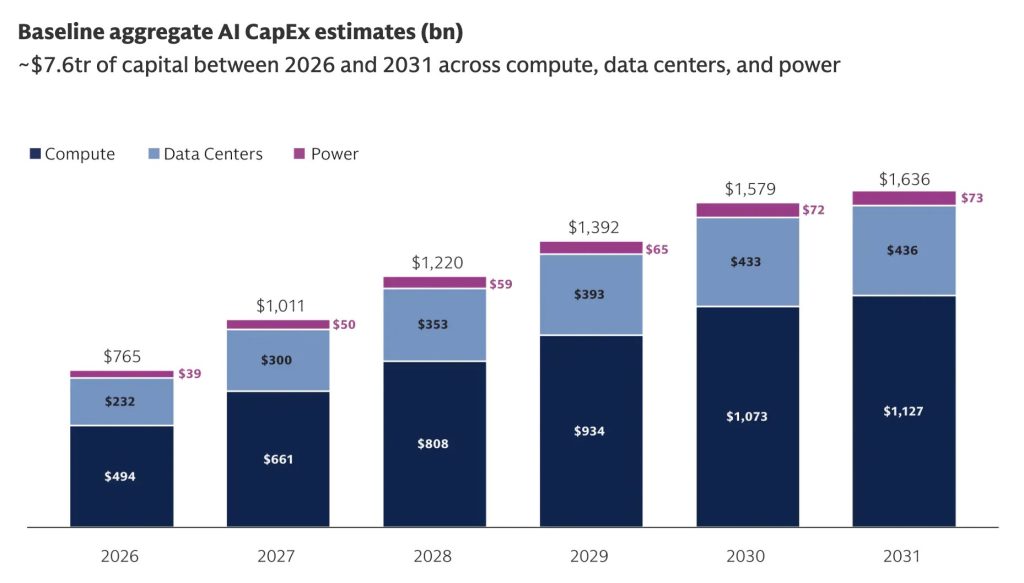
Goldman Sachs has projected cumulative AI infrastructure spending of approximately $7.5 to $7.6 trillion between 2026 and 2031, split across roughly $5.1 trillion in compute, $2.1 trillion in data centers, and $358 billion in power infrastructure, with annual AI capex rising from an estimated $765 billion this year to $1.6 trillion by 2031.
Goldman’s research framework identifies NVIDIA as the dominant beneficiary of the compute layer, with the chipmaker expected to capture roughly 75% of that segment, a concentration that has no precedent in prior technology capex cycles.
The annual run-rate alone makes this the largest discrete capital deployment in technology history, and Goldman Sachs analysts have flagged that consensus estimates have consistently underestimated it: 2026 capex consensus rose from $465 billion to $527 billion within a single earnings season.
🇺🇸 $7.6 trillion in AI CAPEX by 2031 ? Striking but what really bothers me in Goldman Sachs’ estimates is the tiny share allocated to electricity.
📊 Over the full period, Goldman expects around $5.1 trillion to be spent on compute, more than $2.1 trillion on data centers and…
— Christophe Barraud🛢🐳 (@C_Barraud) July 11, 2026
For retail crypto investors tracking AI infrastructure, Goldman’s numbers are not background noise, they are the macro architecture against which every AI compute token, decentralized GPU network, and AI token presale must now be evaluated.
The $7.5 trillion figure represents a capital cycle large enough that even a 0.1% redirection toward crypto-native infrastructure rails would constitute a material token-market catalyst. The question for presale hunters is not whether this cycle is real; Goldman’s upward revision history settles that, but which token sectors are structurally positioned to capture a fragment of it.
Goldman Sachs Tracking Trillions: What the $5.1T Compute Layer Actually Reveals About Crypto’s AI Opportunity
The raw $7.5 trillion headline is striking, but the internal architecture of Goldman’s forecast is what makes it analytically useful for crypto positioning. The compute layer at $5.1 trillion is the dominant spend category, more than twice the data center allocation and roughly fourteen times the power budget, and Goldman’s research grounds it in specific hardware assumptions: next-generation GPU nodes priced at approximately $80,500 per unit, drawing 3,000 watts per package, with a power usage effectiveness ratio of 1.2.
These are not speculative inputs; they reflect actual procurement economics for NVIDIA’s current-generation architecture.
The NVIDIA concentration within that compute layer is the figure that makes decentralized alternatives analytically interesting rather than merely ideological. When a single vendor is expected to capture approximately three-quarters of a $5.1 trillion spend category, the supply-chain risk, pricing power, and export-control exposure concentrated in that one firm create a structural opening for permissionless compute alternatives.
Goldman’s own research notes that insecurity, fear of missing out on AI infrastructure, is as much a driver of the capex boom as measured ROI, which means the cycle has duration risk baked in. The broader Goldman AI investment thesis has already begun reshaping capital flows across emerging markets and asset classes simultaneously.
Power is the smallest line item in dollar terms at $358 billion, but Goldman’s analysts identify it as the primary bottleneck constraining deployment speed, not compute availability. Data center cost assumptions run at $15 million per megawatt of capacity, with new power priced at $2,500 per kilowatt.
Brownfield data center space currently accounts for 15% of 2026 deployments but is projected to reach 30% by 2031 as greenfield sites face grid interconnection delays. The power bottleneck is not a temporary friction; it is a structural constraint that Goldman expects to persist across the entire 2026–2031 window, and it is the single clearest argument for decentralized, location-flexible AI compute infrastructure.