


 Some of the links on this site may be affiliate links. ICOBench may receive advertising commissions when users visit recommended platforms via our affiliate links, at no additional cost to you. All recommendations are based on a comprehensive review process.
Uniswap has spent years proving that decentralized exchanges can generate serious trading volume. The weaker link was always UNI itself. Holders could vote on the protocol, but the token had little direct connection to the fees generated whenever traders used Uniswap.
That changed when governance approved the UNIfication proposal, activating protocol fees and routing them into an automated UNI buyback-and-burn mechanism. Recent votes have expanded that system to more markets, including selected Uniswap v4 pools and deployments on Robinhood Chain.
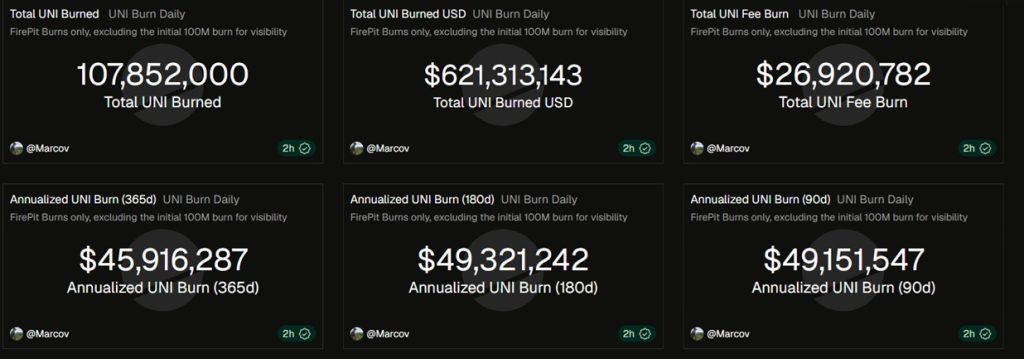
UNI has gained roughly 36% over the past month and now trades at $4.0111, up 3.16% in 24 hours and 6.95% over a week. The reason for the recovery is not especially mysterious: Uniswap activity can now create market demand for UNI before those tokens are permanently removed from circulation. Protocol fees are collected in TokenJar contracts, where searchers exchange UNI of equal value for the accumulated assets. The UNI received through that process is then burned.
❗️@Uniswap flipped the fee switch. LP fees now route to buy and burn $UNI
The headline number: a 100M #UNI retroactive burn, ~16% of circ. supply (~$320M), as if the switch had run since day one. Fee run rate is $2M-5M a day, among the highest in #crypto outside #stablecoins. pic.twitter.com/gbmGzUfXsA
— CryptoDiffer Analytics (@CryptoDiffer) July 29, 2026
The wider market is helping. Bitcoin has risen 1.17% over the past day to $64,139.68. The total crypto market capitalization stands near $2.2 trillion, while Bitcoin dominance remains high at approximately 58.8%. Capital is still concentrated in BTC, but investors are rewarding projects that give established crypto assets more economic purpose.
That argument leads naturally to Bitcoin Hyper (HYPER), an early Bitcoin Layer 2 that has raised $32.9 million at a presale price of $0.01368. Holders can also earn 36% APY through the project’s staking protocol.
How Bitcoin Hyper Makes BTC More Usable
Bitcoin remains crypto’s largest store of value, but its base chain was not built for the speed and programmability now expected in crypto. Transactions can be slow during busy periods, fees fluctuate, and Bitcoin’s scripting environment cannot support the types of decentralized applications found on Ethereum or Solana.
Bitcoin Hyper does not try to rebuild Bitcoin itself, but offers a separate execution layer designed around the Solana Virtual Machine, giving users and developers access to a faster environment – suitable for instant payments or DeFi operations – while Bitcoin remains the underlying settlement asset.
The plan is simple.
Take Bitcoin further. 🚀⚡️https://t.co/VNG0P4GuDo pic.twitter.com/gMYVQUIxBT
— Bitcoin Hyper (@BTC_Hyper2) July 28, 2026
That means BTC can then move through applications built within Bitcoin Hyper rather than waiting for every action to settle individually on Bitcoin’s base chain. Transactions are executed and bundled on the Layer 2. The aim is to let Bitcoin provide the immutable, secure layer while Bitcoin Hyper handles the activity above it.
As a token, HYPER sits inside that system, covering network fees, supporting staking, and providing governance rights – a role awfully like UNI, especially with a mooted burn mechanic. Developers may also use HYPER to launch applications and access network resources.
Is HYPER the Next Crypto to Explode?
Uniswap’s recovery shows why investors are becoming more selective about token economics. A protocol can be widely used without its token capturing much of that success. UNI’s new burn mechanism narrows that gap by converting fees into recurring purchases and permanent supply reductions.
Bitcoin Hyper begins with a different problem: Bitcoin already holds more capital than any other cryptocurrency, but much of that capital remains in cold wallets because there is little utility attached. BTC is bought, transferred, and stored – but little of it reaches decentralized exchanges, lending markets, payment applications, or other financial products.
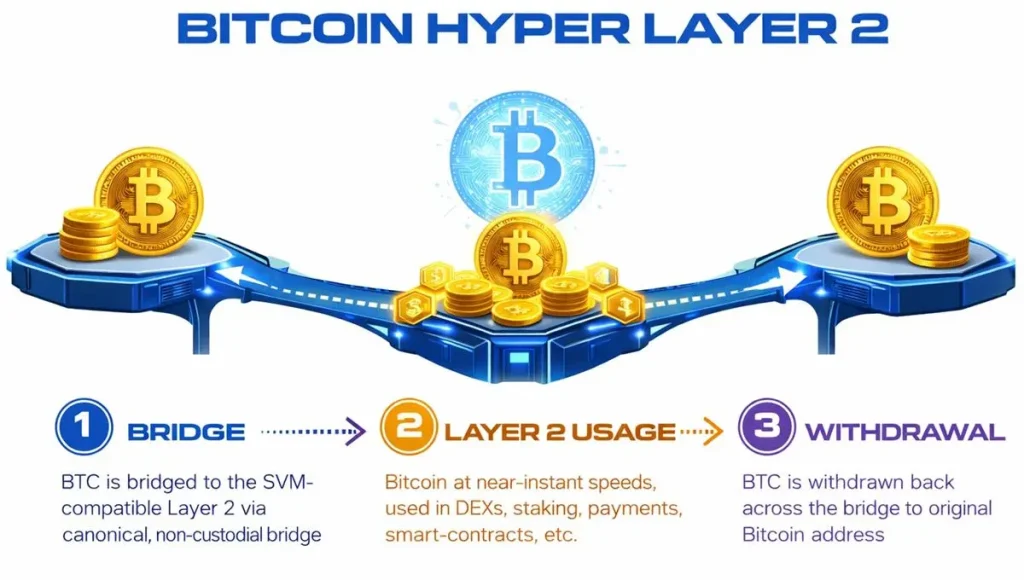
A working Bitcoin Layer 2 opens those markets up without asking holders to trade BTC for an entirely different base asset. That is the larger opportunity behind HYPER – Bitcoin’s security with Solana’s near-instant speed.
The $32.9 million raised so far shows that the market gets the idea, and with smart contract audits from Coinsult and SpyWolf, we expect Bitcoin Hyper to launch the protocol and for HYPER to reach larger exchanges soon. For these reasons, we give HYPER a good chance of being the next crypto to explode.
Utility Is the New Scarcity
Crypto’s oldest investment stories were built around limited supply, but the stronger projects of 2026 ask: what causes people to use the token after they have bought it?
Uniswap now has an answer tied to fees and burns, and Bitcoin Hyper has an answer as a protocol that can give Bitcoin back its original payment goals.