


 Some of the links on this site may be affiliate links. ICOBench may receive advertising commissions when users visit recommended platforms via our affiliate links, at no additional cost to you. All recommendations are based on a comprehensive review process.
Crypto’s largest networks are moving in the same market, but they don’t operate as the same market. Bitcoin, Ethereum, and Solana each hold substantial capital and massive communities, yet if you’ve ever tried to use assets across them, you’ll know the pain of bridges, separate wallets, and seeing liquidity divided between incompatible chains.
That fragmentation exists even on a mildly positive trading day. Bitcoin is up 0.93% at $63,667 right now, while Ethereum has gained 0.33% to $1,862.07. Their seven-day performances remain weaker, at -1.35% and -3.31%, respectively. The figures show a market still searching for momentum, but the real problem is larger than one week’s price action: crypto builds valuable networks without making them work together.
LiquidChain (LIQUID) is therefore gaining attention by treating those divisions as an infrastructure problem and introducing Layer 3, which coordinates liquidity and applications across BTC, ETH, and SOL within a single shared environment.
It’s an early presale, but LIQUID has quickly raised $929,000, at a price of $0.0148, and buyers can earn 1,215% APY through staking.
How LiquidChain Makes Cross-Chain Activity Simpler
Layer 1 blockchains provide the foundations, and Layer 2 networks typically make one underlying chain faster or cheaper. LiquidChain takes a different approach: it sits above several networks to make their separate assets usable within the same applications.
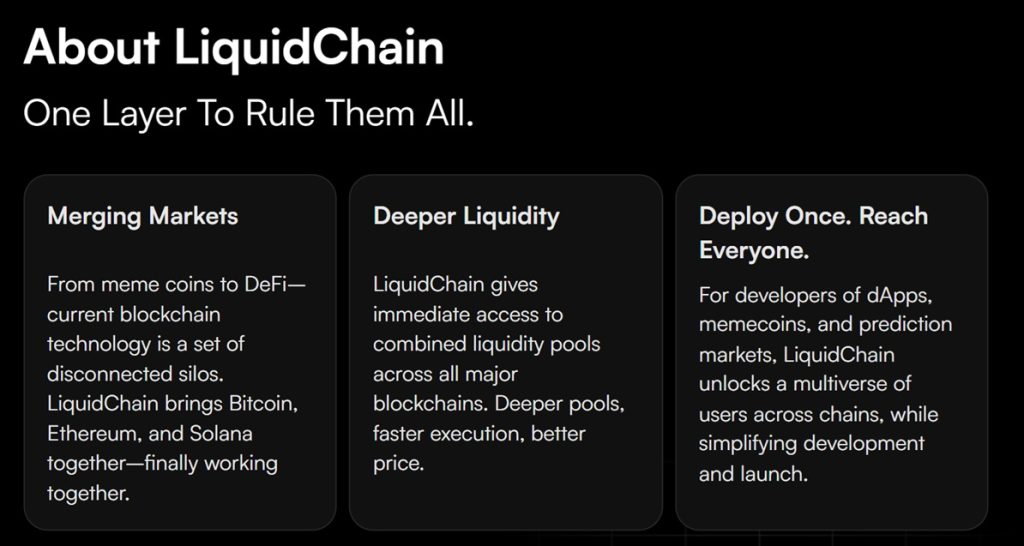
The user benefit comes first, as a trader seeking liquidity across Bitcoin, Ethereum, and Solana currently has to move between isolated markets. LiquidChain aims to enable any DeFi app to recognize activity and capital originating from any of the three and treat them as a single liquidity pool.
Sometimes you don't need another chain. You need another layer. 👁⟁https://t.co/vqvBcdSQYC pic.twitter.com/XSVxo2J2Tp
— LiquidChain (@getliquidchain) August 1, 2026
A decentralized exchange built on the network can draw on deeper shared liquidity rather than a single chain-specific pool. A lending platform can connect collateral on one ecosystem with borrowers using another, and developers can deploy a product once instead of maintaining separate Bitcoin, Ethereum, and Solana versions.
The system is designed so that connected parts of a cross-chain transaction settle together – or not at all. The ambition is to hide more of the friction – and remove most of the cost – from the person using them.
The solution becomes more valuable to solve as each ecosystem grows. LiquidChain does not require Bitcoin users to migrate to Solana, or Ethereum developers to abandon their existing market – it can benefit from all three remaining important.
That gives LIQUID a potentially durable position. Rather than competing to become another dominant base chain, the project is betting that crypto’s future will remain multichain – and that the infrastructure connecting those markets will capture activity.
Why LIQUID Could Be the Next Crypto to Explode
LIQUID is designed to support participation inside the shared network, with the token used for staking, governance, network access, and activity across the Layer 3. Liquidity providers are also intended to receive proportional rewards from unified pools, while execution fees adjust with network demand.
That gives LIQUID a pretty clear route to demand than a presale narrative alone. More applications mean more transactions, and more traders mean more fees. Deeper liquidity makes the network more useful, encouraging further participation.
The 1,215% staking APY is likely to fall as additional tokens enter the pool, so it should not be treated as a permanent rate, but if LiquidChain attracts developers to make its shared markets noticeably better than using separate bridges and applications, there’s a strong future here.
The roadmap offers near-term catalysts, with LiquidChain planning decentralized exchange trading before mainnet, with centralized listings targeted for the third quarter of 2026.
Its post-launch plans include cross-chain applications, unified yield strategies, and routes for institutional capital to enter multichain markets.
The Borders Are Becoming the Product
Crypto spent years debating which blockchain would win – LiquidChain suggests a different answer: several networks may remain successful, and the next valuable layer is the one that makes their differences less burdensome.
Users do not want to think constantly about bridges, wrapped assets, and incompatible liquidity. Developers do not want to build the same product three times. They want capital and applications to move and keep the plumbing under the surface. Basically, they want everything liquid.