


 Some of the links on this site may be affiliate links. ICOBench may receive advertising commissions when users visit recommended platforms via our affiliate links, at no additional cost to you. All recommendations are based on a comprehensive review process.
Crypto has spent years building faster blockchains – it has been far less successful at making them behave like parts of the same economy.
Bitcoin, Ethereum, and Solana each have their own capital, users, and strengths, and Layer 2 networks have helped individual ecosystems process more transactions at lower cost.
But scaling one chain does not solve the problem of liquidity becoming scattered between many of them, and even traditional finance is now confronting the same issue.
Swift, which is preparing 17 banks to pilot transactions on its blockchain-based ledger, describes interoperability as essential as new digital-asset networks proliferate.
That makes the Layer 3 idea worth watching, with LiquidChain (LIQUID) at the forefront as a protocol intended to connect liquidity across Bitcoin, Ethereum and Solana.
LIQUID costs $0.0148 in presale, and has so far raised $930,000, with staking offering 1,214% APY.
The attraction is straightforward – if crypto remains multichain, infrastructure that makes separate pools of capital work together becomes more useful as those economies grow.
How LiquidChain Connects Liquidity Across Chains
Layer 1 networks provide the foundations, and Layer 2s take work away from an individual base chain, usually returning settlement information later.
LiquidChain sits above that structure with a different job: to make liquidity across several chains available through a single shared execution environment.
Once the protocol goes live, Bitcoin, Ethereum, and Solana are verifiably represented on Layer 3, where LiquidChain uses unified liquidity pools rather than a separate pool for each blockchain. Its official materials describe this as creating fungible cross-chain markets, without relying on the conventional process of wrapping an asset each time it enters another ecosystem.
The spark has been found. 👁⟁
The Order approves.https://t.co/vqvBcdSQYC pic.twitter.com/2kOeVPqZQ8
— LiquidChain (@getliquidchain) August 6, 2026
That means a decentralized exchange built on the protocol can draw on connected liquidity rather than operating entirely within a single chain, and a lending protocol can access capital spread across several ecosystems from the same underlying layer.
Its architecture combines a high-performance virtual machine with state verification across the connected networks. Bitcoin UTXOs, Ethereum state, and Solana accounts can be checked by the protocol, while cross-chain operations are designed to settle atomically. In plain English, every part of a linked transaction should complete together, or none of it should.
Developers get another advantage: instead of rebuilding substantially the same product for several chains, LiquidChain will let them deploy via a single protocol and reach users and liquidity across the connected markets. The value of the Layer 3 is therefore as a coordination between destinations that already have scale within their silos.
CertiK has audited the LiquidChain token contract and found no critical, major, medium, minor,, or informational findings.
Could LIQUID Be the Next Crypto to Explode?
The case for LiquidChain becomes stronger if there is no eventual winner among Bitcoin, Ethereum, and Solana.
For years, crypto has sometimes treated interoperability as a temporary inconvenience: eventually, one chain would dominate, and most users would gather there. But reality has moved in the other direction, and different networks have developed different specialties, communities, and pools of capital.
Traditional finance is beginning to plan for that plurality, too – Swift has said institutions face unnecessary cost when tokenized assets sit on networks with different functionality and liquidity profiles. Its own interoperability work is built around the idea that financial institutions cannot reasonably create bespoke connections to every blockchain they encounter.
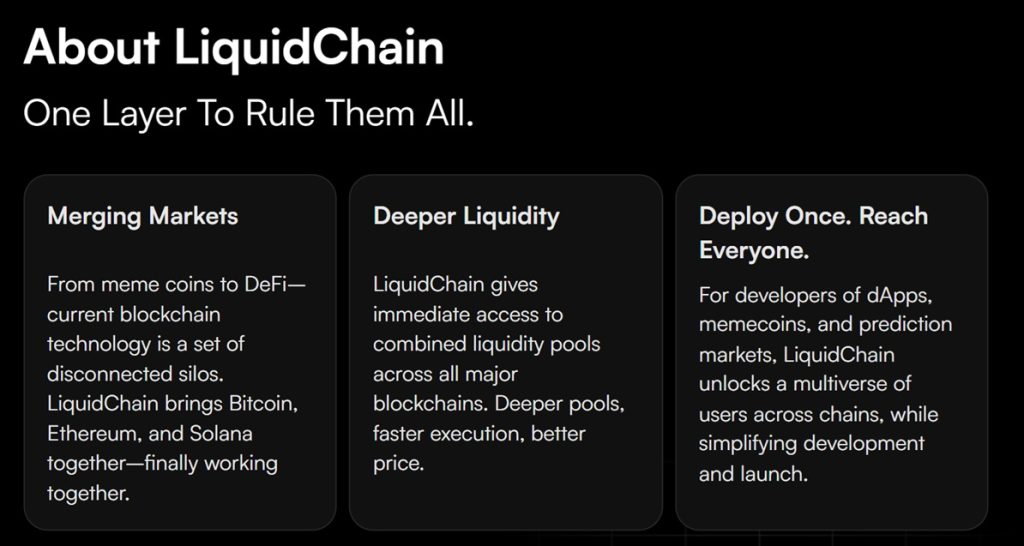
LiquidChain applies a related idea to public crypto: Bitcoin does not need to become Solana, and Solana does not need Ethereum’s architecture. The protocol can become more valuable precisely because those differences survive.
There is a potentially powerful economic effect here, as liquidity is more useful when it can meet other liquidity. A $10 million pool on one network and another $10 million pool elsewhere do not automatically behave like a $20 million market. So, infrastructure that makes capital available across those boundaries can improve the depth available to applications, without requiring every asset holder to migrate to the same chain.
LIQUID (as a token) sits inside that network economy, supporting execution fees, staking, and protocol participation. Early staking currently pays 1,214% APY, although such a high presale rate should not be treated as a permanent yield. The bigger opportunity comes later, as applications use the protocol because connected liquidity gives them something that separate deployments cannot.
The presale has so far raised $930,000 – modest beside some of 2026’s largest token launches, but it is still an early presale with time on its side.
The Future May Need More Than Faster Chains
The first era of blockchain was about proving a decentralized ledger could work – the next produced faster chains, smart contracts, and increasingly specialized networks.
But those successes have created their own problem, and crypto needs better ways for that value to meet.
LiquidChain says the answer is not another winner-take-all blockchain, but a protocol that connects markets. If 2027 brings an even more multichain industry, that may turn out to be the more important infrastructure problem to solve.