

 Some of the links on this site may be affiliate links. ICOBench may receive advertising commissions when users visit recommended platforms via our affiliate links, at no additional cost to you. All recommendations are based on a comprehensive review process.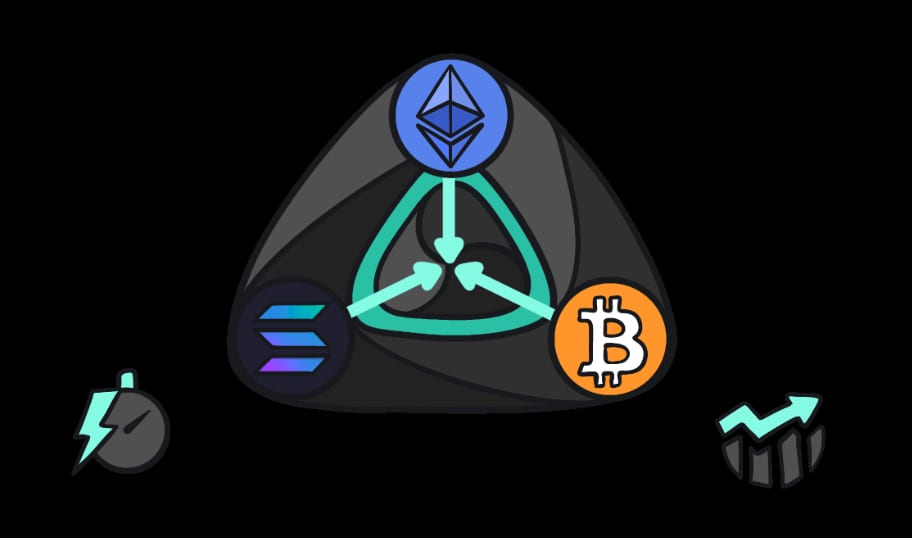
LiquidChain (LIQUID) is starting to pick up the kind of early-stage traction traders watch for: a presale closing in on $1 million, an active social feed, and a narrative that taps directly into one of crypto’s most persistent pain points — liquidity split across chains.
The project, still in development, is building what it describes as a unified Layer 3 execution environment linking Bitcoin’s capital base, Ethereum’s DeFi depth, and Solana’s speed. In plain terms, the bet is that users do not want to keep hopping between ecosystems, dealing with bridges, wrappers, and extra execution risk just to move capital where it is needed.
That framing appears to be helping the momentum. As the presale pushes toward the $1M mark, early buyers are circling LiquidChain as a fresh infrastructure play in the multi-chain market.
LIQUID tokens are currently priced at $0.0447, with the next price increase set to occur in a matter of hours.
Crypto has no shortage of interoperability pitches, but LiquidChain is leaning into a specific angle: not another Layer 2, and not just a bridge, but a Layer 3 sitting above Bitcoin, Ethereum, and Solana as a shared liquidity and execution layer.
That matters because the project is aiming at a problem the market already understands. Bitcoin holds the deepest capital pool, Ethereum remains the center of DeFi composability, and Solana continues to dominate high-speed, low-fee activity. LiquidChain’s proposition is that these strengths should not remain siloed.
Instead of forcing users to choose one chain or shuffle funds through slower and riskier routes, the network is designed to coordinate BTC, ETH, and SOL liquidity inside one environment for payments, DeFi, and high-throughput applications.
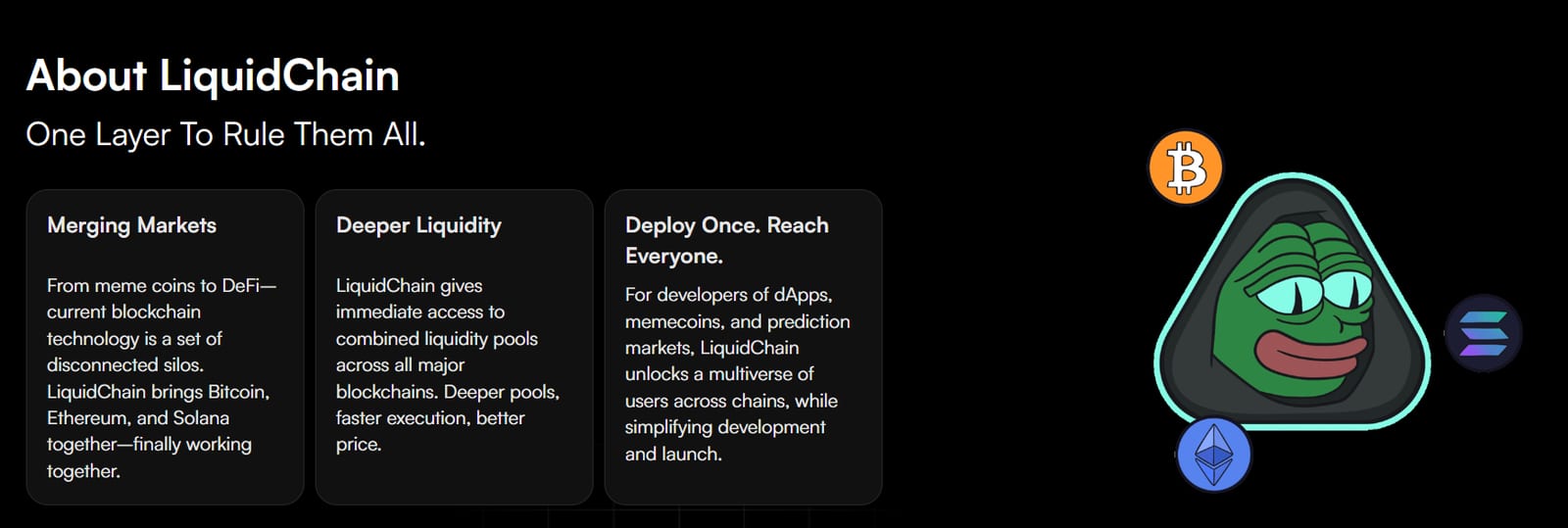
According to the project, the architecture reduces reliance on traditional wrapped assets in many scenarios and reduces reliance on centralized intermediaries. Execution happens on the Layer 3, while finality can be anchored back to the underlying chains where required.
For users, the appeal is straightforward: lower friction, fewer moving parts, and potentially less slippage and bridge risk. For developers, the draw is a composable setup that tries to combine Bitcoin’s security and capital depth, Ethereum’s mature smart contract stack, and Solana’s transaction speed without asking them to leave the LiquidChain environment.
What makes LiquidChain notable from a community perspective is that its message is easy to grasp without sounding too small. Fragmented liquidity is an old problem, but it remains unresolved at scale, giving the project a cleaner lane than many concept-heavy presales that try to manufacture relevance.
That has helped support growing interest as the token sale advances. The project is positioning itself around native cross-chain lending, borrowing, perpetuals, and yield strategies that can draw from Bitcoin, Ethereum, and Solana liquidity at the same time rather than keeping users inside isolated pools.
This is the kind of thesis that tends to get traction when market participants are looking for infrastructure with a broad addressable use case. If LiquidChain can convert early curiosity into sustained developer and user attention, its social momentum could prove more durable than the average presale spike.
Quiet moves. Higher layers. 🔥
LiquidChain L3. 👁⟁https://t.co/vqvBcdSQYC pic.twitter.com/SWWlwqlmUV
— LiquidChain (@getliquidchain) April 3, 2026
The project also says advanced use cases could include BTC-backed ETH derivatives and leveraged positions executed at Solana-like speed, all within a single verifiable environment. That kind of cross-ecosystem composability is central to the pitch and gives supporters something concrete to rally around beyond generic “multi-chain” branding.
LiquidChain further emphasizes verifiable security and decentralization, arguing that the Layer 3 is meant to extend the strengths of the underlying networks rather than weaken them.
LIQUID Tokenomics and Retention Signals
At the center of the LiquidChain ecosystem is the native $LIQUID token, intended to cover Layer 3 gas fees, support staking for rewards and network security, and eventually enable governance participation.
From a community-retention angle, staking is a major part of the setup. Holders can stake LIQUID, and the website states the current expected ROI on staked tokens is 1665%. The project’s stated goal is to encourage early buyers to hold rather than immediately exit after the presale, which could help support liquidity and ecosystem participation in the early phase.
LiquidChain has a fixed total supply of 11,800,000,100 LIQUID tokens, with no further minting after deployment. On allocation, 35% is reserved for ongoing development and ecosystem growth, while 32.5% is assigned to LiquidLabs for global marketing, media, and community-building initiatives across Tier 1 regions.
An additional 15% goes to the AquaVault treasury for strategic partnerships and community activations, 10% is reserved for staking rewards and user incentives, and 7.5% is earmarked for exchange listings and ecosystem growth. Taken together, the tokenomics are structured to emphasize visibility, incentives, and community expansion alongside development.
With the presale now nearing $1 million, supporters are getting in at an early-stage price ahead of any future exchange debut and mainnet-related traction.
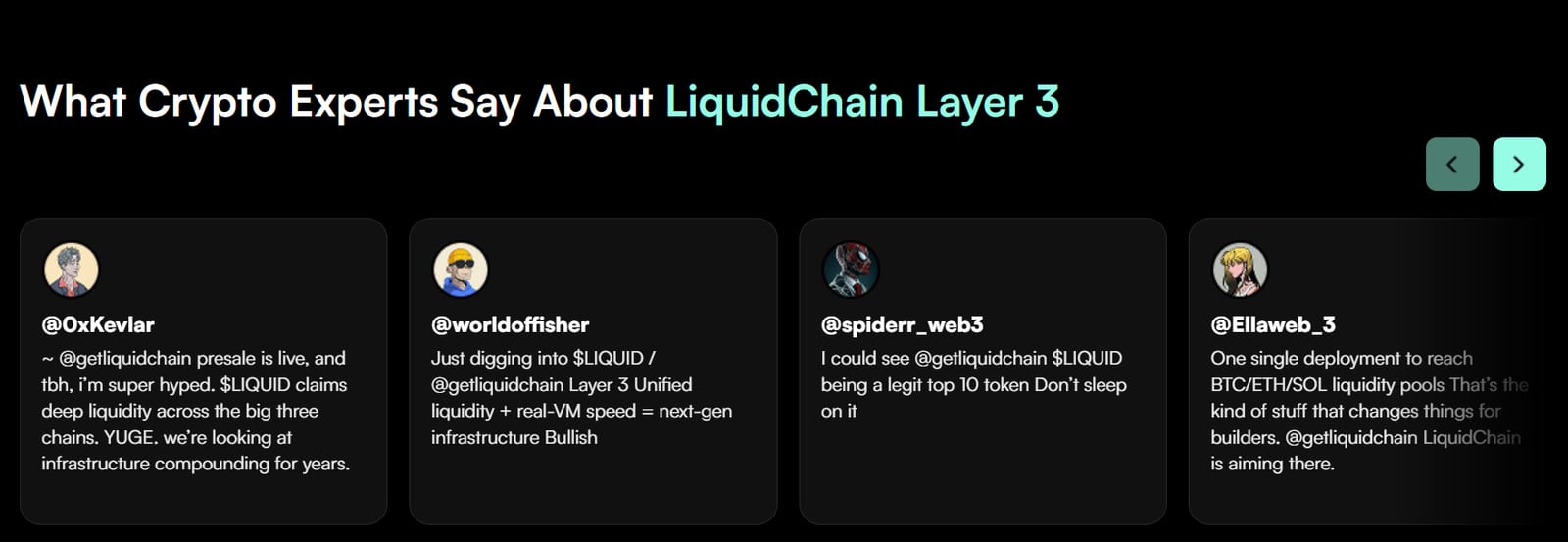
How to Track or Join the LiquidChain Layer 3 Presale
Those looking to participate can visit the official LiquidChain website to buy LIQUID using SOL, ETH, USDT, or other supported cryptocurrencies and payment methods.
The project recommends using secure wallets during the purchase process. Early buyers can also access staking opportunities during the initial phases.
On the security front, LiquidChain says it has completed smart contract audits, including a review by SpyWolf that reported no malicious logic, no hidden minting functions, and no high-severity vulnerabilities in the core token contract.
For anyone judging whether the current momentum is real or fading, the clearest read will likely come from how the community develops from here, especially on its public channels and around future product milestones.
Be part of the LiquidChain community on Telegram and X (Twitter) for the latest updates, developer announcements, and ecosystem news.