


 Some of the links on this site may be affiliate links. ICOBench may receive advertising commissions when users visit recommended platforms via our affiliate links, at no additional cost to you. All recommendations are based on a comprehensive review process.
Crypto has become very good at building separate worlds that don’t talk to each other. Bitcoin holds the deepest pool of capital, Ethereum supports much of decentralized finance, and Solana has made fast, inexpensive execution part of the everyday user experience.
The trouble begins when users or developers try to move between them.
That is a problem becoming ever more apparent, and one that LiquidChain (LIQUID) is leading the fix for, as a Layer 3 project working as a unity layer for Bitcoin, Ethereum, and Solana.
LIQUID is priced at $0.0148 in the presale, which has so far raised $926,000, while buyers can currently earn 1,220% APY through the project’s staking protocol. While those rates are eye-opening, early interest is building around a broader promise: connecting crypto’s biggest markets without forcing users to constantly navigate the borders between them.
How LiquidChain Unites Three Separate Crypto Economies
Layer 1 networks provide the foundations of crypto, and Layer 2s generally make one of those networks faster or cheaper. LiquidChain goes a level higher, positing Layer 3 as a way to coordinate activity across several underlying blockchains.
The virtual machine behind LIQUID executes transactions that reference multiple blockchains in real time, verifying Bitcoin transactions, Ethereum accounts, and Solana states. That allows transactions across multiple networks to be processed through a single shared environment rather than a collection of disconnected applications and bridges.
In plain English, LiquidChain monitors activity across BTC, ETH, and SOL and provides applications with a common layer through which those networks can interact.
Consider this your invitation.
The age of isolated chains is ending. 👁 pic.twitter.com/Iaeuk01uPI
— LiquidChain (@getliquidchain) July 29, 2026
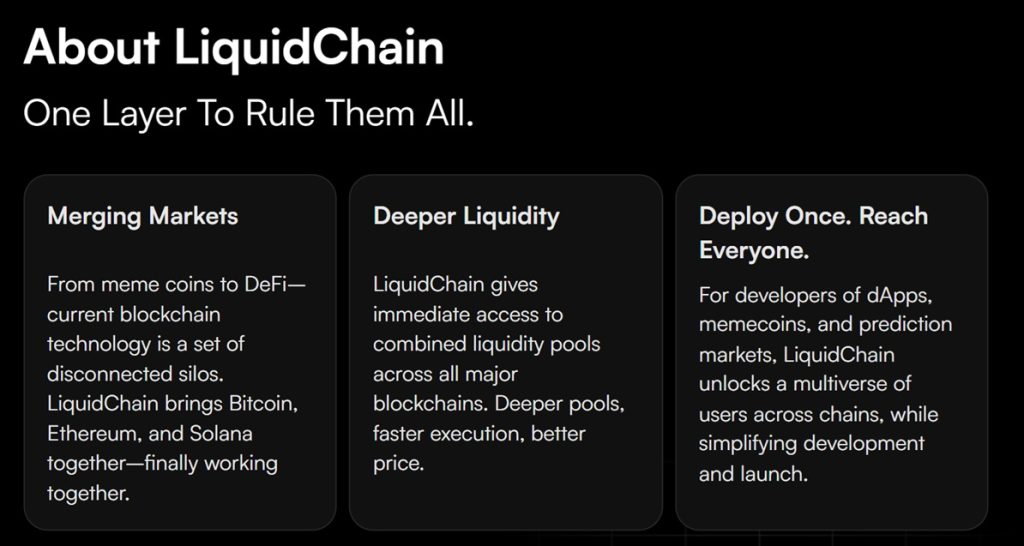
Assets from each chain are then represented in unified liquidity pools, so rather than relying on a market split across several blockchains, traders can access deeper, shared pools through a single layer.
Transactions are intended to settle atomically, meaning the connected parts either complete together or do not complete at all. This reduces the risk of one side of a cross-chain operation succeeding while another fails.
The design can make decentralized exchanges more efficient by bringing fragmented capital into the same market. Lending protocols can also reach collateral and borrowers across several ecosystems. Lastly, developers can use standard software development kits to connect to Bitcoin, Ethereum, and Solana in a single application rather than maintaining three separate products.
That one-build logic may be as important as the liquidity itself: Crypto asks users to think in chains, bridges, wallet compatibility, and token standards, but most people simply want an application to work. LiquidChain is built around moving those technical boundaries into the infrastructure – where they belong.
Why LIQUID Could Be the Next Crypto to Explode
LiquidChain is entering a market built on years of fragmentation. Each major blockchain has attracted its own liquidity, developers, and users, but that success has created increasingly valuable silos.
Traditional bridges offer one answer, though they introduce extra transactions, delays, fees, and security assumptions. Developers also incur the cost of deploying and updating application versions across several chains. So LiquidChain’s opportunity comes from treating those problems as one architectural failure rather than several unrelated inconveniences.
The potential market is considerable – Bitcoin brings capital and monetary credibility, Ethereum brings established DeFi protocols and smart-contract liquidity, and Solana brings high-throughput execution and a growing consumer-facing ecosystem.
That gives LIQUID a different proposition from a conventional Layer 1 token. The token – intended to support transaction fees, staking, governance, liquidity incentives, and access to features across the network – becomes a potential gas token across three massive ecosystems at once. Liquidity providers are set to earn proportional rewards from unified pools, while execution fees adjust according to network demand. LIQUID is expected to become deflationary via burns as well.
The presale remains early at $926,000, giving LIQUID more room to develop than projects that have already raised tens of millions. Its 1,220% staking APY is an eye-catching number, but buyers should understand that rates of this level tend to fall quickly as participation increases.
What matters over the longer term is whether the network can attract applications and enough liquidity to make cross-chain execution materially easier.
The project has also undergone security reviews from SpyWolf and CertiK, according to its official materials. We expect mainnet to launch this year.
Crypto Was Never Supposed to Remain in Silos
Blockchain networks were built to remove intermediaries, yet the industry has gradually created a new set of borders between its own ecosystems. Users can hold BTC, use an Ethereum lending protocol, and trade on Solana, but each step still feels like entering a different financial system.
LiquidChain’s idea is that the winning chain may not be one chain at all: Crypto can keep its specialized networks while adding an execution layer that lets its capital and applications meet.
The $926,000 raise is early confidence for that future, and LiquidChain now has to turn the “unity layer” from a compelling beta into working infrastructure.
If it succeeds, LIQUID will sit at the point where three enormous crypto economies stop competing for isolated pools of activity and begin operating as parts of the same market.