

 Some of the links on this site may be affiliate links. ICOBench may receive advertising commissions when users visit recommended platforms via our affiliate links, at no additional cost to you. All recommendations are based on a comprehensive review process.
Both SOL and XRP have had choppy days over the Easter break, down 3.17% and 2.81% respectively in the last 24 hours, and remaining with 0.5% of their price point from a week ago. It’s a trend across most cryptocurrencies, not helped by a destabilizing time in both global finance and geopolitics.
The frustration with established giants like XRP and Solana stems from a saturation of market cap and a lack of fresh narrative momentum. XRP remains a formidable player in the cross-border payment sector, yet its growth is perpetually tethered to its massive circulating supply and legacy status, making a 10x or 20x move a statistical mountain to climb.
Similarly, Solana has established itself as the retail favorite for speed, but periodic network instability and the centralization of its validator set have created a trust issue that many large-scale developers are no longer willing to pay.
For investors who can disregard the 15-minute candles and take a wider view, the goal is to find where the market will go next, and one avenue is projects aiming to fix Bitcoin at its core. While Bitcoin is the undisputed “digital gold,” its inability to handle high-speed, low-cost transactions and participate in DeFi has left a void that Ethereum and Solana have spent years exploiting.
Can Bitcoin reclaim its original goal as a digital currency, rather than just a place to park money? Can it find the same speed and flexibility that we have grown accustomed to on more modern chains?
These are the questions Bitcoin Hyper (HYPER) aims to answer in time for the next cycle. Having already secured $32.2 million during its presale phase, the project is moving from a theoretical scaling solution to a network that is close to launch.
Currently priced at $0.013678, HYPER offers a low entry point that contrasts sharply with the multi-billion dollar valuations of its older competitors. If Bitcoin Hyper can be the dependable Layer 2 for Bitcoin, a shockwave is coming to crypto.
Resolving the Bitcoin Latency Bottleneck
Bitcoin Hyper is designed to treat the Bitcoin mainnet as a final settlement layer rather than as the layer where you do your transactions. For years, the industry has attempted to force Bitcoin to do things it was never meant to do, and with BTC only able to handle around seven transactions per second, the result is high fees and traffic jams.
HYPER solves this by operating as a high-performance Layer 2 (L2) that processes transactions in milliseconds – thanks to the Solana Virtual Machine-compatible system – before bundling them and anchoring the transactions back to the Bitcoin blockchain. This means that users experience the speed of a modern network like Solana, yet the ultimate security of their assets is backed by the massive hash power of the Bitcoin network.
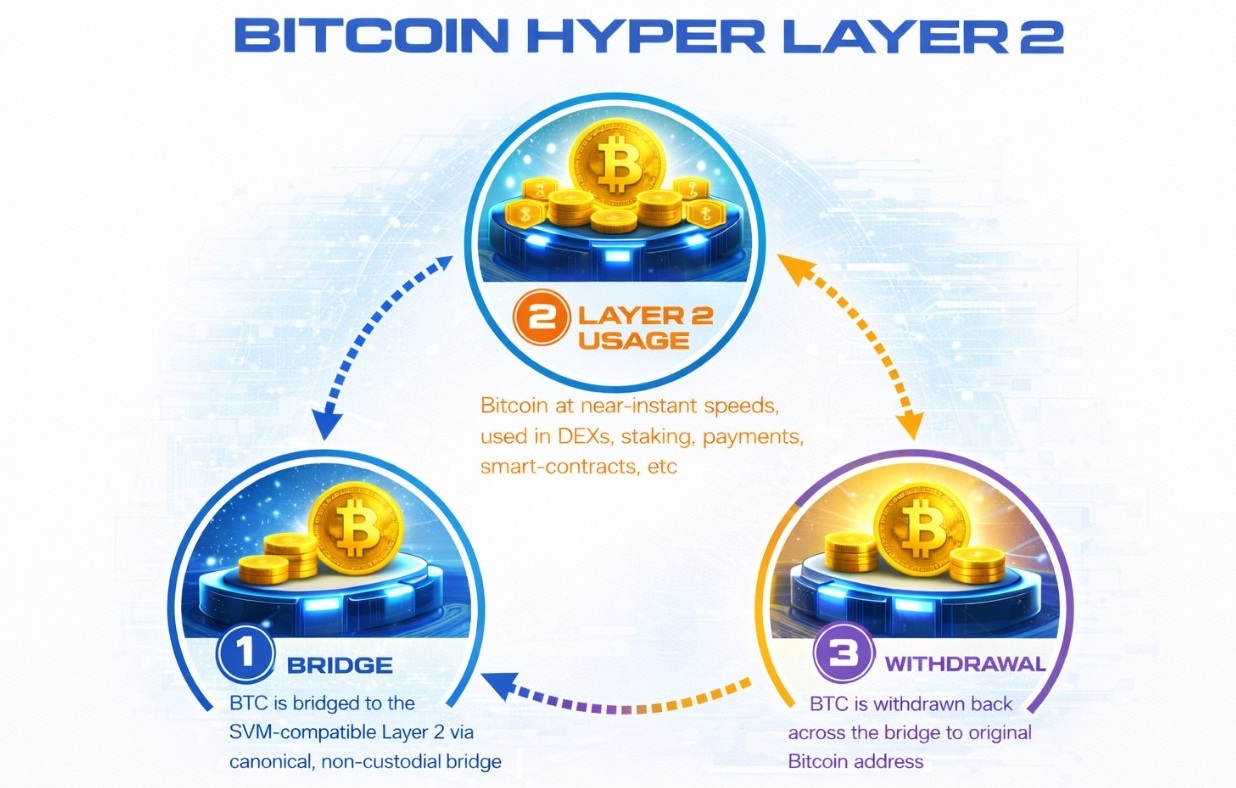
The protocol allows for the execution of smart contracts that are functionally identical to those on Solana or Ethereum, but settled in a Bitcoin-centric environment. This compatibility is a strategic move to attract developers who want to avoid Ethereum’s high gas fees but remain skeptical of the security trade-offs on other L2s.
By providing a familiar environment for decentralized finance (DeFi) and non-fungible token (NFT) developers, HYPER aims to be the primary hub for Bitcoin-based utility.
They're watching charts. 👀
Hypers holding the future. ⚡️🔥https://t.co/VNG0P4GuDo pic.twitter.com/bVPHqdHCQl
— Bitcoin Hyper (@BTC_Hyper2) April 6, 2026
It removes the friction of the 10-minute Bitcoin block time, allowing for real-time utility that was previously impossible – opening up doorways to real-world payments and global transactions that are effectively impossible right now. This is a fundamental re-engineering of how capital moves within the Bitcoin ecosystem.
Why Bitcoin Hyper Is Considered the Best Crypto to Buy Now
When analyzing the potential for outsized returns, the potential upside favors newer, high-utility protocols over aging market leaders. For Solana or XRP to double in price, they require tens of billions of dollars in fresh inflows. For a project like Bitcoin Hyper, which is sitting on a $32.2 million presale foundation and a price of $0.013678, the path to a 100x return is much more plausible. This is why many analysts, such as Borch Crypto, are labeling HYPER as the best crypto to buy now for those seeking asymmetric upside.
The timing of this launch feels like the Layer 2 explosions of the previous cycle, which were dominated by Ethereum-based solutions like Arbitrum. At three times the size of Ethereum by market cap, Bitcoin has an enormous amount of idle capital sitting in cold wallets – and few projects trying to unlock it. If HYPER manages to attract even a small amount of that capital into its Layer 2, the resulting explosion in Total Value Locked (TVL) could dwarf the growth on competing chains. Bitcoin Hyper aims to be the protocol that enables dormant wealth to finally start working for Bitcoin holders.
With Ethereum Layer 2s regularly hitting billion-dollar market caps during bull runs, HYPER has a clear path forward and an alluring end goal.
Recent audits by firms like Coinsult and SpyWolf suggest the smart contracts behind the $32.2 million raise are secure and that the launch is not far off.
The Infrastructure Move of 2026
The shift from speculative tokens to infrastructure-based assets marks the maturity of the crypto market. Bitcoin Hyper aims to be a necessary, “obvious in hindsight” upgrade to the world’s most valuable network.
By directly competing with Ethereum’s smart contract capabilities and Solana’s speed, HYPER can help erase the competitive advantages that altcoins have relied on for years.
With its successful funding round, staking offering 36% APY, and a clear technical path to scaling the world’s largest cryptocurrency, Bitcoin Hyper may be the most significant innovation of 2026.