


 Some of the links on this site may be affiliate links. ICOBench may receive advertising commissions when users visit recommended platforms via our affiliate links, at no additional cost to you. All recommendations are based on a comprehensive review process.
Bitcoin has spent years as the undisputed reserve asset of crypto – the digital gold – but it’s not what its story started out as. A simple transfer still takes minutes and can cost dollars in fees during congestion, which has basically killed its original dream of being used as day-to-day currency.
Meanwhile, Ethereum and Solana have hoovered up the everyday use cases – payments, DeFi, meme – leaving BTC holders watching their holdings sit idle while faster chains handle the actual commerce. This is why Bitcoin’s utility has narrowed to settlement and store of value while the rest of the market races ahead.
Layer 2 networks are the obvious fix, but most past attempts have chased Ethereum-style scaling. Bitcoin Hyper takes a different route by building directly on top of Bitcoin’s security model and importing the Solana Virtual Machine (SVM) for execution. The intended result once HYPER leaves presale is near-instant BTC payments without touching the congested main chain.
Bitcoin Hyper’s presale has already raised $32.2 million at a token price of $0.0136778, with staking available at a 36% APY. That combination, real technical differentiation plus capital inflow, has put Bitcoin Hyper (HYPER) on the radar for anyone hunting the next Layer 2 play that unlocks a massive market. And does it for the biggest crypto of them all.
A project that solves the speed-and-cost problem without compromising the base layer’s proof-of-work security is a massive draw. Bitcoin Hyper is shaping up to be the best crypto to buy by giving Bitcoin back its true narrative as a global digital currency.
How Bitcoin Hyper Offers a New Path for BTC
Bitcoin Hyper operates as a Layer 2 built directly on Bitcoin, using the Solana Virtual Machine (SVM) for execution while keeping native BTC as the final settlement and security layer.
The process starts with the Canonical Bridge, a decentralized, non-custodial system. Users send BTC to a monitored address on the Bitcoin mainnet, and the bridge’s Bitcoin Relay Program (an SVM smart contract) verifies the deposit by checking block headers and transaction proofs, then mints an equivalent amount of wrapped BTC on the L2.
Once the wrapped BTC lands on Bitcoin Hyper, the SVM takes over. Because the virtual machine supports parallel processing and execution, payments, swaps, and DeFi interactions settle in under a second with fees that are often fractions of a cent.
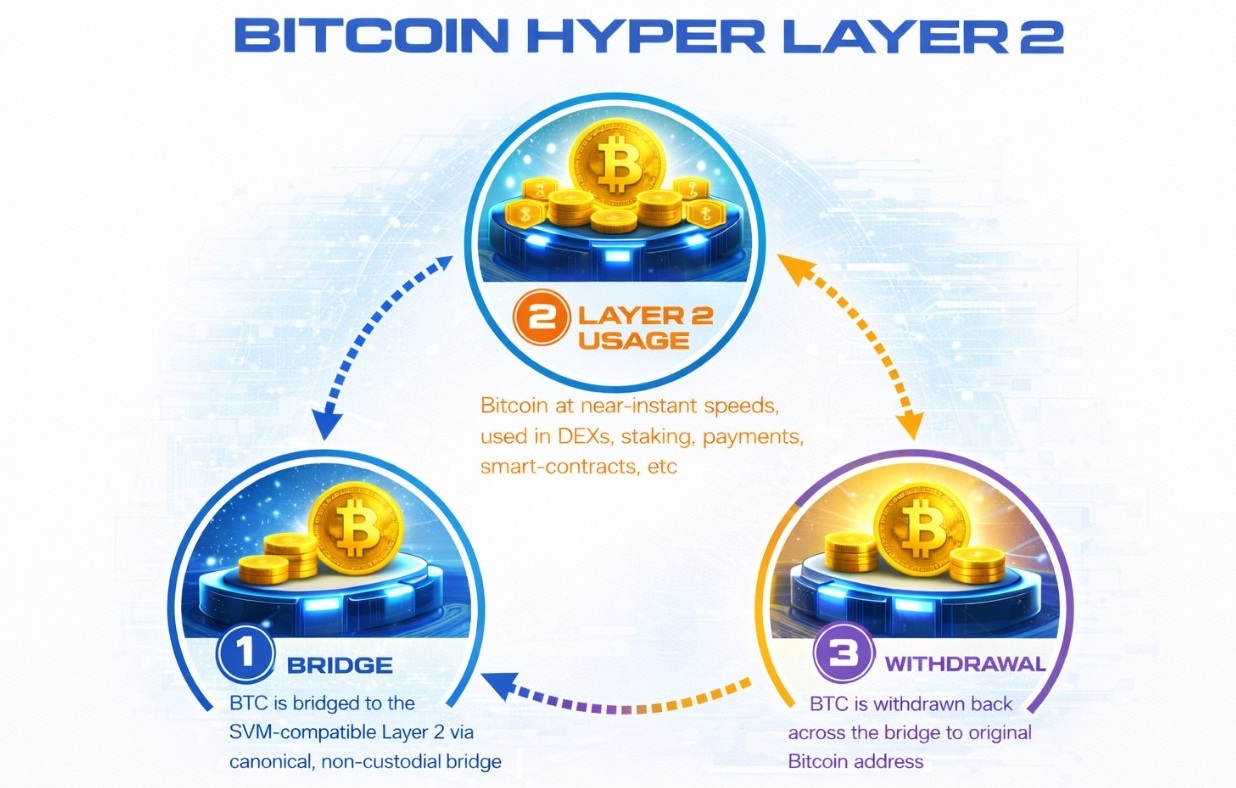
This is the part that finally makes BTC usable for real-world payments: instant peer-to-peer transfers, microtransactions, and everyday commerce become practical instead of painful on the main chain. Gas for every action is paid in the native HYPER token, giving it immediate utility beyond speculation.
When users want their native BTC back, the flow reverses. They burn the wrapped tokens on the L2, and the system batches the transactions, compresses them, generates the necessary validity proofs, and anchors the updated state to Bitcoin Layer 1. The bridge then releases the original BTC directly to the user’s mainnet address.
There are no custodians and no long lockups, and Bitcoin remains the ultimate settlement layer (with the protocol batching up thousands of transactions at a time and settling them on the Bitcoin layer in one fell swoop), while the SVM delivers the instant, near-zero-cost execution layer that Bitcoin has always needed.
Why Bitcoin Hyper Could Have a Bullish Year
With audits complete, we expect HYPER’s Mainnet to go live in Q2 2026, marking the project’s move from presale to live use. Once the Canonical Bridge is fully operational and the first wave of DeFi and payment dApps arrives, the flywheel starts.
BTC holders will finally get to use their coins for something other than HODLing, and start enjoying frictionless, low-cost BTC payments, the missing piece ever since the Lightning Network proved too narrow for broad adoption.
Reading quietly. Building loudly ⚡️https://t.co/VNG0P4GuDo pic.twitter.com/TwDC6AwhGg
— Bitcoin Hyper (@BTC_Hyper2) March 30, 2026
Exchange listings are already in the roadmap for the next phase. With $32.2 million already raised, exchanges will want to list a project with a proven audience and ambitious – but achievable – plans. And projects that solve a genuine Bitcoin pain point and deliver measurable product-market fit have historically rocketed once utility turns on. Layer 2s on Ethereum have quickly reached into the billions once they start picking up speed – and Bitcoin is a much bigger prize.
So Bitcoin Hyper’s combination of SVM execution, trustless bridging, and real staking yield makes it one of the best crypto to buy in 2026, ideally creating a Bitcoin renaissance in the years to come.
The Payments Layer Bitcoin Needed
Bitcoin never lacked security or scarcity, but it did lack the payment rails. Bitcoin Hyper is not another sidechain promising the moon, but it is the first Layer 2 that treats BTC as the settlement asset and delivers Solana-grade execution without requiring users to leave the Bitcoin security model.
For an asset that still dominates market cap yet struggles with daily utility, it’s a big deal. The presale numbers, the staking uptake, and the clean audit trail suggest the market has already spotted what’s next.
Whether it becomes the default payment layer on Bitcoin will depend on execution over the next few years, but the foundations are already in place.