


 Some of the links on this site may be affiliate links. ICOBench may receive advertising commissions when users visit recommended platforms via our affiliate links, at no additional cost to you. All recommendations are based on a comprehensive review process.
Crypto’s largest networks have spent years growing into distinct islands – Bitcoin became the market’s principal store of value, Ethereum developed the deepest smart contract ecosystem, and Solana proved that blockchains could support fast, inexpensive consumer applications.
Their strengths are obvious – the trouble begins when users try to move between them.
While Bitcoin and Ethereum have shown modest low-percentage gains across the week, capital remains concentrated in the largest networks even as their liquidity and applications operate largely apart.
If Layer 1 blockchains provided the foundations, Layer 2 networks made individual ecosystems cheaper and faster, then the next opportunity lies above them: infrastructure capable of making several major chains behave together. That is why LiquidChain (LIQUID) is attracting attention, with a presale that has already raised $917,000 on the idea that no chain needs to be an island.
How LiquidChain Turns Separate Networks Into One Execution Layer
LiquidChain is a Layer 3 network connecting Bitcoin, Ethereum and Solana through a unified protocol. It is not trying to replace these blockchains or persuade users that one should defeat the others, but comes at it from the opposite assumption: each network has already developed something valuable, and the larger prize may come from allowing those strengths to work together.
According to the project, fragmented liquidity creates several avoidable costs, from developers needing to deploy separate versions of an application across different chains to traders facing delays, fees, and additional security risks when bridging assets. And liquidity remains divided among pools that cannot easily communicate with one another.
Third layer. Third eye. 👁
Coincidence? The Order thinks not.https://t.co/vqvBcdSQYC pic.twitter.com/TkjPSubTRQ
— LiquidChain (@getliquidchain) July 24, 2026
LiquidChain is intended to coordinate activity across the three networks while monitoring their states in real time, and applications built on top can, via LIQUID, reach all three without recreating the same product several times.
The LIQUID token itself is the operating asset, intended for transaction fees, staking, and liquidity incentives – with rewards distributed proportionally through unified pools. The network plans to keep execution costs low and adjust them according to demand rather than relying on a fixed fee structure.
Security has also been addressed before the network’s wider launch, with audit reviews by CertiK and SpyWolf.
Why LIQUID Could Be the Best Crypto to Buy Before July Ends
LiquidChain becomes more interesting when viewed with the direction of the wider market. Bitcoin continues to absorb capital but offers relatively limited native programmability. Ethereum remains the centre of DeFi, although its applications are largely designed around Ethereum-compatible liquidity. Solana has speed and a growing user base, yet it remains another self-contained economy.
A credible connection between those networks would not need to manufacture a market – it would be opening passages between markets that already exist.
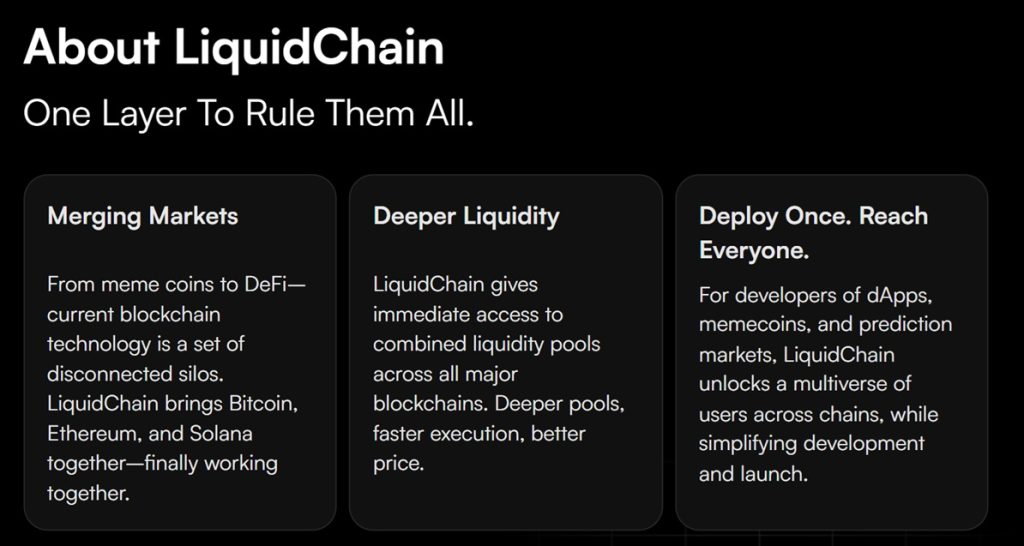
That gives LiquidChain a possible route through 2026 and into 2027, where developers can build once and reach liquidity across several chains, and traders can interact with assets without treating every move between networks as a separate operation. Bitcoin holders might gain access to more active financial applications without Bitcoin itself having to change.
The presale’s approach toward $1 million is an early indication that investors understand the scale of that proposition. The 1,228% staking APY is designed to reward participation before launch, although the rate will naturally decline as more holders enter the staking pool.
The Next Crypto Era May Be Built Between Chains
Crypto spent its first era building independent networks, and its second making them faster. The third may be defined by what happens between them.
LiquidChain is pursuing the less-visible layer of the market: the infrastructure that lets established blockchains remain distinct while becoming more useful together. Quiet projects are often overlooked because their value is not immediately theatrical. Bridges, execution layers, and liquidity systems only become obvious once people begin relying on them.
LIQUID is still at the presale stage, but its ambition is unusually mature.