


 Some of the links on this site may be affiliate links. ICOBench may receive advertising commissions when users visit recommended platforms via our affiliate links, at no additional cost to you. All recommendations are based on a comprehensive review process.
Early-stage tokens draw attention when they have a useful purpose or catch virality from the start – and by doing so are much more appealing than large-cap coins from an ROI perspective. Traders who want the best returns look to get in as early as possible.
Infrastructure coins and, of course, meme coins can both define their own markets. Infrastructure projects can open brand-new markets, while meme coins can fly when they hit a narrative the mainstream didn’t know it wanted.
Two projects are succeeding on this front right now: LiquidChain, which offers cross-chain liquidity and opens up the Layer 3 market, and Maxi Doge, which is building a meme-led trading culture with unusually strong early momentum.
Both share the same advantage: they’re early, and they’re successfully growing.
LiquidChain (LIQUID): A Layer 3 Built Around Liquidity Efficiency
LiquidChain is a Layer 3 network designed to optimize liquidity across chains – because right now crypto is in a fragmented state. So LiquidChain focuses on how capital moves across chains and how efficiently it can be deployed.
The project sits above existing Layer 2 ecosystems (think Arbitrum, Optimism, etc) and acts as a coordination layer for liquidity. Fragmentation has become one of the more persistent inefficiencies in DeFi, with assets existing across multiple chains, and moving them introduces friction, cost, and delay.
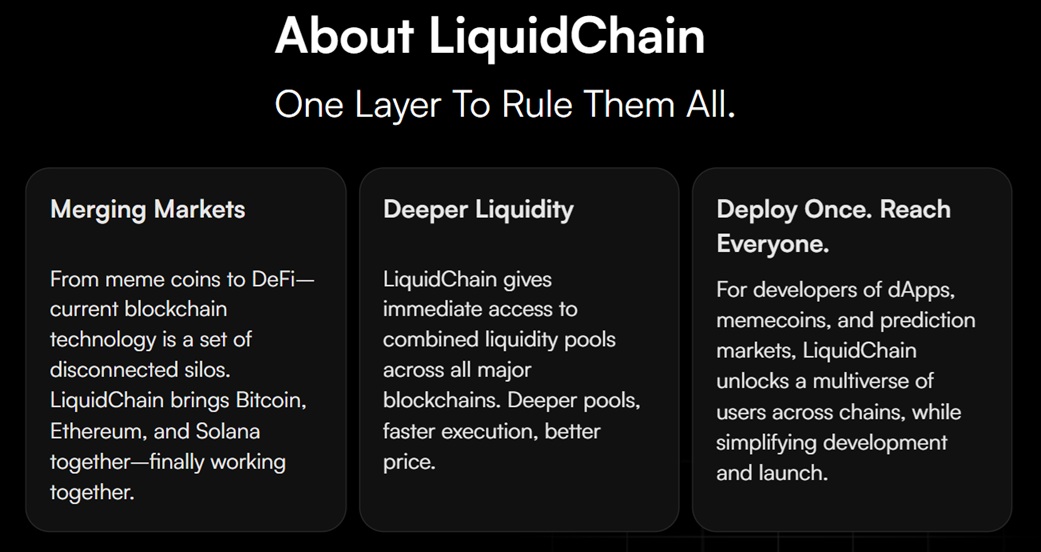
LIQUID’s architecture, as described in its whitepaper, leans on aggregated liquidity pools and routing logic that can dynamically allocate capital where it is most needed. In practical terms, that means traders and protocols don’t need to spend as much time thinking about where liquidity sits. The network handles that distribution.
That design choice matters more than it first appears, because it’s not just the end-user that suffers. Projects themselves can launch anywhere, but they struggle to maintain depth without spreading themselves thin. LiquidChain’s approach is to treat liquidity as a shared resource rather than a chain-specific one.
The token, LIQUID, is currently priced at $0.0143, with $622,000 raised in presale funding so far and staking yields advertised at an astonishing 1,724% APY via its staking portal. Expect this rate to decline over time, with the high APY designed to encourage early participation and lock in supply before broader distribution.
Audits from SpyWolf and Certik are listed on the project site, which adds technical reassurance, although the real test and price discovery will come once the routing mechanisms are live.
There’s a clear reason LiquidChain is getting attention now: it follows on from Layer 2 scaling, which solved one problem. But L2s created another problem: capital was now spread across too many environments. A Layer 3 focused on liquidity rather than execution speed is a logical next step, and one that hasn’t yet been crowded out by competing designs.
If liquidity coordination becomes a core part of the next cycle’s infrastructure, then getting early exposure to a network built around that premise carries obvious upside potential.
Maxi Doge (MAXI): Meme Culture With Structured Incentives
Maxi Doge is taking a very different route. It is a narrative-first meme coin, built around a trading persona that leans into high-conviction, high-risk behavior.
The project frames itself around “Leverage King culture,” a stylized take on the kind of trader who pushes positions aggressively and treats volatility as an opportunity rather than a threat. It’s deliberately exaggerated, but its “gym bro” mascot lands because it reflects a real subset of the market: those who are always seeking to improve themselves.
STEP ASIDE SILVER SURF. pic.twitter.com/2JBYENhnyW
— MaxiDoge (@MaxiDoge_) March 24, 2026
The token, MAXI, is priced at $0.000281, with $4.7 million in presale funding already raised. Staking offers a 66% APY.
The project outlines a mix of gamified trading features, community competitions, and leaderboard-style engagement mechanics once the full project goes live. These are designed to keep users active rather than passive, which is critical for meme tokens that rely on constant attention.
Security audits from SolidProof and Coinsult are very welcome in meme coin land, and help filter out weaker entrants in a crowded category.
What separates Maxi Doge from the long tail of meme coins is its ability to convert attention into participation. So many meme coins launch with a fizzle, but it is a hugely bullish sign that nearly $5 million has arrived at MAXI without a single exchange listing. The branding and narrative are obviously landing, making MAXI one of the best crypto presales to buy before the next bull run. There’s a base forming, and that matters more than any individual feature.
So Maxi Doge’s advantage is that it has started building that momentum before listing, rather than relying on it afterward. The staking layer adds a secondary incentive, but the real driver is community alignment around a shared identity.
For early participants, the logic is familiar. If the project can maintain its engagement pace and avoid diluting its core theme, it has room to expand well beyond its presale discount pricing.
Presales Still Offer the Cleanest Upside
Presales are not a shortcut to guaranteed returns, but they remain one of the few places where market expectations haven’t fully formed, and where most outsized moves begin.
LiquidChain and Maxi Doge approach the opportunity from opposite directions. One is trying to solve a structural inefficiency in DeFi. The other is building a cultural layer around trading. Both are early enough that they offer compelling opportunities.