Some of the links on this site may be affiliate links. ICOBench may receive advertising commissions when users visit recommended platforms via our affiliate links, at no additional cost to you. All recommendations are based on a comprehensive review process.
Bitcoin has held steady above the $60,000 mark after a period of consolidation this week, with recent sessions showing modest gains across major assets. Ethereum and Solana have posted gains of 4% and 6% over the past day, respectively, while the altcoin sector remains sensitive to Bitcoin’s direction, but projects with clear technical progress and fresh narratives continue to draw capital. Crypto presales have been performing well too, offering investors early exposure to new infrastructure plays at discounted prices and with staking incentives that serve as practical alternative investment options right now.
Among the best altcoins under $1, three stand out for distinct reasons that could support stronger moves through July. Cardano (ADA) is advancing its governance model after a major network upgrade; Bitcoin Hyper (HYPER) is pushing forward with its Bitcoin Layer 2 approach; and LiquidChain (LIQUID) is targeting unified liquidity across Bitcoin, Ethereum, and Solana in its ongoing Layer 3 presale.
Cardano (ADA)
Cardano runs a Layer 1 proof-of-stake blockchain built on the Ouroboros protocol, which prioritizes security, sustainability, and peer-reviewed design. The platform supports smart contracts and decentralized applications, with ongoing work on scaling tools such as Hydra and Mithril to enable faster transactions and greater data availability.
In mid-June 2026, the van Rossem hard fork went live on mainnet, a change that moved final execution decisions to the decentralized on-chain governance community and reduced reliance on earlier off-chain processes. The shift forms part of the broader Cardano Vision 2026 program, which targets post-quantum security measures, multi-layer scalability improvements, decentralized identity systems, and expanded zero-knowledge verification capabilities. A partnership with the Brazilian Olympic Committee also highlights real-world adoption efforts.
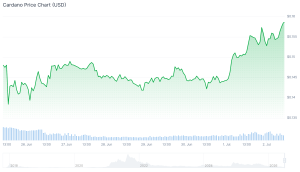
ADA is now trading near $0.16 with a market cap of $5.9 billion and 24-hour volume above $216 million, and the token has recorded a roughly 7% gain over the latest 24-hour period. After earlier price pressure that took ADA to multi-month lows, Cardano’s combination of completed governance upgrades and steady development activity gives the project a clearer path to participate in a broader altcoin recovery.
Bitcoin Hyper (HYPER)
Bitcoin Hyper (HYPER) is building a Layer 2 network on Bitcoin that aims to deliver near-instant, low-cost transactions while keeping the base layer’s security guarantees. The design uses a high-throughput virtual machine for execution and zero-knowledge proofs to verify state, with periodic commitments back to Bitcoin for final settlement. This setup targets payments, DeFi activity, decentralized applications, and meme coin launches that currently face speed and fee constraints on the main Bitcoin chain.
Welcome to the future.
Welcome… To $HYPER. 🔥⚡️https://t.co/VNG0P4GuDo pic.twitter.com/V7MrVjeLkc
— Bitcoin Hyper (@BTC_Hyper2) July 2, 2026
The presale has raised approximately $32.91 million, and the token price stands at $0.0136825 per HYPER. Buyers can choose to stake at purchase for rewards listed at 36% APY, and token allocations direct 30% to ongoing development, 25% to a treasury and business growth, 20% to marketing, 15% to community rewards, and 10% to exchange listings. A bridge, wallet, explorer, and staking interface are already part of the L2’s integrated environment.
Interest in Bitcoin scaling solutions remains elevated while the leading cryptocurrency consolidates above key support, and the HYPER presale’s progress and the project’s focus on practical infrastructure give participants a direct way to back this narrative at the current entry price. Delivery of the promised performance and security features after the token generation event will shape how the network attracts users and developers in the months ahead.
LiquidChain (LIQUID)
LiquidChain (LIQUID) is developing a Layer 3 execution environment to connect liquidity and application composability across Bitcoin, Ethereum, and Solana. The architecture combines a high-performance virtual machine with trust-minimized cross-chain proofs and messaging, allowing assets from the three chains to interact in unified pools without standard wrapping steps. The goal is simpler deployment for developers of decentralized applications, meme coins, and prediction markets that want access to users and capital from multiple networks at once.
That moment when you see the LiquidChain utility for the first time. 👁⟁https://t.co/vqvBcdSQYC pic.twitter.com/KboySb8c4X
— LiquidChain (@getliquidchain) July 2, 2026
LIQUID’s presale has passed $882,000 in raised funds toward a near-stage target of $989,000, with the token itself priced at $0.01475. Staking rewards during the presale are based on a 1,273% APY rate. Total supply is fixed at approximately 11.8 billion LIQUID tokens, with allocations of 35% for development, 32.5% for marketing and growth initiatives, 15% for business development, 10% for community rewards, and 7.5% for listings and expansion.
Fragmented liquidity across major chains continues to create friction for traders and builders, so a project that offers verifiable unified markets and atomic cross-chain settlement could see increased relevance if overall market activity picks up. The LIQUID presale provides an early discounted entry with staking incentives, and its successful testnet progress and eventual mainnet launch will test whether the technical vision translates into sustained usage and token demand.