

 Some of the links on this site may be affiliate links. ICOBench may receive advertising commissions when users visit recommended platforms via our affiliate links, at no additional cost to you. All recommendations are based on a comprehensive review process.
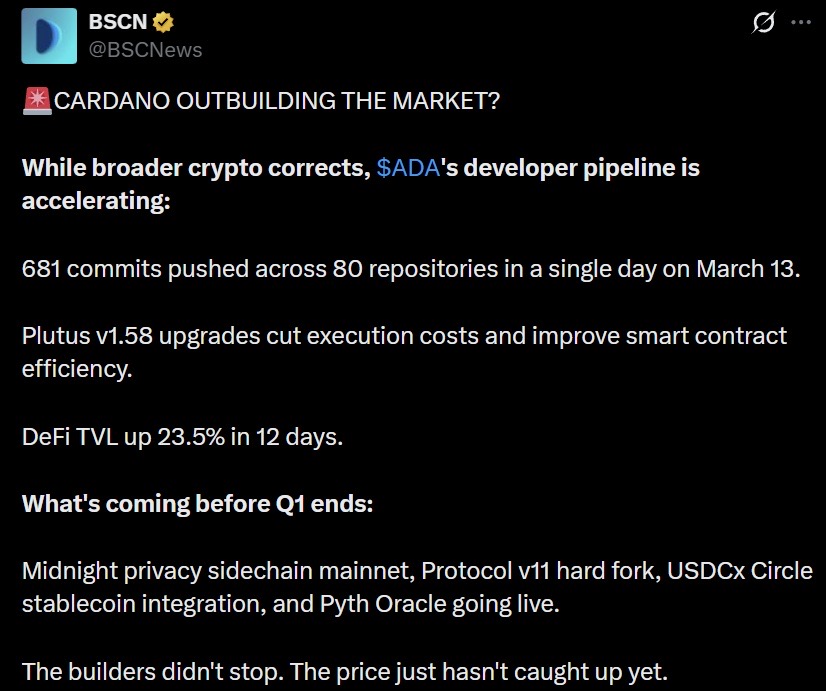
Cardano has been slowly building lately. Across 80 repositories, developers pushed 681 commits in a single day on March 13. Plutus v1.58 just rolled out, cutting execution costs and improving smart contract efficiency. DeFi TVL climbed 23.5% in 12 days.
The ADA price hasn’t reacted much. It sits where it’s been, waiting for the market to notice what’s happening under the hood. Before Q1 ends, Cardano expects the Midnight privacy sidechain mainnet, Protocol v11 hard fork, USDCx Circle stablecoin integration, and Pyth Oracle going live. The builders didn’t stop. The price just hasn’t caught up yet.
But while Cardano builds for today’s blockchain challenges, another project is solving something far bigger. Something Cardano can’t touch. Its name is BMIC ($BMIC), and its crypto presale just passed $500,000 raised.
Cardano Builds, ADA Price Waits
The BSC News thread captured what’s happening. Cardano’s developer pipeline is accelerating at a time when broader crypto corrects. The numbers don’t lie. 681 commits in one day shows serious building activity.
The technical upgrades matter. Plutus v1.58 makes smart contracts cheaper and more efficient. That removes friction for developers choosing where to build. DeFi TVL jumping 23.5% in less than two weeks shows capital starting to move back into the ecosystem.
Source: X/@BSCNews
What’s coming before April matters even more. The Midnight privacy sidechain brings something Cardano has lacked; native privacy features. Protocol v11 hard fork continues the steady technical evolution. USDCx integration brings Circle’s stablecoin into the ecosystem. Pyth Oracle goes live, giving developers better price data.
All of this is real progress. Cardano keeps building through bear and bull alike. Eventually, the ADA price usually catches up. The question is whether that’s enough.
Because while Cardano builds better blockchain infrastructure, it doesn’t address the existential threat hanging over every crypto project today.
BMIC: Solving What Cardano Can’t Touch
Here’s what Cardano isn’t building. Quantum resistance. Not in its roadmap. Not in its priorities. And that’s a problem every holder needs to understand.
Quantum computers are advancing faster than most realize. When they reach sufficient power, they will break the cryptography securing every standard wallet. Every public key sitting on-chain becomes a target. Data collected now can be cracked later. Your private keys, your transactions, your entire portfolio become exposed eventually.
BMIC built the only complete defense against this future. Its crypto presale has already raised nearly $500,000 from backers who understand what’s coming. Prices are still low. The window won’t stay open forever.
Here’s what BMIC actually built. Think of it as a complete financial system designed for a world that doesn’t exist yet. Wallet, staking, payments; every piece runs on cryptography built to survive quantum computing. Not individual components stitched together later. Everything designed from the start to work as one unit.
The wallet solves something fundamental. Every wallet you’ve ever used leaves traces. Your public key sits on a chain somewhere, visible to anyone looking. That’s like leaving your house keys under the mat with your address written on them. BMIC took a different approach. Using smart accounts and private routing, your keys never appear anywhere. No traces means nothing for future quantum systems to find.
Staking works the same way. When you stake tokens today, your public key gets recorded permanently. That record sits there waiting. BMIC redesigned staking so keys stay hidden through the entire process. The rewards come in. The exposure doesn’t.
Payments needed the same treatment. Every transaction leaves a trail. BMIC built a payment layer where signatures stay masked and routes stay private. Even if someone captures transaction data now, they can’t use it later. The system blocks cloning, prevents recovery, and stands up to attacks that haven’t been invented yet.
Behind everything runs AI that never stops watching. It studies traffic patterns, adjusts cryptographic settings based on what it sees, and balances workloads across different systems. When new threats appear, the AI adapts. When standards change, the AI updates. You don’t do anything. The protection just keeps getting better.
For companies and institutions, BMIC built something equally important. Banks can add quantum-safe custody without replacing their entire backend. Healthcare providers can secure patient data through simple connections. Government agencies can protect communications alongside existing infrastructure.
BMIC: Best Crypto Presale in 2026?
Cardano keeps building. That’s good. The ADA price will likely catch up eventually. Midnight, Protocol v11, USDCx, Pyth; all real upgrades that improve the ecosystem.
But none of them solve what BMIC solves. Cardano can’t offer quantum-secure staking because it doesn’t exist anywhere else. Cardano can’t offer zero public-key exposure because every chain today exposes keys by design. Cardano can’t offer PQC-protected payments because the technology wasn’t built for that.
BMIC built it. That’s why this crypto presale keeps growing while others struggle. That’s why nearly $500,000 flowed in during early stages. And that’s why BMIC might be the best crypto presale to buy in 2026 regardless of where Cardano trades next.
The presale details matter. Prices start at $0.048485 per token and increase through up to 50 phases to $0.058182. The launch price will exceed the final presale tier. You can join using ETH, USDT, or USDC on Ethereum.
Cardano builds for today’s blockchain wars. BMIC builds for the quantum age that follows. One is a solid project with real development momentum. The other solves a problem nothing else can touch.
Overall, BMIC deserves serious attention. The presale is still open. Prices are still low. The window closes eventually.
Meet the future of quantum-secure Web3 with BMIC:
Presale: https://bmic.ai/
Social: https://x.com/BMIC_ai
Telegram: https://t.me/+6d1dX_uwKKdhZDFk