




 Some of the links on this site may be affiliate links. ICOBench may receive advertising commissions when users visit recommended platforms via our affiliate links, at no additional cost to you. All recommendations are based on a comprehensive review process.
In Bitcoin news today, BTC traded at $78,400 on August 31 as the Japanese Yen breached 160 per US dollar in Tokyo trading and a U.S. strike on Iran’s Larak Island added to market uncertainty.
The developments followed Friday’s broad dollar advance and hawkish remarks from Warsh at Jackson Hole, which had lifted expectations for a Federal Reserve rate hike.
The total crypto market cap is down 0.5% over the past 24 hours, sitting at $2.71 trillion, with a daily trading volume exceeding $78.9Bn.
$BTC might be setting up for another cycle repeat.
The last two major downtrends lasted roughly a year before turning into massive expansions.
2018–19 led to +2000%
2022–23 led to +700%Now we’re seeing a similar structure again. My base case is this correction cycle wraps up… pic.twitter.com/zc68ZHifFR
— Wealthmanager (@Wealthmanager) August 31, 2026
Bitcoin News Today: ETF Flows and Rate Expectations
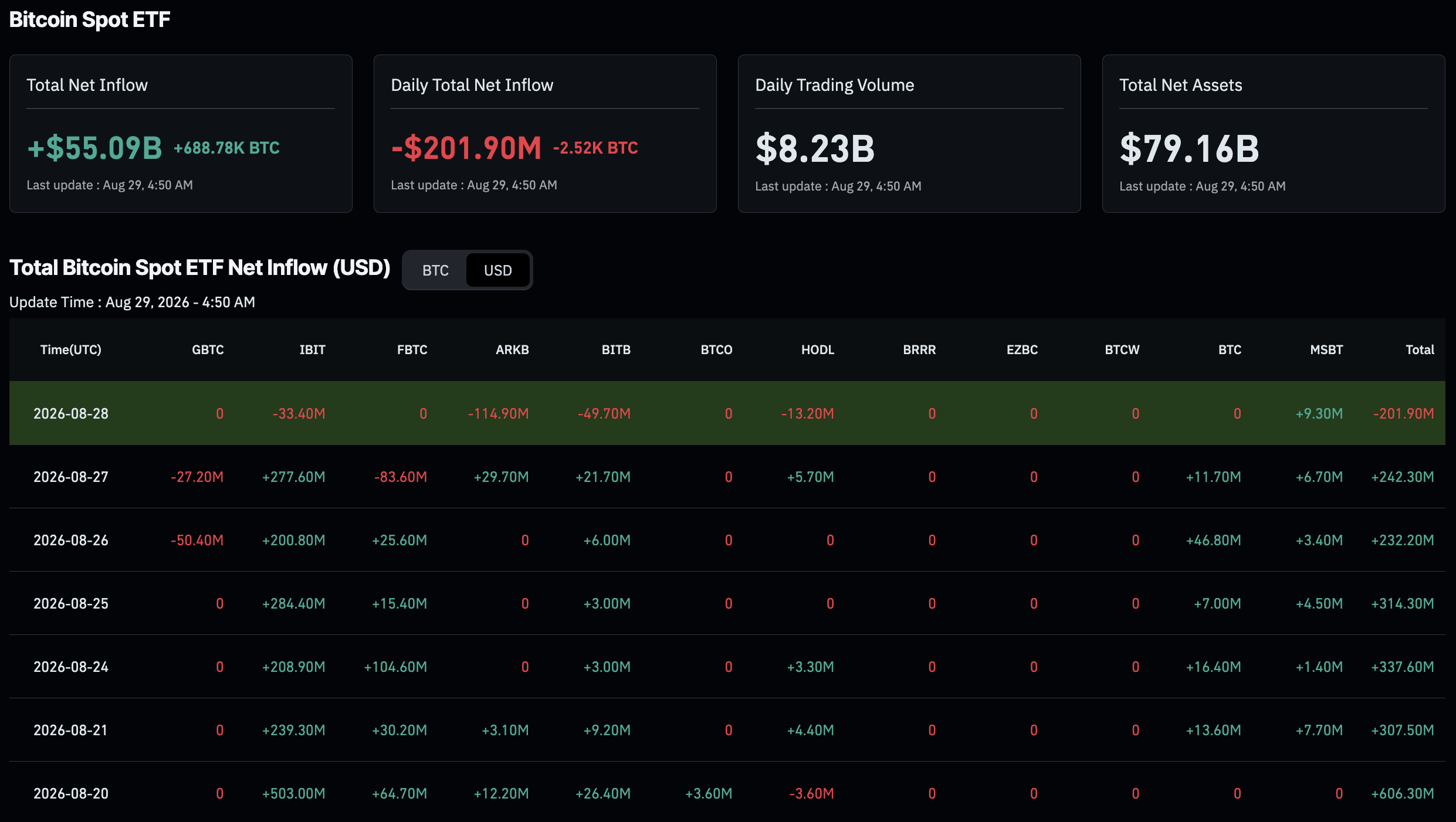
Bond investors had been pricing a Fed positioned to hike, and the resulting repricing had pulled institutional money out of Bitcoin ETFs across May and June, according to the Cryptonews report.
Monday was the final trading session of August, making the month’s closing ETF total a focal point for whether an eight-day Bitcoin ETF inflow run had survived the change in rate expectations.
CoinDesk identified August’s total ETF closing flow as the more immediate crypto-market indicator. The result was expected to provide a clearer view of whether the recent inflow run had continued or ended as rate expectations shifted.
DISCOVER: Trade Bitcoin on Binance Today
Dollar, Yen and Geopolitical Risk Complicate Bitcoin’s Outlook
In other Bitcoin news today, the yen’s move beyond 160 per dollar followed Friday’s broad dollar advance and hawkish remarks from Warsh at Jackson Hole.
US Treasury Secretary Scott Bessent said Sunday that recent yen moves had been contained and did not warrant a joint US-Japan intervention like the one seen last month. He had warned Friday that a disorderly yen market could feed through to higher U.S. interest rates.
That connection places Tokyo’s currency market alongside Wall Street’s rate expectations and the crypto market’s positioning. The yen has long been used as a funding currency for investments in US stocks and Treasury notes.
The U.S. strike on Iran’s Larak Island added another macro risk alongside yen weakness and higher rate expectations. Reuters reported that oil rose as Gulf tensions flared and US equities fell, while Bitcoin’s response was comparatively muted, with its daily loss remaining under 1%.
The wider crypto market showed mixed performance. Solana and Dogecoin each fell roughly 3% on the day, while Ether, BNB, Zcash and Tron were within 2% of flat. On a weekly basis, Solana was up about 8%, while Dogecoin was down roughly 10%.
U.S. Treasury Secretary Bessent says his “belief is that the Japanese government and BOJ will do things that will lead to a stronger yen.” pic.twitter.com/8uXtMFbnGn
— Shay Boloor (@StockSavvyShay) August 31, 2026
What Could Shape Bitcoin’s Next Move?
Reuters reported that investors were turning to upcoming U.S. data, including the nonfarm payrolls report and consumer inflation figures, which could shape expectations ahead of the September Fed meeting.
The dollar’s direction, the yen’s movement near intervention-sensitive levels, and the path of rate expectations remain key variables for risk assets, including Bitcoin. Bitcoin remained near $78,000 amid these competing market pressures.