


 Some of the links on this site may be affiliate links. ICOBench may receive advertising commissions when users visit recommended platforms via our affiliate links, at no additional cost to you. All recommendations are based on a comprehensive review process.
Bitcoin’s next big crypto opportunity may not come from another change in the BTC price.
Developers are still working on a much older problem: how to make the world’s largest cryptocurrency useful for more than holding and transferring value.
Bitcoin Layer 2 projects have moved back into focus in August, with networks including Stacks, Bitlayer, Citrea, and Rootstock pursuing different ways to support payments, lending, trading, and decentralized finance around BTC. Stacks is also preparing a new 90-day DeFi incentive program that will reward borrowing and liquidity activity involving its Bitcoin-linked sBTC asset.
While they all have different strengths and weaknesses, Bitcoin Hyper (HYPER) is the one catching attention right now, with a presale that has raised more than $33 million thanks to its novel proposal: a Bitcoin Layer 2 built to be compatible with the Solana Virtual Machine (SVM).
Solana speeds with BTC’s security and safety? It’s a mix that’s fetching attention for good reasons.
Bitcoin Layer 2s Are Tackling a Much Bigger BTC Opportunity
Bitcoin’s limitations are well known – the base network deliberately favors security and decentralization over raw transaction speed, while its scripting system is far more restrictive than the smart contract environments found on networks such as Ethereum and Solana.
That is rarely a problem for someone simply buying BTC and keeping it in a wallet, but it becomes much more noticeable when developers try to use Bitcoin for real-world payments, decentralized exchanges, lending markets, or other applications requiring frequent transactions.
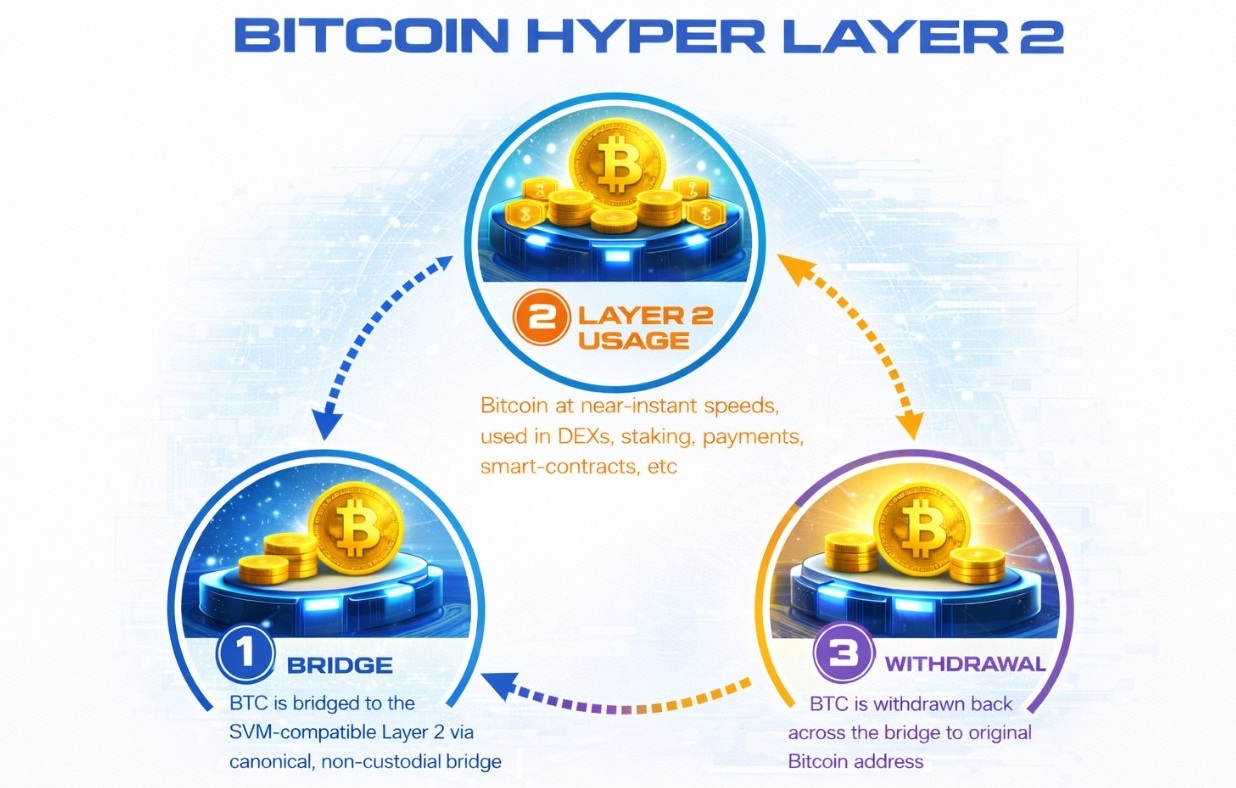
So Layer 2 projects move that activity away from Bitcoin’s base layer while retaining a connection to BTC and the Bitcoin network.
There is no single agreed model – Stacks has developed its own smart contract environment and sBTC asset, while Bitlayer is working with BitVM technology and zero-knowledge proofs. Citrea takes another rollup-based approach, and Rootstock has long offered an EVM-compatible smart contract network connected to Bitcoin.
What links these projects is the amount of capital they are trying to put to work: BTC remains by far the largest cryptocurrency, with more than a $1.5 trillion in TVL, but compared with other major blockchain ecosystems, relatively little of that value participates in on-chain financial applications.
Even established Bitcoin scaling projects are still testing demand; Stacks said this month that its earlier Dual Stacking pilot distributed 22.4 BTC to 1,044 participants, while sBTC deployment peaked at over 5,000 BTC. Its next incentive program will direct Bitcoin rewards toward borrowing and liquidity markets beginning around September 10.
Bitcoin Hyper Brings SVM Execution Into the Mix
Rather than trying to make Bitcoin itself execute more transactions (which is effectively impossible, the Bitcoin main chain can only process around 7 transactions per second), Bitcoin Hyper is building a separate high-performance environment using the Solana Virtual Machine.
The SVM is already associated with fast blockchain applications and high transaction throughput, and Bitcoin Hyper plans to use it for activities that would be difficult or expensive to perform directly on Bitcoin, including real-world payments, trading, lending, staking, and decentralized apps.
BTC is moved into the Layer 2 environment, which can then be used within those applications, while Bitcoin Hyper periodically commits the Layer 2 state back to Bitcoin. The project also plans to use zero-knowledge proofs to verify transaction validity.
Effectively, the BTC main chain remains the ultimate ledger, but transactions can occur fast enough to be processed at, say, a supermarket register.
How HYPER Works
HYPER is the network’s native token, used for transaction fees and smart contract execution, and holders can also stake it to participate in governance.
The project’s whitepaper lists additional potential uses, including access to ecosystem features and incentives for developers building applications on the network.
Hyper speed. Maximum blast. 💥⚡️https://t.co/VNG0P4GuDo pic.twitter.com/R7BUhvLCZW
— Bitcoin Hyper (@BTC_Hyper2) August 24, 2026
The token has a fixed supply of 21 billion HYPER, and its Ethereum contract has also been reviewed by SpyWolf, whose audit covers common vulnerabilities and logic flaws.
Presale demand has already provided Bitcoin Hyper with one obvious advantage over many early-stage Layer 2 projects: visibility. HYPER has raised more than $33 million, with tokens priced at $0.0136852 and staking offering 35% APY.
Whether that makes HYPER the next crypto to explode will ultimately depend on execution after the presale – a Bitcoin Layer 2 needs more than fast transactions on paper. But the broader market evidently recognizes the protocol’s value.
Stacks, Bitlayer, Citrea, and others are approaching it with increasingly different technical designs, but Bitcoin Hyper says that combining Bitcoin with an SVM execution layer offers a faster route and brings Bitcoin right back to Satoshi’s original currency goals without sacrificing security.