


 Some of the links on this site may be affiliate links. ICOBench may receive advertising commissions when users visit recommended platforms via our affiliate links, at no additional cost to you. All recommendations are based on a comprehensive review process.
Bitcoin is roaring back, and the question for crypto traders is already moving from whether the recovery is real to what comes next.
BTC trades at $79,511, up 1.39% over the past 24 hours and 10.83% in a week, following a rally that has brought the world’s biggest cryptocurrency back toward the psychologically important $80,000 level.
The comeback has coincided with renewed institutional demand and inflows into U.S. spot Bitcoin ETFs, adding some heavyweight buying to a recovery that initially caught plenty of traders off guard.
Yet another question sits underneath Bitcoin’s epic return – how high BTC can go is one thing, but developers are increasingly interested in something different: how useful can that Bitcoin become?
That puts Bitcoin Hyper (HYPER) in an interesting position – potentially as the next crypto to explode. Its presale has already raised more than $33 million around a plan to combine Bitcoin’s settlement and security with a much faster Solana Virtual Machine-based execution layer.
Bitcoin’s Comeback Revives a Much Bigger Question
Bitcoin has become extraordinarily successful as an asset – its fixed supply and decentralized network created a form of digital scarcity that has grown from an experiment between cypherpunks into an asset owned through major investment funds, corporate treasuries, and millions of individual wallets.
But Bitcoin was originally described as peer-to-peer electronic cash, and using it as everyday money remains more difficult.
The main chain deliberately prioritizes security and decentralization over speed, processing only about 7 transactions per second. That is fine when BTC is being held for years or used for high-value settlement, but it’s an issue when someone wants to pay for shopping, trade assets, use a lending platform, or interact with an application without a ten-minute wait time.
Modern crypto users have become accustomed to networks where transactions arrive in seconds and cost fractions of a dollar, and Bitcoin simply was never designed to compete with that kind of execution environment.
The opportunity for Layer 2 projects is therefore increasingly philosophical as much as technical: the next phase could be about turning that enormous store of capital into money people can actually use.
Bitcoin Hyper Says BTC’s Next Story Is Utility
Bitcoin Hyper takes a fairly aggressive approach to that problem – rather than attempting to make Bitcoin process thousands of transactions every second, the project is building a separate Layer 2 environment compatible with the Solana Virtual Machine (SVM).
The idea is to separate jobs according to what each technology does best, so that Bitcoin remains the ultimate settlement layer beneath the system, while the SVM-based Layer 2 handles activity that requires speed and low cost.
So HYPER gives users an environment designed for near-instant transactions, real-world payments, trading, lending, and decentralized applications – Bitcoin can remain Bitcoin while becoming fast enough to use at something as ordinary as a supermarket register.
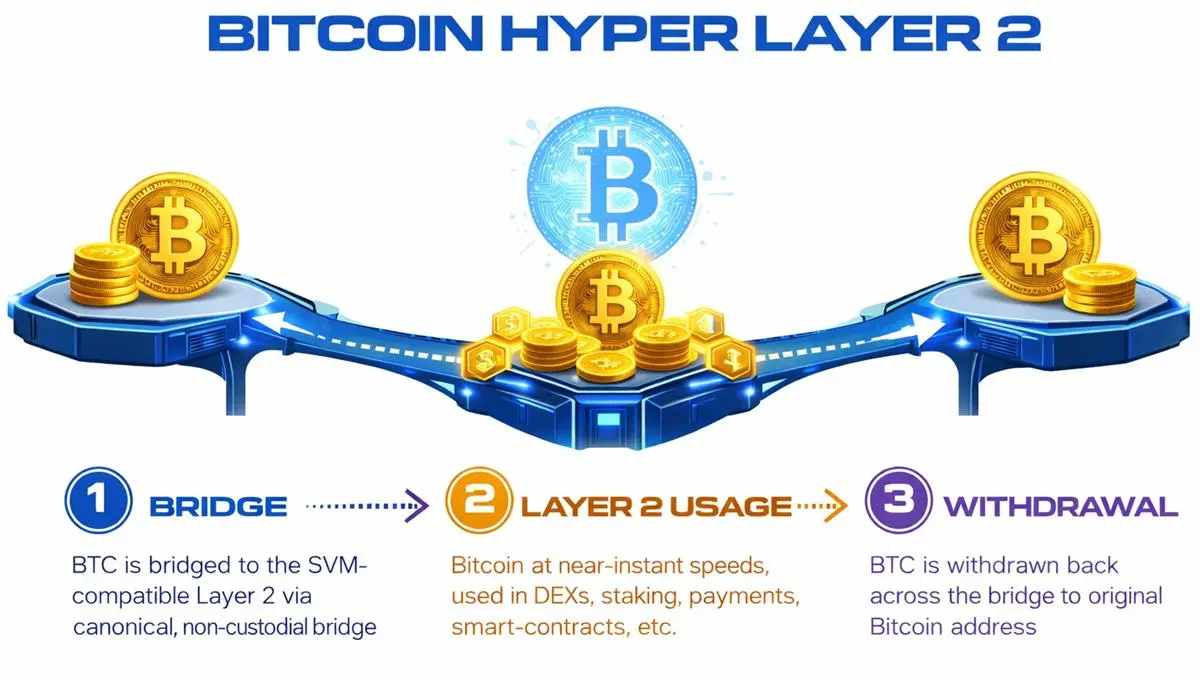
That takes BTC much closer to the currency role originally imagined for it, without asking the Bitcoin main chain to fundamentally change how it works.
Bitcoin Hyper also plans to use zero-knowledge proofs as part of the system for verifying activity between the execution environment and Bitcoin, where transactions are batched and then written back to the main chain. Developers can build applications around BTC rather than treating it simply as an asset sitting dormant in a wallet.
HYPER is priced at $0.01368 and has its own role – the Layer 2’s native gas token, paying for transactions and smart contract execution, while holders can also stake their tokens and participate in governance, with presale staking currently offering 35% APY.
HYPER is One of the Biggest Presales of 2026
The more eye-catching figure is the raise, more than $33 million has gone into HYPER before exchange trading begins, making Bitcoin Hyper one of the biggest crypto presales of 2026.
That level of funding suggests investors are interested in a Bitcoin story that goes far beyond waiting for BTC to appreciate. Holders want to use their Bitcoin, and are wondering whether it can be currency – free to move, rather than digital gold that remains in the vault.
None of this means Bitcoin’s price suddenly stops being important – its comeback is what has put BTC back at the center of attention. But Bitcoin Hyper is suggesting a new future for the most important cryptocurrency.
The reins are in Hyper’s hands. 🔥⚡️https://t.co/VNG0P4GuDo pic.twitter.com/ikQcDYWJXe
— Bitcoin Hyper (@BTC_Hyper2) August 27, 2026
HYPER’s smart contracts have undergone audits from Coinsult and SpyWolf, suggesting the project is progressing nicely toward launch.
Bitcoin’s first great achievement was becoming valuable – the next chapter is about making that value genuinely useful for payments, applications, and on-chain finance.
HYPER could be the project that directs where Bitcoin goes next – and is potentially the next crypto to explode as a result.