

 Some of the links on this site may be affiliate links. ICOBench may receive advertising commissions when users visit recommended platforms via our affiliate links, at no additional cost to you. All recommendations are based on a comprehensive review process.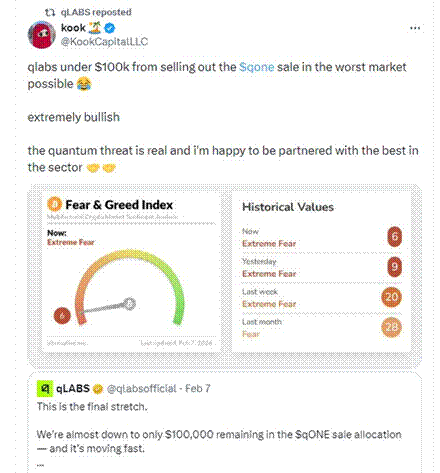
There’s a pattern in crypto that the best investors understand instinctively: the projects that define the next cycle are almost always born during the worst moments of the current one. Ethereum launched in the aftermath of the 2014 bear. Solana’s early days happened during the 2020 crash. Chainlink found its footing while most of the market was in despair. The common thread is that real infrastructure doesn’t need a bull market to justify its existence. It builds when no one is watching, and compounds when everyone finally pays attention.
$qONE fits this pattern almost perfectly. It sold out its entire $950K presale in under 24 hours while the crypto Fear & Greed Index sat at 6 out of 100 – one of the lowest readings in the history of the index. Now it’s live on Hyperliquid, listed on CoinMarketCap, and trading above its public sale price. The bear market didn’t slow it down. If anything, it filtered out the noise and left only conviction.
Bear Markets Filter for Quality
When the market is green, everything sells. Meme coins with cartoon logos raise millions. AI wrappers launch at $500M FDV. The signal-to-noise ratio drops to near zero. But when the Fear & Greed Index is in single digits, only projects with genuine substance attract capital. The speculators are gone. The tourists have left. What remains is conviction money – investors who are buying because they’ve done the work and believe in the fundamentals.
The $qONE presale attracted $13 million in registered demand during those conditions. The buyers who showed up weren’t chasing a green candle. They were underwriting a thesis: quantum computing will break blockchain cryptography, $4 trillion in assets are exposed, and qLABS is the only team with patented, NIST-approved, enterprise-deployed technology ready to protect them. When a project’s buyer base is built on conviction rather than FOMO, the foundation is fundamentally different.
The Credentials That Attracted Bear Market Capital
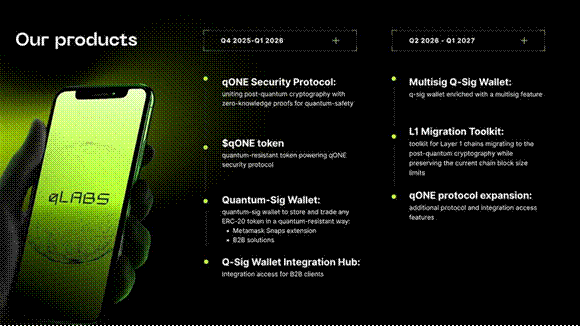
Conviction buyers don’t invest in promises. They invest in evidence. Here’s what $qONE put on the table:
- Publicly traded parent company: 01 Quantum Inc. (TSXV: ONE | OTCQB: OONEF). Auditable financials, regulatory oversight, real accountability. You can look up the stock ticker right now.
- Two U.S. patents: Patent 11,271,715 and Patent 11,669,833 protecting IronCAP™ post-quantum cryptography. This isn’t open-source code anyone can fork. It’s proprietary, patented infrastructure.
- Enterprise clients in production: Hitachi, PwC, Thales, and CGI. Not partnership announcements – live deployments of IronCAP™ technology.
- NIST-approved cryptography: The same post-quantum standards the U.S. government mandates for its own agencies.
- Named, verifiable team: Andrew Cheung (CTO, CEO of 01 Quantum), Antanas Guoga / Tony G (President, former EU parliamentarian), Ada Jonuse (Executive Director), Gintautas Nekrosius (CMO, $100M+ raised in previous launches).
This is not a typical bear market micro-cap. It’s institutional-grade infrastructure that happened to launch during a down market – which, historically, is exactly when the best entry points appear.
Where $qONE Stands Today
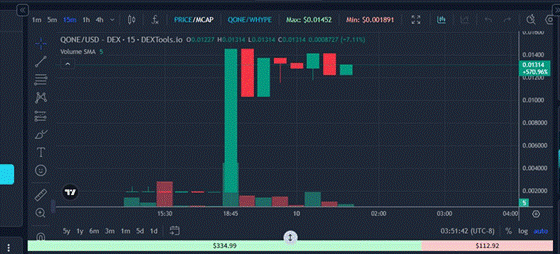
The TGE is complete. Tokens are claimed and trading. The price rallied 570% from its post-launch low of $0.00189 and is now consolidating in the $0.012–$0.014 range — above the $0.01 public sale price. The token is live on CoinMarketCap and DEXTools. Cryptonews, CoinSpeaker, 99Bitcoins, and The Quantum Insider have all covered the launch.
Looking ahead, the L1 Migration Toolkit ships by end of March. Additional exchange listings are in the pipeline. The Ethereum Foundation has made post-quantum security a strategic priority. CoinMarketCap’s Quantum-Resistant category is growing. And $qONE is trading at roughly $13M FDV against a $20 billion target market.
Every cycle, investors look back and wish they’d bought the infrastructure that mattered during the moments everyone else was afraid. Ethereum at launch. Solana under a dollar. Chainlink in obscurity. The projects that defined each cycle were available to anyone willing to look past the fear. $qONE is available right now, on Hyperliquid, at valuations that still reflect a one-week-old token – not the category-defining infrastructure it’s building.
CoinMarketCap: https://coinmarketcap.com/currencies/qone/
DEXTools Chart: https://www.dextools.io/app/hyperevm/pair-explorer/0xa96c8366828a22cc0e900f9b12273883a56ee148
Official Site:https://qlabs.tech/
Official X Account: https://x.com/qlabsofficial