


 Some of the links on this site may be affiliate links. ICOBench may receive advertising commissions when users visit recommended platforms via our affiliate links, at no additional cost to you. All recommendations are based on a comprehensive review process.
Jupiter is stripping another pain point out of moving money across blockchains, with the Solana trading platform launching Universal Deposit, which allows users to send supported crypto from Ethereum, Base, Arbitrum, Sui, or Solana and receive USDC on Solana through a single deposit flow.
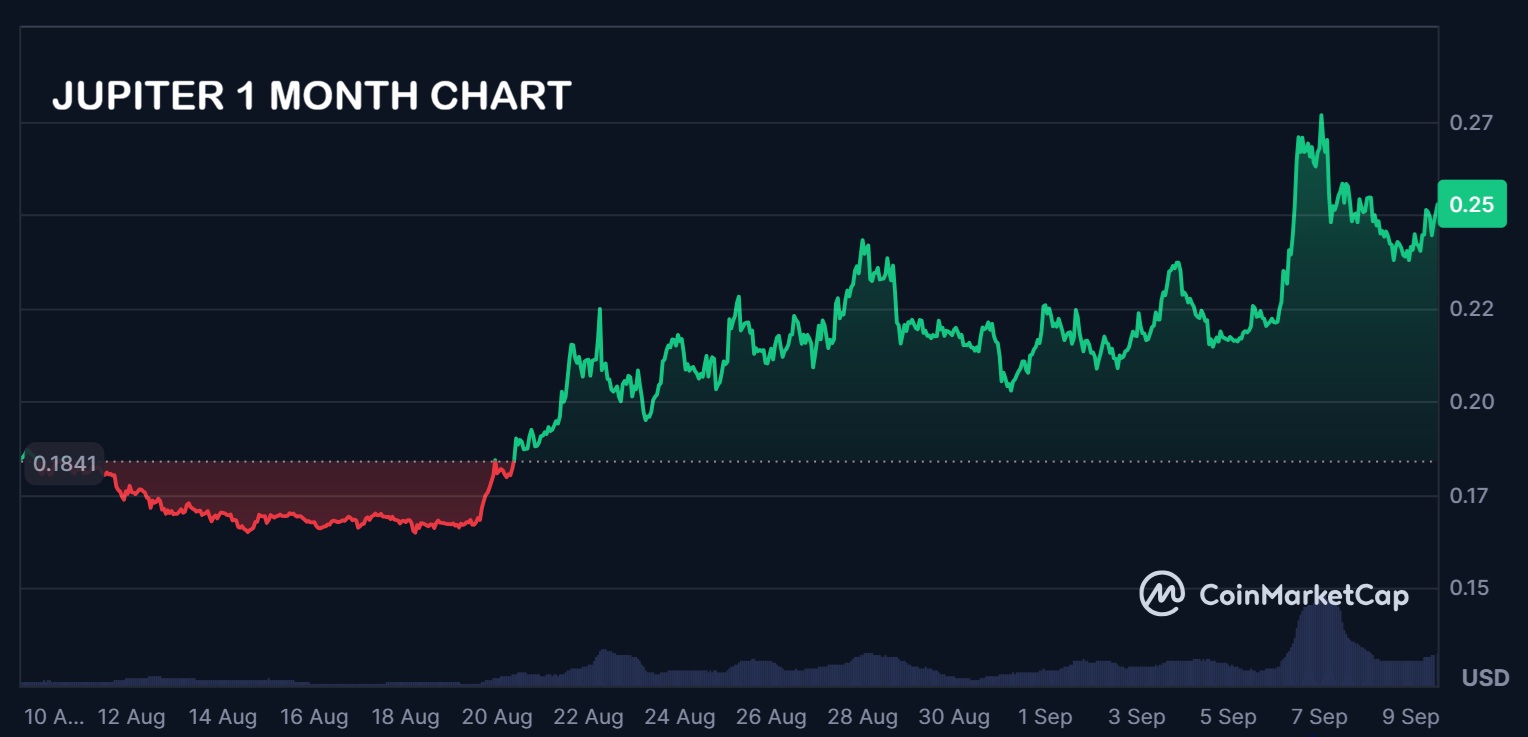
Jupiter handles the conversion and cross-chain routing behind the scenes, and the latest bow to its arrow has helped JUP trade at $0.25215, up 4.37% in 24 hours and 19.14% over seven days. Contrast that with Bitcoin, which is trading at $79,480.48 after a 3.45% weekly gain.
There is a bigger idea underneath Jupiter’s new feature: users don’t particularly want to understand bridges – they simply want their money to arrive.
It’s another reason to watch projects like LiquidChain (LIQUID), a Layer 3 designed to make Bitcoin, Ethereum, and Solana easier to use together, and another signal that the multichain future is the correct one.
Jupiter Shows Where Multichain Crypto Is Heading
Using several blockchains today requires the user to understand far too much about how they work, which is painful. You don’t need to understand how Amazon Cloud Services work to watch something on Netflix.
Want to move an Ethereum token onto Solana? First, find an appropriate bridge, then check which networks it supports, then work out what asset arrives on the other side. Then make sure there is enough gas – and perhaps swap the bridged token into the asset actually wanted afterward.
On Jupiter’s side, Universal Deposit compresses much of that into a single experience, with cross-chain deposits that automatically convert to USDC, while Universal Deposit currently supports Solana, Ethereum, Base, Arbitrum, and Sui.
It is good software design because the difficult part still happens, but the user simply does not have to orchestrate every step.
Crypto spent years celebrating the fact that anyone could bridge between networks. The next stage is making people forget they are bridging at all.
LiquidChain takes that principle beyond deposits into Solana.
LiquidChain Wants BTC, ETH, and SOL to Feel Like One Market
LiquidChain connects three of crypto’s biggest ecosystems through a shared Layer 3, with the whitepaper describing a cross-chain virtual machine and a unified proof system designed to coordinate activity across Bitcoin, Ethereum, and Solana.
That sounds technical, but the user benefit isn’t – it means users can access liquidity on BTC, ETH, and SOL from one place instead of manually hopping between chains, bridges, and separate apps.
So someone with capital in Bitcoin, Ethereum tokens, and positions on Solana should be able to manage that capital without thinking of it as three disconnected portfolios.
The Order rests. The architecture never sleeps. 👁️⟁https://t.co/vqvBcdSQYC pic.twitter.com/bNof4XHJ58
— LiquidChain (@getliquidchain) September 9, 2026
LiquidChain also uses atomic execution for connected multichain actions – several steps can be handled as one operation, rather than completing the first transaction and leaving the user stranded if something goes wrong later in the sequence. It’s like Jupiter’s offering, but on steroids, as everything is on one chain.
Developers also benefit from the same simplification: instead of building and maintaining separate versions of a product for Bitcoin, Ethereum, and Solana, integrating with LiquidChain provides access to all three.
In a sense, LiquidChain extends Jupiter’s idea to trading, liquidity, portfolio management, and other financial tools across several networks. What chain you are on can stop being important – just a background detail.
Is LIQUID the Next Crypto to Explode?
LIQUID remains early compared with Jupiter, which has become one of Solana’s central trading platforms, but that is what makes the presale interesting.
LiquidChain has raised $964,000 and is closing in on its first $1 million milestone, while LIQUID remains available for $0.0149 before public exchange trading.
LIQUID itself supports activity across the network, equivalent to gas fees. Presale staking currently offers a staggering 1,188% APY, although that rate will drop as more stakers join the ecosystem. SpyWolf and CertiK have reviewed the project.

The larger opportunity comes after the presale, when LiquidChain moves toward network deployment and exchange listings, and the project turns its technical design into something people can use.
Jupiter offers a useful glimpse of what that experience should look like – users will be able to deposit money, trade an asset, manage a portfolio, or use a financial product, without involving any cross-chain transactions. The blockchain underneath becomes an irrelevant implementation detail.
If multichain crypto becomes easier, the infrastructure that succeeds will probably be the infrastructure users barely notice.