


 Some of the links on this site may be affiliate links. ICOBench may receive advertising commissions when users visit recommended platforms via our affiliate links, at no additional cost to you. All recommendations are based on a comprehensive review process.
The global crypto market cap sits at $2.6 trillion today, and despite a modest pullback, Bitcoin’s dominance is currently 60.13%. The broader altcoin sector is showing signs of rotation.
The more interesting crypto coins are using the cultural cliches of the space (the Pepe frogs, the laser-eyed dogs, the internet-native branding) as a way to provide something with depth. That’s the move LiquidChain (LIQUID) is making – a meme coin shell but disguising a true ecosystem inside.
LiquidChain has raised $782,000 in its presale at a token price of $0.0146, with staking already live and an APY of ~1,390%. The staking figure alone has driven significant early engagement, with holders locking in before any exchange listing and earning yield while they wait.
But what LiquidChain really is is a Layer 3 that connects the major chains.
What LiquidChain Actually Does
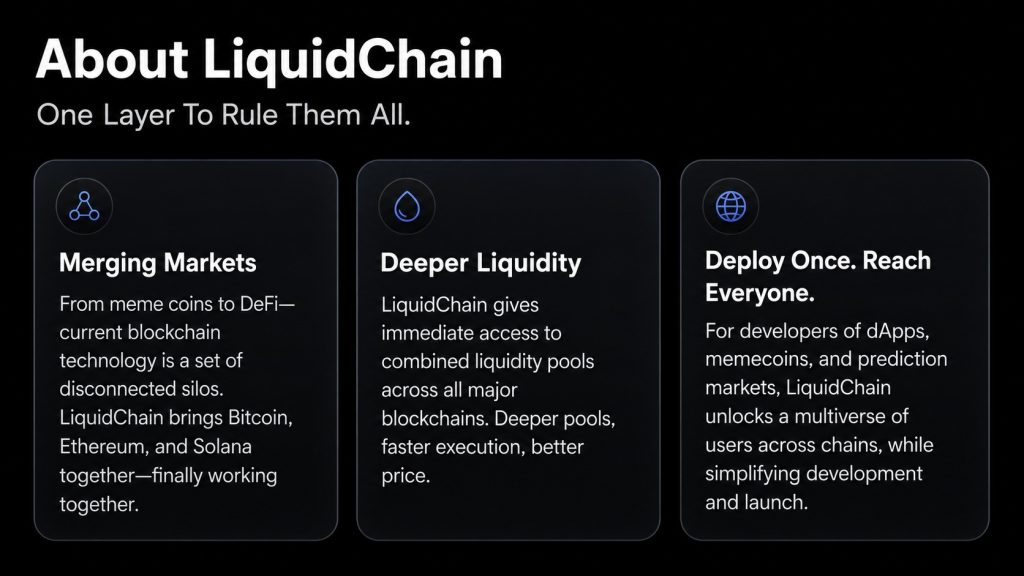
LiquidChain is built as a Cross-Chain Layer 3 (L3) that combines liquidity from Bitcoin, Ethereum, and Solana into a single execution environment. The core problem it’s solving isn’t a small one: Bitcoin, Ethereum, and Solana each dominate separate verticals (like store of value, DeFi depth, and transaction speed), yet their liquidity is effectively siloed from each other.
Multi-chain transactions require bridges, swaps, and multiple steps, all of which are slow and costly, and can be risky. Users currently need to rely on wrapped assets, centralized custody risks, and synthetic token vulnerabilities. Meanwhile, developers building dApps for multiple ecosystems must maintain separate codebases and liquidity integrations.
Built differently. Moving accordingly 👁⟁https://t.co/vqvBcdSQYC pic.twitter.com/Ij2V9s94Pz
— LiquidChain (@getliquidchain) May 21, 2026
This is what LiquidChain is trying to get rid of: building a Unified Liquidity Layer that aggregates liquidity from BTC, ETH, and SOL into a single market, enabling users to carry out cross-chain transactions in one atomic operation. Settlement is verifiable on-chain, removing wrapped asset risk, and developers can deploy once to reach users across all chains.
Instead of bridging assets, LiquidChain operates across all the major chains at once – that’s the basis of a Layer 3 protocol. It uses existing network validators and consensus mechanisms, while introducing a new settlement layer optimized for cross-chain execution. The smart contracts have already been audited by both SpyWolf and CertiK.
So, in effect, users can see the majority of crypto’s liquidity in one environment, and developers can code once and access all the major chains. LiquidChain effectively has access to trillions of liquidity the moment it launches.
The LIQUID token powers the ecosystem through liquidity staking, transaction fees, and developer grants used to bootstrap ecosystem applications.
Why LIQUID Could Be a 100X Crypto After Exchange Listings
LIQUID is set to debut on decentralized exchanges prior to mainnet launch, with centralized listings targeted for later in 2026. Projects that arrive on centralized exchanges with verified audit credentials, a live staking product, and an already-funded treasury tend to get listed faster and at higher initial valuations, and LiquidChain has all three.
The meme-like branding is also a deliberate strategy. The whitepaper imagery of Pepe, a hooded Shiba, a laser-eyed penguin, all of which speak directly to the demographic that drives presale momentum and social amplification.
But beneath that layer, the infrastructure aims to address a real, unsolved DeFi problem of fragmentation across over $1.5 trillion in liquidity across Bitcoin, Ethereum, and Solana, across incompatible chains. If LiquidChain executes on its roadmap, the addressable market is every protocol, developer, and institutional desk currently losing efficiency to cross-chain friction.
The $782,000 raised so far represents early conviction, not peak momentum. And yet a 100x from here is less than $75 million, which is a low number for a protocol with such a large market. If LiquidChain maximizes chain efficiency, long-term targets will be much higher.
The Early-Entry Window Is Closing
LiquidChain is a relatively new presale, but it is moving fast, with listings and mainnet expected this year. The staking APY will shrink as more tokens enter the system, but right now, it is a great use for tokens while we wait for the full launch.