Some of the links on this site may be affiliate links. ICOBench may receive advertising commissions when users visit recommended platforms via our affiliate links, at no additional cost to you. All recommendations are based on a comprehensive review process.
Bitcoin is trading at $77,477.64, down 4.15% over the past seven days. Ethereum sits at $2,128.25, essentially flat on the day (+0.02%) but down 7.76% on the week. Meanwhile, a debate that has been years in the making remains unresolved: Bitcoin holds the lion’s share of the market’s value, yet the trillions of value locked in it are effectively inert due to slow transaction times.
Bitcoin can handle around 7 transactions per second, which is not much for buying a coffee or a pair of jeans in a shop. It is a bottleneck that prevents BTC’s adoption for real-time or high-volume use cases.
Meanwhile, Ethereum and Solana snatched the DeFi and real-world payments narrative away from Bitcoin, with Solana allowing thousands of transactions per second. Bitcoin remains a store of value that most people hold rather than spend, and it’s nowhere near Satoshi’s original vision of peer-to-peer electronic cash.
That’s the game Bitcoin Hyper (HYPER) is looking to fix – and it’s been a massive presale so far, raising $32.7 million, with $HYPER currently priced at $0.01368 and staking live at 36% APY.
Those figures – particularly the fundraising total – put it among the more heavily backed launches of the year.
How Bitcoin Hyper Thinks About Payments
Bitcoin Hyper is designed to overcome Bitcoin’s core limitations: slow transaction speeds, high fees, and limited programmability. While Bitcoin remains the most secure blockchain, it struggles with speed, cost, and flexibility – and is unsuitable for modern decentralized applications.
So, HYPER introduces a Layer 2 solution that processes transactions with extremely low latency, thereby drastically improving speed and lowering costs. By integrating the Solana Virtual Machine (SVM), the project brings fast, scalable smart contracts to the Bitcoin ecosystem.
How life starts looking when it's powered by $HYPER. 🔥⚡️https://t.co/VNG0P4GuDo pic.twitter.com/f6LyqA8Myv
— Bitcoin Hyper (@BTC_Hyper2) May 19, 2026
The decision to use the SVM is deliberate – rather than build a new execution environment from scratch, the project imports battle-tested infrastructure that already supports the kind of high-throughput DeFi and payments applications that Bitcoin needs.
Users can move their Bitcoin into the Bitcoin Hyper ecosystem and withdraw back to native BTC at any time, via a non-custodial bridge, so users retain control of their assets throughout. Then users (and developers) achieve Solana-like transaction speeds while still settling on Bitcoin’s secure network.
The Bitcoin Hyper Layer 2 environment is powered by its own validator network, which uses a Proof-of-Stake (PoS) model. This ensures that all transaction processing, smart contract execution, and off-chain computation within the Bitcoin Hyper network remains energy-efficient and environmentally sustainable.
Smart contracts have been audited by Coinsult and SpyWolf, and the HYPER token supply is fixed at 21 billion.
Why HYPER Could Be the Next 100X Crypto Opportunity in This Market
The Bitcoin Layer 2 space is significantly less crowded than its Ethereum equivalent. That’s partly because it’s harder to build on: Bitcoin’s base layer intentionally limits programmability and provides no native support for smart contracts or decentralized applications.
Developers are forced to build around these limitations, leading to fragmented, clunky solutions or total reliance on other blockchains for programmability. Bitcoin Hyper‘s SVM integration is a direct answer to that, and if it delivers, the addressable market is substantial. Bitcoin’s market cap is roughly six times Ethereum’s at current prices, yet it hosts a fraction of Ethereum’s on-chain activity.
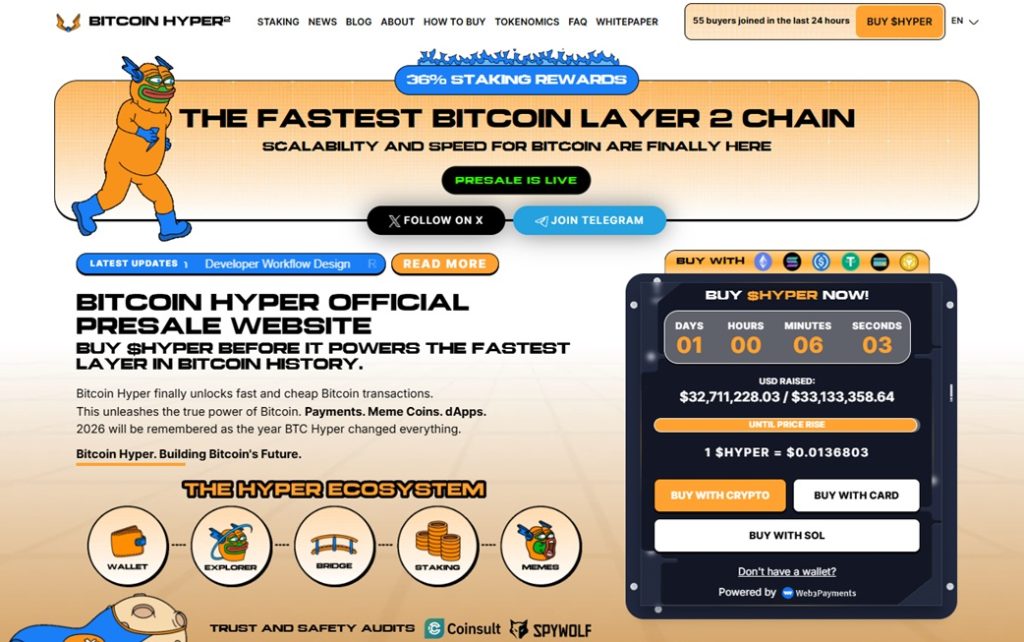
The Bitcoin Hyper ecosystem will support high-speed payments in wrapped BTC, DeFi applications such as swaps, lending, and staking, and NFT platforms and gaming dApps.
Mainnet deployment is targeted for later in 2026, with exchange listings and a developer toolkit to follow.
Anyone looking for the next 100x crypto narrative in 2026 is increasingly pointing toward Bitcoin utility plays – and Bitcoin Hyper is the most funded pure Layer 2 bet currently in presale.
The Payment Problem Is Bitcoin’s Oldest Unsolved Issue
Bitcoin has been trying to fix its payment problem since 2015. The Lightning Network made progress on micropayments but never achieved mainstream adoption.
What Bitcoin Hyper is building is architecturally different: full smart contract support, Solana-grade execution speed, and a bridge that keeps users inside the Bitcoin ecosystem without routing value through a third-party chain.
If HYPER returns Bitcoin to Satoshi’s original goals, this project could be one we’re all talking about next year.