


 Some of the links on this site may be affiliate links. ICOBench may receive advertising commissions when users visit recommended platforms via our affiliate links, at no additional cost to you. All recommendations are based on a comprehensive review process.
Crypto isn’t exactly known for rewarding patience. In the short term, it’s all about timing – catching the right rally, stepping aside before the pullback, moving on to the next narrative. That way of thinking makes sense if you’re trading day to day, and it won’t do you any good if you’re holding assets you don’t plan to touch for years.
That tension between short-term thinking and long-term reality is the space BMIC ($BMIC) is trying to work in.
The project isn’t chasing momentum or headlines. On the contrary, it was built around the question: what does crypto custody look like over decades, not just the next cycle? That perspective is why BMIC has started appearing in discussions about the best crypto presales to buy among investors who prioritize infrastructure over hype.
Custody Has Quietly Become the Biggest Risk Surface
Not that long ago, wallets had a pretty straightforward job. You held your assets, signed a transaction when needed, and that was it. Now they’re involved in almost everything – getting into DeFi, voting on proposals, holding NFTs, managing identity, and even connecting to AI-driven tools. At the same time, people are keeping more value on-chain and holding it there for much longer, often across several networks.
Combine those two things, and the risk picture changes because a wallet is no longer just a piece of software. The wallet now becomes a long-term security anchor. If something goes wrong at that level, the fallout doesn’t stop at a single transaction — it ripples through everything tied to it.
That’s the starting point for BMIC’s thinking, not charts or short-term price moves.
Why Long-Term Security Is Being Revisited Now
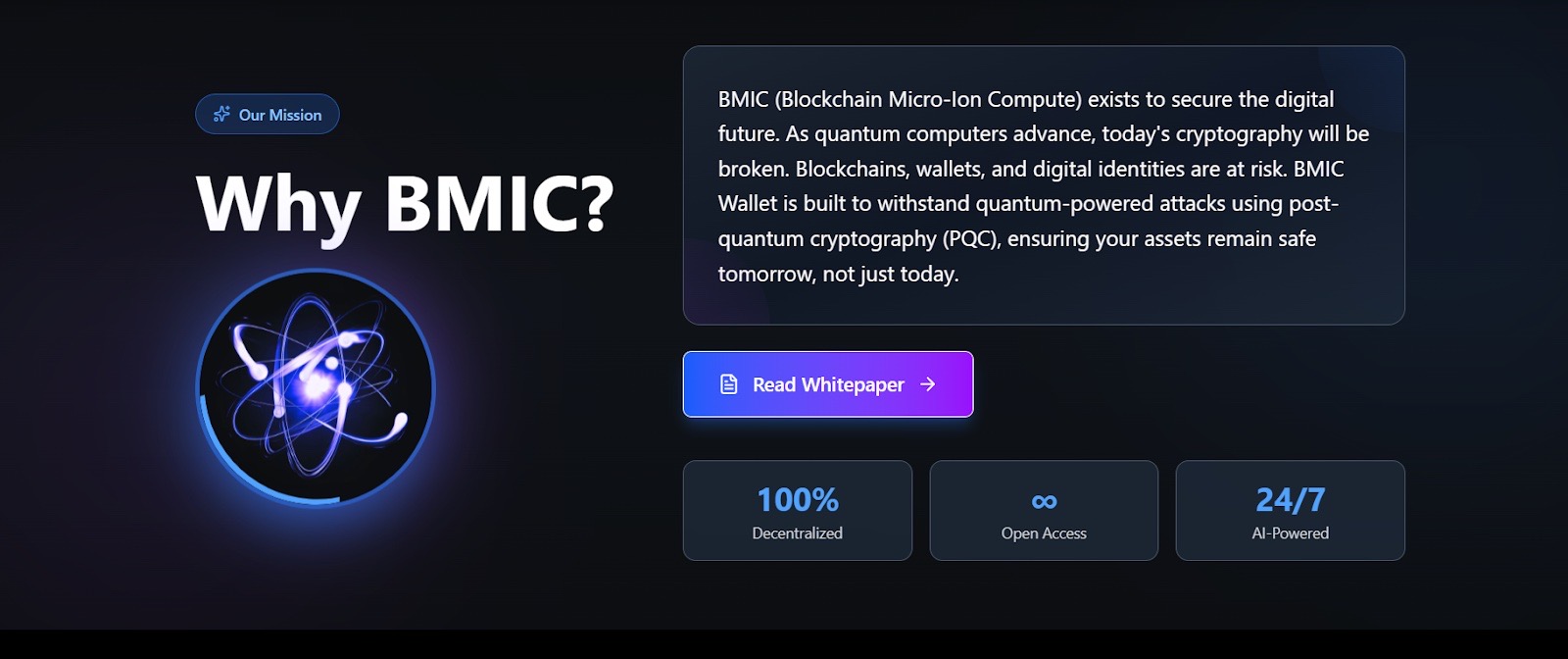
Quantum computing isn’t an immediate threat to blockchains, but it has altered the way long-term security planning is discussed. Standards bodies have already begun preparing for a post-quantum world, signaling that today’s cryptographic assumptions won’t last forever.
There’s still no public evidence of quantum computers breaking real-world blockchain encryption at practical key sizes. The issue isn’t urgency — it’s durability. Systems built today need to survive environments that don’t exist yet.
For long-term holders, that context matters more than most market narratives.
How BMIC Approaches the Problem
BMIC doesn’t frame itself as a breakthrough that replaces everything overnight. Instead, it takes a layered approach. Based on the project’s own materials and third-party coverage, BMIC is building a wallet architecture designed to combine existing encryption with quantum-resistant methods over time.
The structure is meant to be modular. Rather than forcing users to migrate assets whenever standards change, cryptographic components can be updated as the threat landscape evolves. It’s a slow-burn approach, but one that fits the problem BMIC is addressing.
The BMIC token sits inside that system, intended to support security services, staking mechanisms, and access to future compute-related features. In practice, the project treats security as something ongoing – not a one-time setup.
Why This Isn’t About “Beating” Hardware Wallets
Everything we previously said isn’t an argument against hardware wallets. On the contrary, devices like Ledger solved real problems and still do. They were built around assumptions that made sense at the time: isolation, trusted cryptography, and minimal change beyond firmware updates.
However, the challenge is that the environment has changed since then. Wallets now function as gateways, not just vaults. With that being said, when the old security models don’t evolve alongside that shift, cracks start to show – not immediately, but eventually.
BMIC’s thesis is that custody tools should evolve at the same pace as the ecosystems they protect.
Crypto Presale Overview
The BMIC’s presale has stages, with pricing increasing gradually as each phase fills. At the time of writing, the presale has raised just over $300,000, and $BMIC is priced at $0.048881.
The project states that the total token supply is fixed at 1.5 billion tokens, with no mechanism to increase it. Fifty percent of the supply is allocated to the public presale.
The remaining allocation is spread across staking and rewards, liquidity and exchange listings, ecosystem reserves, marketing, and a relatively small team allocation that is subject to vesting.
Why BMIC Could Easily Be the Best Crypto to Buy Now – Verdict
Most crypto projects optimize for attention. BMIC optimizes for time.
Whether that approach pays off will depend on how well the team executes and how the security landscape evolves.
But for investors who think about where crypto infrastructure needs to be ten years from now — not just next quarter — BMIC is a presale worth understanding.
Official BMIC links
Presale: https://bmic.ai/
Social: https://x.com/BMIC_ai
Telegram: https://t.me/+6d1dX_uwKKdhZDFk