


 Some of the links on this site may be affiliate links. ICOBench may receive advertising commissions when users visit recommended platforms via our affiliate links, at no additional cost to you. All recommendations are based on a comprehensive review process.
While Bitcoin hovers in a consolidation pattern that has tested the patience of institutional holders, there are always fireworks in the market, especially among altcoins. Monero (XMR) and Toncoin (TON) are both up by about 7% this week, driven by continued market appetite for privacy and integrated social payments.
But the real story is the move toward a new sector that didn’t exist in earnest two years ago: high-performance Bitcoin Layer 2s.
Analysts have spotted an influx of investor money into Bitcoin Hyper (HYPER), a project that has quietly raised $31.8 million in what is shaping up to be the largest presale event of 2026. For the last three years, Bitcoin has effectively been valuable, secure… and totally incapable of doing anything interesting.
While Ethereum and Solana built empires of decentralized finance (DeFi), payments, and high-speed trading, Bitcoin remained a passive store of value. Bitcoin Hyper is promising to change that when it launches this year.
The project is currently priced at $0.0136765, with a staking APY of 37%, and the near-$32 million raised shows market demand for Bitcoin’s future to be beyond “digital gold”.
Solana Virtual Machine Meets Bitcoin Security
The primary criticism of previous Bitcoin layers, like the Lightning Network or early sidechains, was that they were clunky. They required specialized knowledge, suffered from latency issues, or simply didn’t support the kind of smart contracts that power modern DeFi.
Bitcoin Hyper goes for an effective technical choice by integrating the Solana Virtual Machine (SVM) directly as a Layer 2 on top of Bitcoin.
This architecture allows Bitcoin Hyper to process transactions at speeds that rival Solana, thousands of transactions per second, while settling the final state back to the Bitcoin blockchain. By using the SVM, developers can port existing applications from the Solana ecosystem over to Bitcoin with minimal friction. For instance, a decentralized exchange that runs smoothly on Solana should be able to run on Bitcoin Hyper, denominated in BTC, without the user ever needing to touch a separate chain.
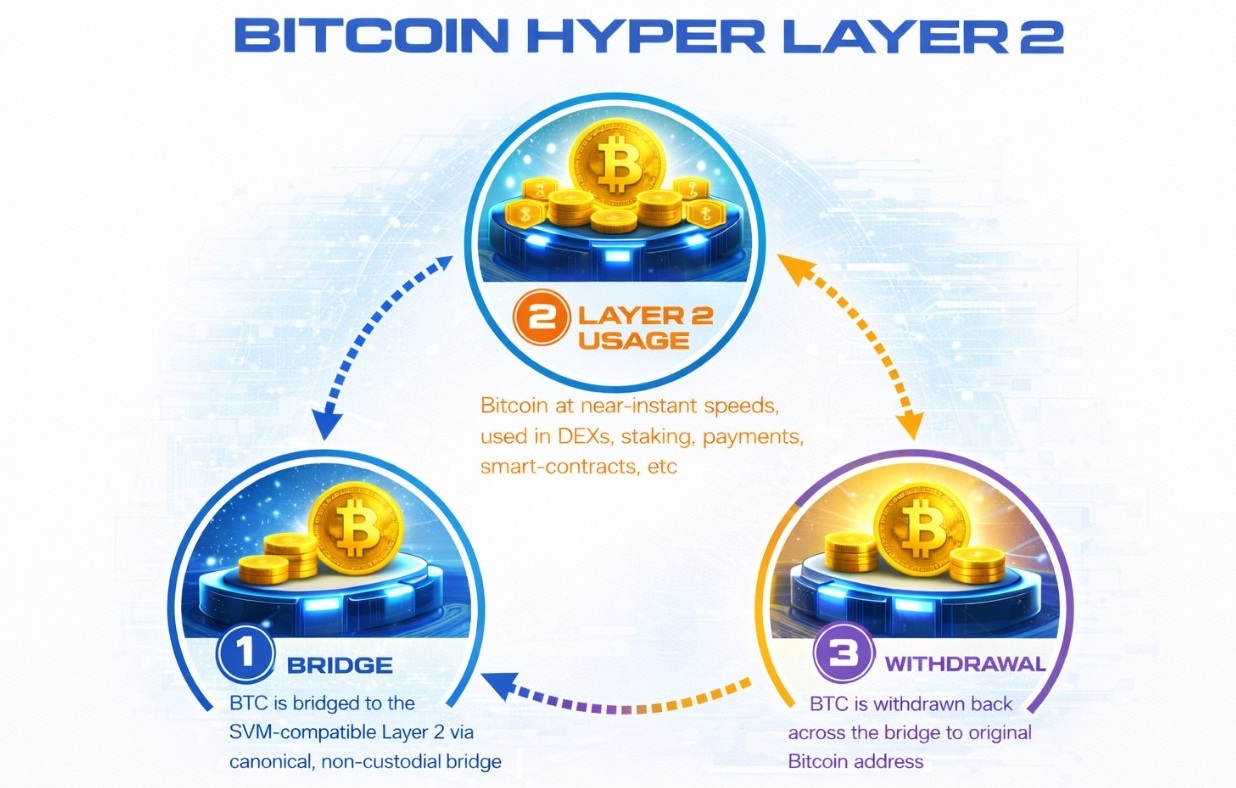
In essence, users can deposit native BTC into a canonical bridge, which locks the asset on the main chain and mints a wrapped equivalent on the Hyper L2. This wrapped Bitcoin is fully programmable and can be staked, lent, used as collateral for derivatives, or swapped in milliseconds. Thousands of these high-speed transactions are then batched into a single cryptographic proof that is periodically posted back to the Bitcoin mainnet.
So while the execution is fast and off-chain, the final settlement inherits the security guarantees of the Bitcoin network itself.
The project has undergone full audits by Coinsult and SpyWolf, a necessary step that, among other things, suggests the launch and exchange listings are close. The audits confirmed the integrity of the smart contracts, specifically the minting authority and the bridge mechanics, giving institutional desks the green light to allocate.
Why 2026 Favors the “High-Performance” Narrative
The timing of Bitcoin Hyper’s rise correlates with a broader fatigue in Ethereum. Gas fees on Ethereum L1 remain unpredictable, and while L2s like Arbitrum and Optimism alleviate some pressure, liquidity remains fragmented. In contrast, Bitcoin holds over $1.5 trillion in idle capital, untapped.
Analysts such as Borch Crypto predict that as the mainnet goes live and the first wave of “Bitcoin DeFi” applications launch, the demand for the HYPER token, which is used for gas and governance, could trigger a supply squeeze, making it one of the best altcoins to buy right now.
Furthermore, the resurgence of Monero and Toncoin this week signals a market rotation into functional crypto. Monero’s gains are being driven by privacy advocates pushing back against new surveillance mandates in the EU, while Toncoin is rallying on the back of payments within Telegram.
Both movements suggest that utility is driving price action, and Bitcoin Hyper fits this trend perfectly. It offers the utility of a high-speed smart contract platform with the monetary premium of Bitcoin.
If the project delivers on its roadmap, the $31.8 million raised so far could be the floor rather than the ceiling, especially as the presale pricing of $0.0136765 offers a low barrier to entry for retail investors who feel priced out of SOL or ETH.
The Verdict: What To Buy Next
Projects that launch with vague promises and no product fit are punished quickly. Bitcoin Hyper has raised substantial capital by addressing the single largest inefficiency in the crypto market: the lack of programmability for Bitcoin.
While Monero and Toncoin are enjoying their moment in the sun, they are ultimately playing in smaller sandboxes. Bitcoin Hyper is seeking to unlock liquidity for the largest asset in the digital asset class.
The $31.8 million already committed suggests that investors believe the reward is worth the risk.