


 Some of the links on this site may be affiliate links. ICOBench may receive advertising commissions when users visit recommended platforms via our affiliate links, at no additional cost to you. All recommendations are based on a comprehensive review process.
The global crypto market cap sits at $2.28T today, with Ethereum (ETH) trading up 9.46% in the past 24 hours – its most sustained move in months. Bitcoin (BTC) has held more conservative ground, up 4.34% on the day.
In turn, it set off a sea of green candles across crypto, with ZEC, NEAR, JUP, XLM and AERO seeing between 15% to 49% gains in 24 hours.

But what next for the big dog? Bitcoin, the world’s largest crypto asset by market cap at $1.24T, only processes around 7 transactions per second on its base layer. So it’s original aim of being a daily currency feels, 17 years on… ambitious.
Because Bitcoin was never designed for speed, scalability, or programmability, so on-chain Bitcoin transactions often take several minutes to confirm, and during periods of high demand, fees can spike dramatically.
It means the payments ambition – fast, cheap, global – quietly moved to Ethereum, then Solana, leaving Bitcoin’s base chain largely behind. The question no one has answered convincingly until now is whether Bitcoin’s security and brand can be reunited with real-world utility.
That’s the specific problem Bitcoin Hyper (HYPER) was built to solve, and why an astonishing $32.8 million has entered the presale, with early stakers earning 36% APY, and the token is currently priced at $0.01368.
With the Layer 2 space on Bitcoin drawing serious attention, Bitcoin Hyper is looking like the next crypto to explode.
How Bitcoin Hyper Actually Works
Bitcoin Hyper operates as a high-performance, low-latency Layer 2 blockchain. Transactions are executed in a highly optimized L2 virtual machine and later settled on the Bitcoin Layer 1, enabling high-throughput, low-cost settlement without congesting the base network. The architecture borrows intelligently from Solana – arguably the fastest production environment in crypto.
By integrating the Solana Virtual Machine (SVM), Bitcoin Hyper brings the performance and developer experience of Solana to the Bitcoin ecosystem – something unthinkable on native Bitcoin. Developers who already know Rust and the SVM toolchain can build here without relearning an entirely new system.
Big sky. Big view.
Bigger things loading for Hyper. ⚡️🔥https://t.co/VNG0P4GuDo pic.twitter.com/EURUyWMjGB
— Bitcoin Hyper (@BTC_Hyper2) June 15, 2026
The security model is Bitcoin’s own proof-of-work for final settlement, with a Proof-of-Stake validator layer handling L2 computation – energy-efficient by design. In short, transactions on the L2 are later batched up, compressed, and sent off to the L1 for ledger keeping.
Smart contract audits have been conducted by Coinsult and SpyWolf.
The tokenomics allocate 30% to development, 25% to treasury, 20% to marketing, 15% to rewards, and 10% to exchange listings, with the mainnet launch targeted for later in 2026.
Why HYPER Could Have a Bullish Second Half of 2026
Token listings are targeted for 2026, aligned with the completion of the presale, which puts the next stage of the project on a very near-term horizon.
What makes HYPER plausible as the next crypto to explode in the Layer 2 sector is less about hype mechanics and more about market position. Ethereum’s Layer 2 ecosystem – Arbitrum, Optimism, Base – is crowded, mature, and increasingly competitive.
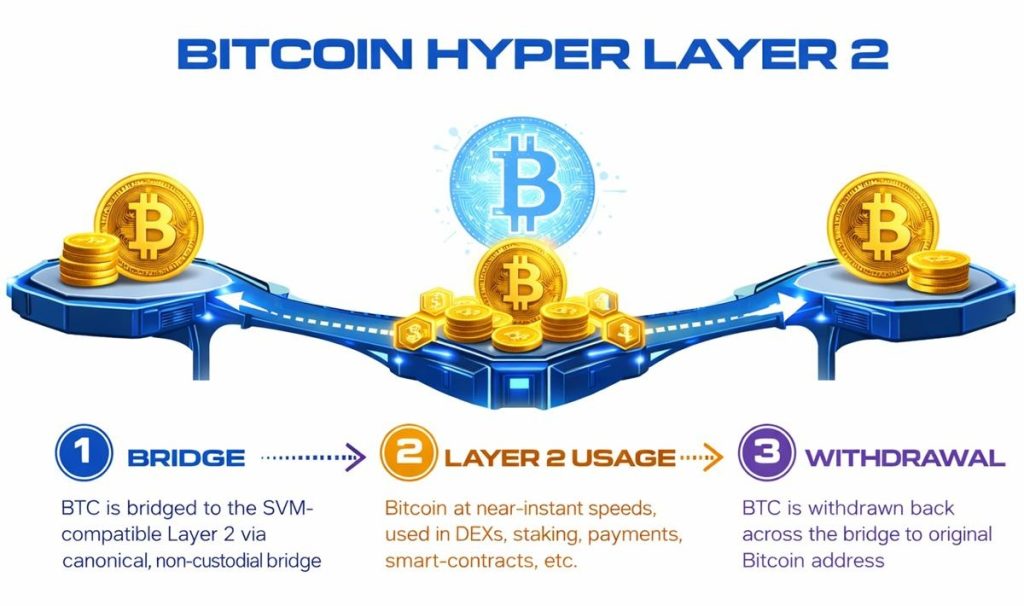
Bitcoin’s Layer 2 landscape is almost entirely open, and the speed problem HYPER is tackling is real. The addressable market for a fix is enormous: Bitcoin’s user base, its liquidity, and its institutional credibility, none of which Ethereum or Solana can claim at the same scale.
The ecosystem Bitcoin Hyper supports includes high-speed payments, DeFi applications such as swaps, lending, and staking, NFT platforms and gaming dApps, and developer tools for building scalable smart contracts in Rust. If HYPER does little more than bring payments back to Bitcoin, it will be one of the loudest protocols of the next bull run.
Returning to the Original Idea
There’s something significant about what Bitcoin Hyper is attempting. Satoshi’s 2008 whitepaper described BTC as a “peer-to-peer electronic cash system,” not a digital commodity to be stored and revered. The base chain’s 7 TPS ceiling didn’t kill that vision, but it deferred it indefinitely.
Bitcoin Hyper reimagines what’s possible on the Bitcoin network by introducing a scalable, fast, and programmable Layer 2 ecosystem – without compromising Bitcoin’s core security principles. It’s a return to the original idea, built with tools that didn’t exist in 2008.