


 Some of the links on this site may be affiliate links. ICOBench may receive advertising commissions when users visit recommended platforms via our affiliate links, at no additional cost to you. All recommendations are based on a comprehensive review process.
The narrative of 2026 hasn’t been about new chains killing old ones, but about waking the sleeping giant. For years, more than a trillion dollars in Bitcoin sat idle, treated as digital gold that you hold but never use.
But the market is currently waking up to Bitcoin Layer 2 solutions, and the idea that the liquidity trapped on the main chain could be usable. Bitcoin Hyper (HYPER) has become one of the largest presales of the year by leading the narrative.
While crypto struggles with a confidence issue, Bitcoin Hyper has raised $31.6 million by promising to solve the speed, security, and cost issues associated with BTC. HYPER is currently priced at $0.0136762, and for those willing to lock their assets early, the protocol is offering a staking APY of 37%.
HYPER investors are betting that the friction of using BTC (primarily slow block times and high fees) is the only thing holding it back from dominating decentralized finance (DeFi) the way Ethereum has.
The SVM Difference: How Bitcoin Hyper Works
Most attempts to scale Bitcoin have followed a predictable path: build a sidechain or try to fit Ethereum’s Virtual Machine (EVM) onto Bitcoin’s architecture. Bitcoin Hyper has taken a different, more technical route. It integrates the Solana Virtual Machine (SVM) as its execution layer while using Bitcoin for settlement and security.
Ethereum’s EVM is the industry standard, but it is not the fastest engine for high-frequency trading or complex applications. The SVM is designed for parallel processing, enabling throughput that dwarfs that of traditional EVM Layer 2s. By anchoring to Bitcoin, HYPER aims to offer the best of both worlds: the security of Bitcoin and the speed of the fastest chain.
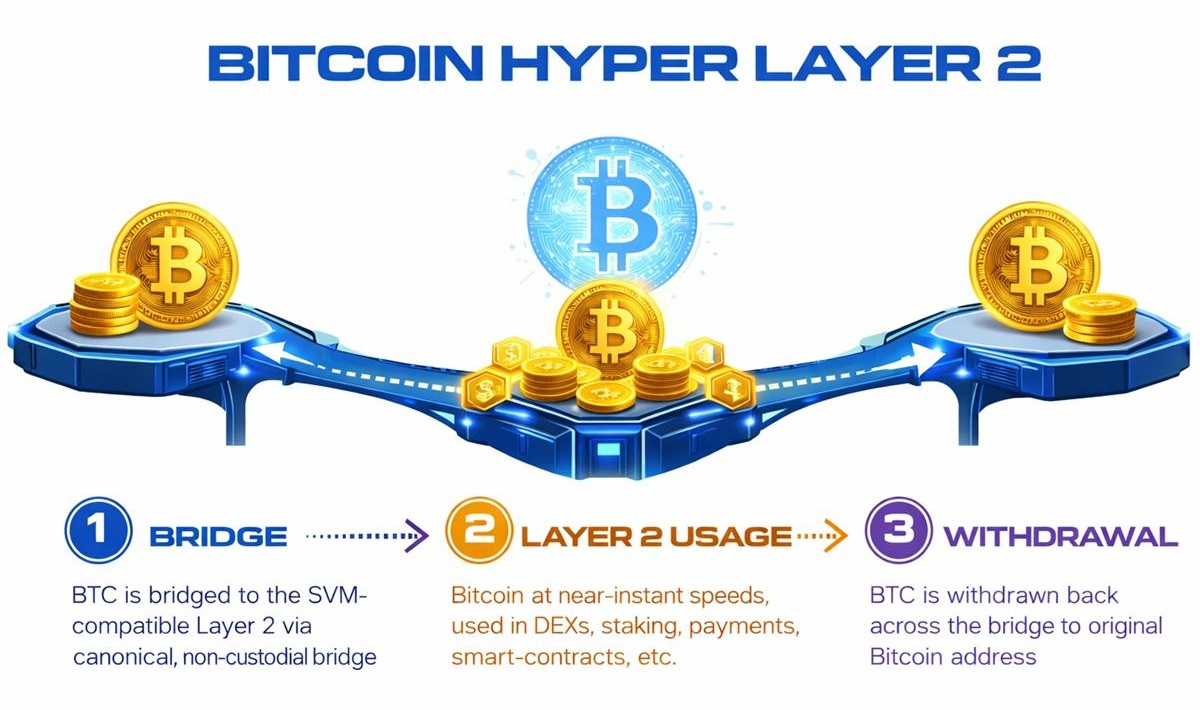
The mechanics rely on a Canonical Bridge. Users deposit native BTC into a designated address on the main network. A smart contract, the Bitcoin Relay Program, verifies the transaction headers and proofs. Once verified, the protocol mints an equivalent amount of wrapped assets on the Bitcoin Hyper Layer 2.
This allows users to transact, trade, and interact with dApps with sub-second finality and costs of a fraction of a cent, while the ledger’s truth remains secured by Bitcoin’s proof-of-work.
Why 2026 Could Be the Year of the L2
The bullish case for Bitcoin Hyper relies on a simple comparison with the Ethereum ecosystem. Look at Optimism or Arbitrum. These Layer 2s didn’t just scale Ethereum; they unlocked billions in value that was previously priced out of the main chain. They created entire economies of lending, borrowing, and trading that simply couldn’t exist on Layer 1.
Bitcoin Hyper aims to do exactly this, but for a market cap three times that of Ethereum’s. It won’t take much TVL moving over to HYPER to make this the most talked-about ecosystem in 2026.
Experts such as Borch Crypto have already highlighted how big HYPER can get, calling the project “huge” and potentially a game-changer for Bitcoin itself.
The fact that Bitcoin Hyper has raised nearly $32 million without a major exchange listing suggests that investors are ready for the public launch.
Technical But Achievable
Bitcoin Hyper is attempting a difficult engineering feat, but the market has clearly voted with its wallet. Raising over $31 million in a presale environment is rare and indicates a high degree of confidence in the team’s SVM-on-Bitcoin approach.
If the protocol delivers on its promise to bring Solana-level speed to the Bitcoin network, it will be a critical piece of infrastructure for the entire crypto economy.
Visit Bitcoin Hyper Presale