


 Some of the links on this site may be affiliate links. ICOBench may receive advertising commissions when users visit recommended platforms via our affiliate links, at no additional cost to you. All recommendations are based on a comprehensive review process.
The Law of Large Numbers has turned former crypto giants into slow-moving behemoths where, if you buy a project with a $5 billion market cap, you effectively need $5 billion in fresh capital just to see a 2x return.
So investors looking for the kind of aggressive, portfolio-defining returns that characterized the early 2020s are no longer looking at the top 20. They are looking for infrastructure plays that haven’t yet priced in their utility.
The shift is currently centered on a specific narrative: unlocking dormant liquidity in Bitcoin. While Ethereum has been sliced and diced by a dozen Layer 2s, Bitcoin has remained largely a store of value: relatively secure, but static. But a Bitcoin Layer 2 that can make BTC actually useful for payments and DeFi use would be a massive deal across crypto: something that can successfully bring DeFi speeds to Bitcoin’s security.
Leading the way is Bitcoin Hyper (HYPER), a project that has already raised $31.4 million in its ongoing presale, aiming to bring the speed of Solana to the security of Bitcoin.
At its current price of $0.0136757, the project has attracted significant whale attention not just for its tech stack but also for its staking protocol, which offers a 37% APY. It is an aggressive entry into a sector that many analysts believe will define the 2026 bull run, making it our choice for the best crypto to buy now.
The HYPER Engine: Solana Virtual Machine Meets BTC
The technical architecture of Bitcoin Hyper is what separates the project from the “wrapper” tokens of the previous cycle. Most attempts to scale Bitcoin have involved sidechains, whereas HYPER integrates the Solana Virtual Machine (SVM) directly as a Layer 2 execution environment.
Here is how it works: Bitcoin’s base layer is incredibly secure, but it is slow, processing roughly 7 transactions per second (TPS). It is a settlement layer, not an execution layer. Bitcoin Hyper acts as the high-speed execution layer on top. Users deposit native Bitcoin into a “Canonical Bridge,” a trustless vault that locks the asset on the main chain. In return, they receive a 1:1 pegged asset on the Bitcoin Hyper network.
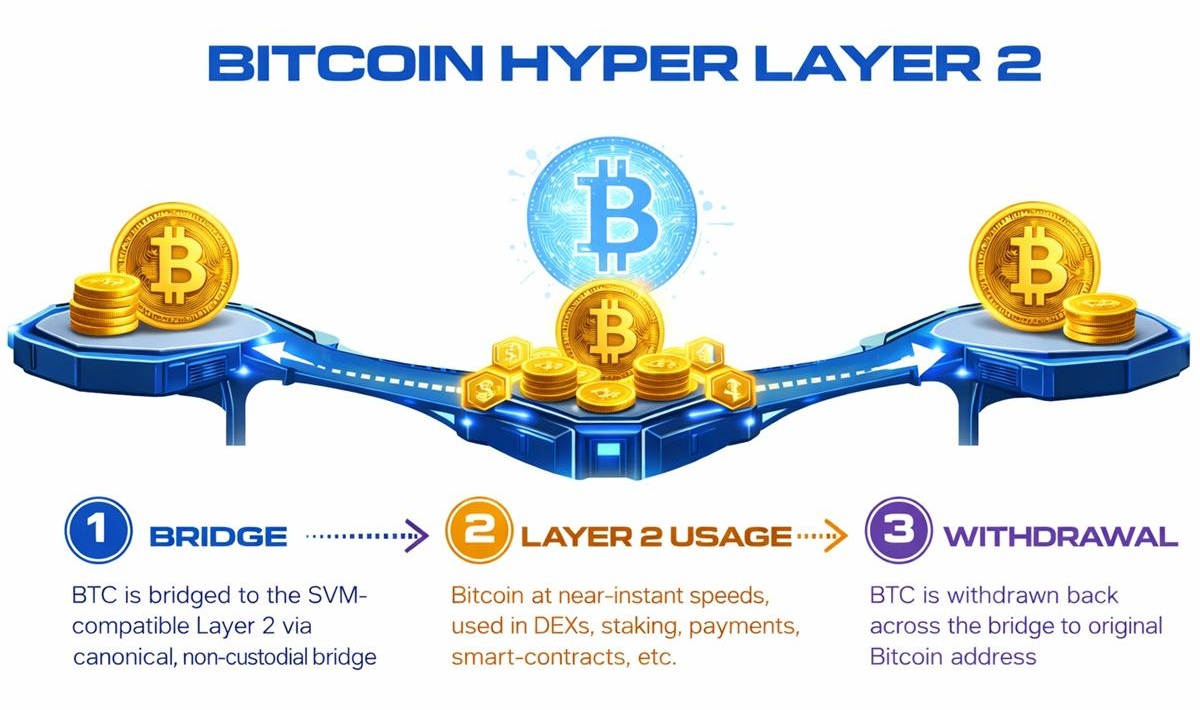
Once on the HYPER network, Bitcoin effectively becomes programmable. Because the network runs on the SVM, it can process thousands of transactions per second with negligible fees, supporting complex smart contracts, decentralized exchanges, and high-frequency trading applications that were previously impossible on Bitcoin.
Crucially, the security is anchored back to the main chain. Bitcoin Hyper uses Zero-Knowledge (ZK) proofs to batch and compress these Layer 2 transactions, periodically committing the state back to Bitcoin. It’s effectively strapping a jet engine to a freight train: you get the unstoppable momentum of the train (Bitcoin’s security) with the velocity of the jet (SVM speed).
The Bull Case: Why Hyper Leads the “Dinosaur” Coins
To understand the 150x potential of a project like Bitcoin Hyper, you have to look at what it is competing against. Projects with multi-billion-dollar valuations that have little room to grow.
Take Monero (XMR). It is the king of privacy, technically brilliant, and widely used. But in 2026, it faces an existential ceiling: regulatory pressure. With exchanges delisting privacy coins to comply with global AML laws, Monero’s liquidity is being squeezed. It has a floor, but its ceiling is capped by the very governments it tries to evade.
Then there is UNUS SED LEO. It is a functional token for the Bitfinex ecosystem, but it rises and falls with the exchange’s volume. It is a utility play, not a growth play. You hold LEO to save on fees, not to multiply your net worth.
Tron (TRX) is perhaps the most direct comparison in terms of throughput. It handles massive volume, mostly in USDT transfers. But Tron is a legacy chain. Its market cap is already large. For Tron to do a 10x, it would need to flip Ethereum, a scenario that remains statistically improbable.
Bitcoin Hyper sits at the other end of this spectrum. It is capitalizing on the “Bitcoin DeFi” narrative, which is arguably the largest untapped market in crypto. Over $1 trillion in Bitcoin is sitting idle in wallets. If Bitcoin Hyper captures even a fraction of that liquidity, its Total Value Locked (TVL) would skyrocket, dragging the token price up with it.
Analysts such as crypto expert ClayBro have picked up on the massive buys, exploring how HYPER can direct Bitcoin back into its original purpose of digital currency: useful again in the real-world with fast payments and near-zero fees.
The math favors the presale. While Monero and Tron fight to maintain their billion-dollar valuations, Bitcoin Hyper is starting from a relatively microscopic valuation. The upside of a successful Layer 2 launch in a trending sector is mathematically superior to the “safety” of holding a stagnant top-tier coin.
HYPER: The Infrastructure Play of 2026
The crypto market of 2026 is less about blind speculation and more about infrastructure. The projects that win this cycle will be those that solve actual bottlenecks, and Bitcoin’s lack of programmability is the industry’s biggest bottleneck.
Bitcoin Hyper is aiming to be the solution, and one that doesn’t want to change or compete with Bitcoin, but to build a better fast lane on top of it. With $31.4 million in funding for the project and a staking APY that encourages long-term holding, investors are making a confident choice.