


 Some of the links on this site may be affiliate links. ICOBench may receive advertising commissions when users visit recommended platforms via our affiliate links, at no additional cost to you. All recommendations are based on a comprehensive review process.
The global crypto market cap sits at $2.55 trillion today, but the mood is cautious. Bitcoin (BTC) is trading at $76,966 (-1.64% in 24H, or -5.03% in 7 days) and ETH at $2,131 (-2.85% in 24H or -8.25% in 7 days) – both assets nursing losses over the weekend. Bitcoin’s dominance is currently 60.1%.
While Bitcoin dominates, the figure masks a deeper problem: Bitcoin is the most-held crypto asset on earth, but it is not particularly useful. Bitcoin’s transaction speed is capped at around 7 transactions per second, which makes it unsuitable for use as currency at the cash register. Whereas Ethereum and Solana have built ecosystems around fast, low-cost transfers, Bitcoin remains a store of value, not a platform for innovation – until now.
That “until now” is where Bitcoin Hyper (HYPER) enters, described as the first Bitcoin Layer 2 protocol, and one that has already raised $32.7 million in the presale stage, with staking available at 36% APY.
The raise shows a real appetite for a version of Bitcoin that does more than sit still.
How Bitcoin Hyper Works for Payments
Bitcoin Hyper is designed to overcome Bitcoin’s core limitations (including slow transaction speeds, high fees, and limited programmability). While Bitcoin remains the most secure blockchain, it has been left for dust by other Layer 1s.
HYPER’s answer comes in three parts.
Let’s start with the first pillar – the Solana Virtual Machine. By integrating the SVM, Bitcoin Hyper enables lightning-fast, low-latency execution of smart contracts and decentralized applications, instantly bringing the performance and developer experience of Solana to the Bitcoin ecosystem, something previously impossible on native Bitcoin.
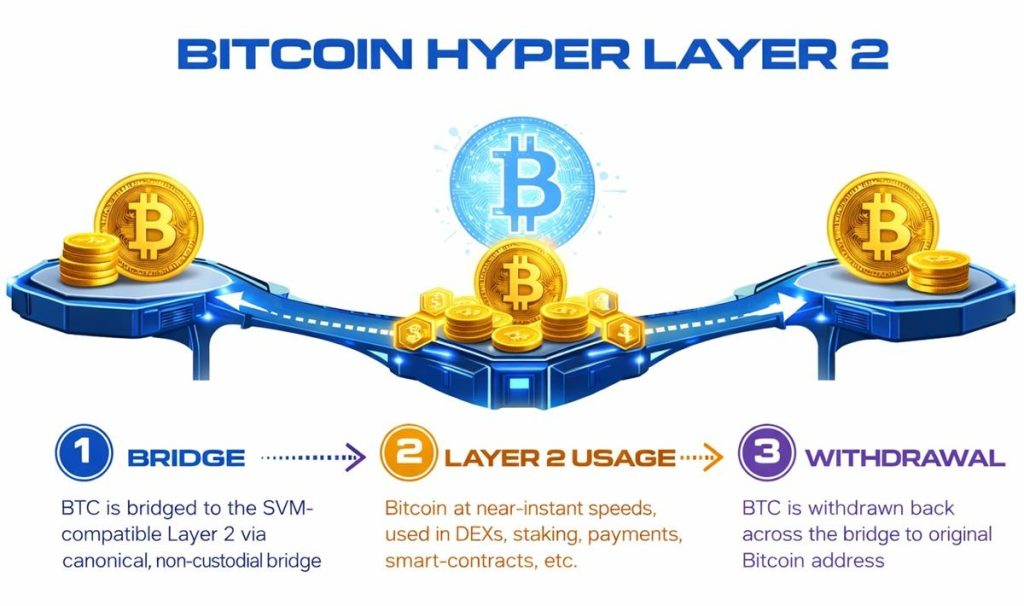
Next is the high-performance, low-latency Layer 2 blockchain. Transactions are executed in this highly optimized virtual machine and later settled on Bitcoin Layer 1, enabling high-throughput, low-cost settlement while preserving Bitcoin’s security as the base layer, without the congestion.
The third pillar is what the project calls the Canonical Bridge, or a decentralized, non-custodial bridge that mints equivalent tokens on the Layer 2. These can be used within the Bitcoin Hyper ecosystem and later withdrawn back to native BTC at any time.
The smart contracts underpinning this have been audited by Coinsult and SpyWolf, with results published onsite.
Gas fees on the network are paid in HYPER, and optional burn mechanics can reduce token supply based on protocol activity. Total supply is fixed at 21 billion tokens (a deliberate nod to Bitcoin’s own hard cap of 21 million).
Why 2026 Could Be a Strong Year for HYPER
The Layer 2 narrative has already made fortunes on Ethereum. Arbitrum, Optimism, and Base drew billions in TVL by solving Ethereum’s throughput problem. Bitcoin’s version simply hasn’t happened yet – and the addressable market is considerably larger given BTC’s $1.5 trillion market cap and global brand recognition.
Bitcoin's breaking the sound barrier.
With a little bit of Hyperspeed. ⚡️🔥https://t.co/VNG0P4GuDo pic.twitter.com/DIGBOJx5o7
— Bitcoin Hyper (@BTC_Hyper2) May 18, 2026
Phase 3 of Bitcoin Hyper’s roadmap targets mainnet launch in 2026, including the deployment of the Layer 2 network, activation of the Canonical Bridge, and integration of the Solana Virtual Machine for dApp support.
This suggests that exchange listings and developer onboarding will arrive in the second half of this year, meaning the presale window, which is still open, will not remain open much longer.
The successful raise shows the appetite for the idea. Crossing $32.7 million in a market where Bitcoin and Ethereum are both under pressure over the past week shows investors believe the base chain’s limitations are a solvable problem, not a permanent feature.
The Satoshi Case
There is an argument, separate from price mechanics, that Bitcoin Hyper is pursuing something worth paying attention to on principle. Satoshi’s original vision for Bitcoin was a peer-to-peer electronic cash system.
On-chain Bitcoin transactions are slow by today’s standards, often taking several minutes to confirm, and during periods of high demand, fees can spike dramatically, pricing out everyday users and making micropayments impractical.
The digital gold narrative that replaced that vision was, in part, a concession to those limits.
Together, Bitcoin Hyper’s components turn it into a high-performance layer for developers and users who want to build, trade, and interact at scale, while still anchored to Bitcoin’s unmatched security and brand trust.