


 Some of the links on this site may be affiliate links. ICOBench may receive advertising commissions when users visit recommended platforms via our affiliate links, at no additional cost to you. All recommendations are based on a comprehensive review process.
Bitcoin can move $1 billion across the world without a bank – but buying lunch with it is still awkward. That contradiction has followed BTC for years: the asset became more valuable, more widely held and more institutional, while its everyday usefulness is still up for debate.
The market is offering no easy answer – Bitcoin is almost flat over seven days at $63,974.32, gaining 0.33% in the past 24 hours. It marks an uneasy, almost flat six months in crypto.
That puts the focus on Bitcoin Hyper (HYPER), which is building a faster payments and application layer around BTC. HYPER, priced at $0.01368 in the presale, has raised $32.9 million so far and offers a current staking APY of 36%.
Its aim is to restore Bitcoin to its first purpose: digital money should move, not spend its entire life in a wallet.
How Bitcoin Hyper Makes BTC Usable at Modern Speeds
Bitcoin’s base chain processes roughly seven transactions per second – a limit that is part of a design that values security and decentralization over speed, but leaves little space for instant payments or applications handling large numbers of users.
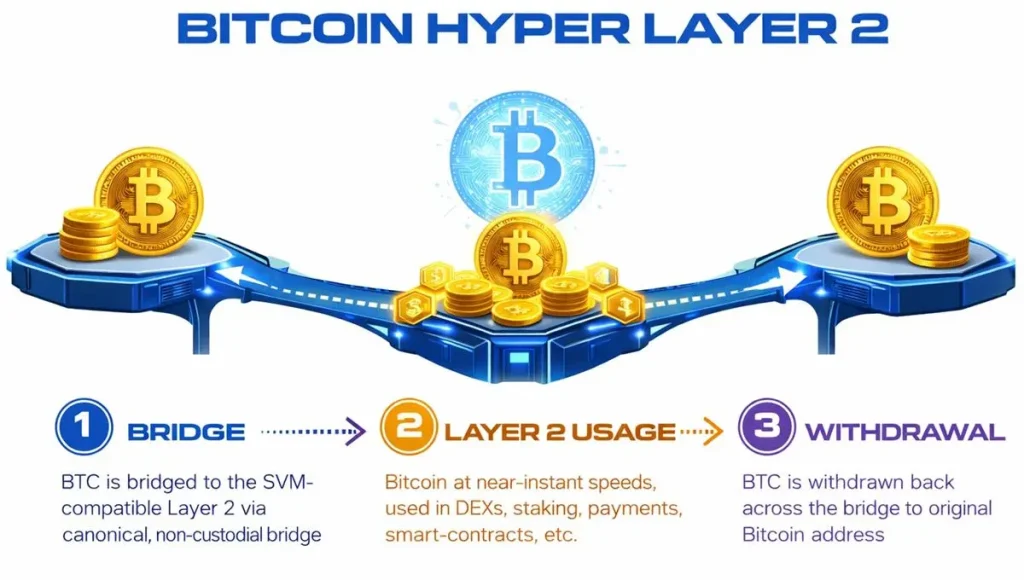
Bitcoin Hyper moves that activity onto a separate Layer 2, where BTC is deposited through a Canonical Bridge, and then transferred at Solana-like speeds, without placing each action directly onto Bitcoin’s crowded base chain.
How does it get that fast? The project uses the Solana Virtual Machine as its execution engine, and developers already familiar with Solana-style tools can build payment services, exchanges, staking products, and other smart contract applications, but around Bitcoin rather than SOL.
Speed and simplicity are essential for the next generation of Bitcoin apps.
Bitcoin Hyper is building an ecosystem where interactions feel fast, smooth, and easy to understand, so users can focus on what they want to do instead of the technology behind it.
Fast experiences… pic.twitter.com/8b4Q7eubEI
— Bitcoin Hyper (@BTC_Hyper2) August 3, 2026
That is a practical leap, allowing a merchant to receive BTC value without waiting for base-layer confirmation. Transactions carried out on Bitcoin Hyper are grouped together and then periodically recorded back onto the Bitcoin layer. When someone wants to leave the Layer 2, the bridge releases the corresponding BTC.
None of this requires Bitcoin itself to process thousands of payments every second – its job remains narrower. Bitcoin Hyper handles the volume, then uses the original network as the place where ownership ultimately settles.
Developers get a faster place to build, while BTC remains the asset users bring with them.
Can HYPER Be the Best Crypto to Buy for Bitcoin’s Next Phase?
Ethereum and Solana grew into application networks because developers could experiment cheaply and users could transact quickly. Bitcoin accumulated more capital than either, yet most of that BTC has relatively little to do once it reaches a wallet.
That imbalance is the opportunity – Bitcoin Hyper does not need to persuade the market that Bitcoin matters. It just has to give existing holders useful reasons to move a portion of their BTC onto its Layer 2.
Payments are the obvious starting point – cheap, quick transfers take Bitcoin closer to the peer-to-peer cash described at its birth. The larger prize comes afterward: trading, lending, staking, and new applications built for people who want to use BTC without leaving its wider economy.
Competition exists, as Bitcoin already has Lightning, sidechains, and several projects pursuing Layer 2 designs. Still, the field is less crowded than Ethereum scaling, where networks compete fiercely for the same liquidity and developers. Bitcoin Hyper enters with a clear technical choice – the SVM – and nearly $33 million of presale backing.
HYPER is used to pay network fees and support staking and governance, so users will encounter the token while carrying out activity, rather than holding it solely in anticipation of an exchange listing.
The presale total does not prove the network will succeed, but it does give Bitcoin Hyper a massive audience before launch. New chains often discover that good infrastructure feels empty without users, liquidity, or developers. HYPER has already gathered thousands of early buyers around a problem that is easy to recognize.
Bitcoin Still Has Unfinished Business
Bitcoin became digital gold because the market valued scarcity more urgently than spending. That outcome was not a failure, but it is only one of many destinations.
A payments and application layer can reopen the other path without forcing the base chain into a redesign – Bitcoin keeps the rules that made it trusted, and the faster activity happens elsewhere.
Bitcoin Hyper now has to turn a large presale into working infrastructure. If it does, BTC may finally gain an everyday economy proportionate to its monetary weight – and HYPER will have shaped it.