


 Some of the links on this site may be affiliate links. ICOBench may receive advertising commissions when users visit recommended platforms via our affiliate links, at no additional cost to you. All recommendations are based on a comprehensive review process.
While Bitcoin quickly became the default store of value in crypto. It lost the payments battle to Ethereum shortly after. The original cryptocurrency remains too slow and too expensive for real-world transactions.
Early dreams of buying coffee with BTC died as network fees spiked and block times stubbornly remained at 10 minutes, while Ethereum took over by building a financial ecosystem with support for Layer 2s.
So Bitcoin sits largely dormant as a utility network, and the market has long accepted this limitation, treating it strictly as digital gold.
That tolerance might soon be ending, judging by Layer 2 scaling solutions dominating the conversations. Base layers simply cannot handle global transaction volume without sacrificing decentralization or security. The demand for a functional, high-speed Bitcoin payment layer has never been higher, and investors see one project that may fix the problem this year.
Bitcoin Hyper (HYPER) is in the middle of a highly successful presale, having already raised $32 million from early buyers, demonstrating strong market appetite for a dedicated Bitcoin Layer 2. At a current presale price of $0.013677, the protocol also offers a 37% staking APY.
How the Bitcoin Hyper Network Operates
The mechanics of Bitcoin Hyper (HYPER) rely on taking the heavy lifting away from Bitcoin’s mainnet. The base layer of Bitcoin processes roughly seven transactions per second and was never designed to handle the throughput of a global payment processor. Bitcoin Hyper will handle transaction requests using Solana Virtual Machine-compatible smart contracts, bundle them, and process them on its own secondary layer. It then anchors the final state back to the Bitcoin blockchain.
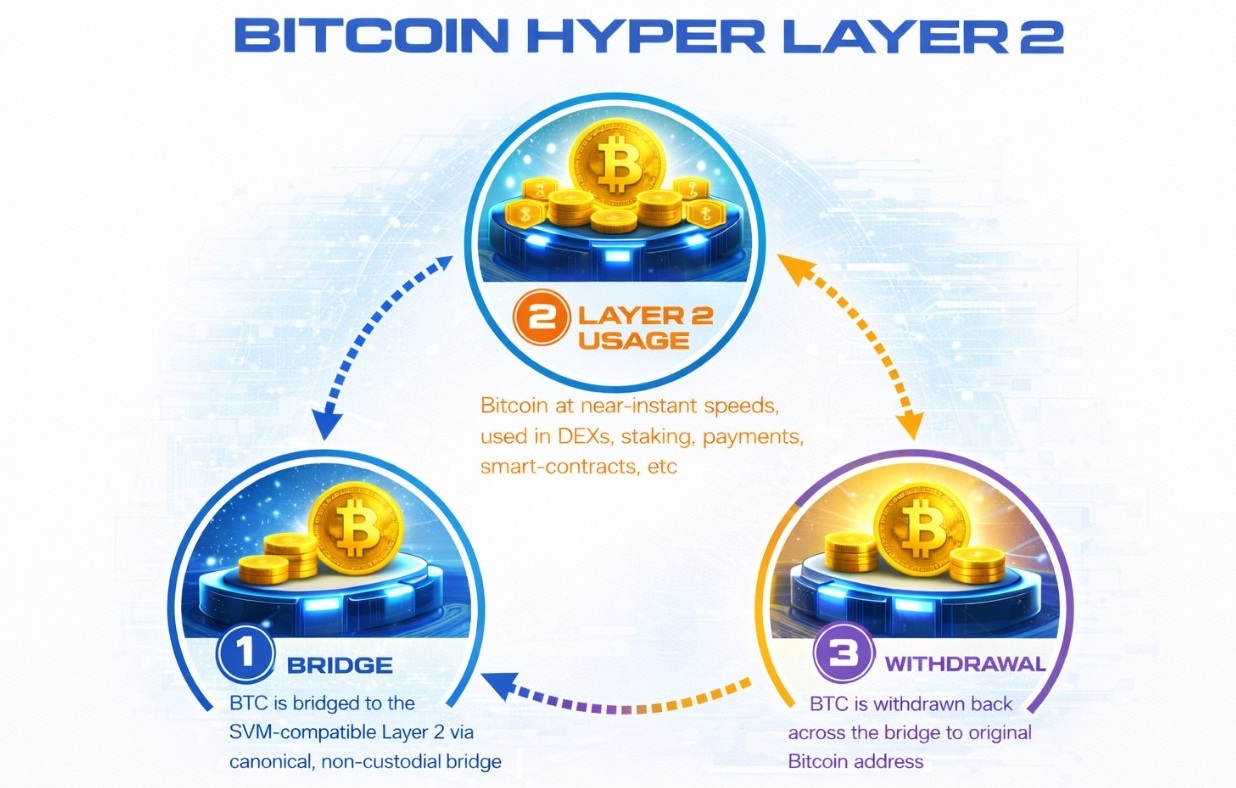
Users interact with the HYPER token to pay for these micro-transactions and execute smart contracts. Instead of waiting ten minutes or more for a block confirmation on the main chain, users get near-instant settlement. The architecture mirrors the successful rollups seen on Ethereum, but applies them to the most liquid digital asset in the world. By operating as a Layer 2, Bitcoin Hyper avoids the trap of trying to fork Bitcoin or alter its core code, a strategy that has historically failed.
Security is a frequent failure point for new Layer 2 networks. Many sacrifice decentralization for speed, relying on a small handful of centralized sequencers. Bitcoin Hyper relies on the underlying cryptographic security of the Bitcoin network for final settlement. The project’s smart contracts and operational code have passed audits from Coinsult and SpyWolf.
In simple terms, it is Solana on top, which can handle thousands of transactions per second, and Bitcoin as the security layer. It’s simple and elegant, and could give BTC back its payment narrative.
Why HYPER Could Outpace ETH and ADA in 2026
Ethereum and Cardano have dominated the utility conversation for years. ETH is the undisputed leader in decentralized finance, but its own Layer 1 fees remain a persistent barrier for retail users. During periods of high network activity, executing a simple swap on Ethereum can cost more than the transaction itself.
The Layer 2 sector is currently the most aggressive growth vertical in crypto, and investors are looking for the next major scaling breakthrough. ETH relies on a fragmented web of competing Layer 2s, such as Arbitrum, Optimism, and Base, which often cannibalize each other’s liquidity and confuse end users. HYPER has a clear, uncontested target: make Bitcoin usable for daily commerce.
Bitcoin Hyper does not ask users to sell their Bitcoin to buy into a completely different Layer 1 ecosystem. It builds the utility directly on top of the asset they already hold. The staggering $32 million raised in the presale indicates that capital is rotating back toward Bitcoin-native infrastructure. As analyst Borch Crypto said, the opportunity here is “huge”.
At $0.0136772, HYPER’s price places early buyers ahead of the retail wave expected when the token hits public exchanges, and a low initial market cap combined with high locked liquidity creates the conditions for rapid price appreciation once trading volume increases. While a bull run may let ETH and other altcoins achieve 2x or 3x, HYPER could run and run once the protocol launches later this year and starts getting put to use.
The market knows Bitcoin won’t upgrade its base layer, and the future of cryptocurrency payments requires secondary networks that actually work. Bitcoin Hyper provides the infrastructure to turn the world’s largest digital asset into a functional currency. The capital flowing into its presale shows that investors are already trusting Bitcoin Layer 2s to dominate the rest of the year. HYPER is in the lead.