


 Some of the links on this site may be affiliate links. ICOBench may receive advertising commissions when users visit recommended platforms via our affiliate links, at no additional cost to you. All recommendations are based on a comprehensive review process.
Bitcoin is trading at $76,931.44, down 1.44% on the day and 4.71% over the past week. Ethereum is at $2,119.64, off 2.93% in 24 hours and 9.10% across the seven-day window.
Although the wider community had hopes of BTC setting $80,000 as a new support, a pullback is not unusual, but the pressure is enough to take attention away from large-caps and toward projects at the beginning of their journeys, where the entry price gives a higher chance of ROI – and the project’s aims are ones that could drive the next bull run.
And one of the problems most worth solving now is chain fragmentation. Layer 1s still provide the base chain, and Layer 2s provide scale, speed, and cheaper execution. But the market is increasingly crowded with separate networks, bridges, appchains, rollups, and liquiditys that do not naturally talk to each other.
That is where the Layer 3 argument starts to look more interesting – a layer that sits above existing chains and sees them all as buckets of liquidity to use, rather than separate silos.
It is the genesis of an idea that has already seen over $750,000 flow into LiquidChain (LIQUID), the cross-chain Layer 3 protocol currently in presale at $0.0146 per token, and offering staking APY of over 1400%.
How LiquidChain’s Cross-Chain Layer Works
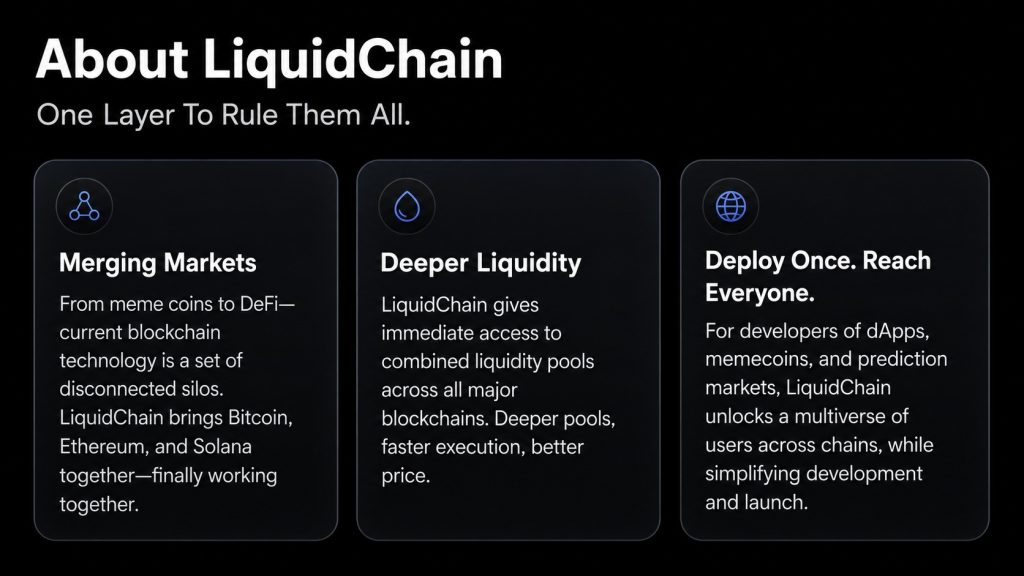
LiquidChain operates as an overarching network that sits above existing Layer 1 and Layer 2 environments – instead of competing with Ethereum or Solana, it aggregates liquidity from them.
The protocol represents assets from Bitcoin, Ethereum, and Solana, creating deep markets without requiring token wrapping. A high-performance virtual machine built on Solana handles execution, allowing for real-time DeFi applications across multiple chains. And underpinning it all, a trust-minimized protocol verifies the states of BTC, ETH, and SOL, ensuring every transaction is settled atomically and securely across chains.
The Order creates. ⟁
The Order executes. 👁https://t.co/vqvBcdSQYC pic.twitter.com/Odw9EOttUK
— LiquidChain (@getliquidchain) May 18, 2026
It offers a much wider world for the user – but also for the developer, who by building a decentralized exchange on LiquidChain instantly taps into the liquidity pools of every connected network.
Users can then interact with a single interface, and the protocol handles bridging, gas conversions, and finality in the background. Its goal is to give users and developers access to Bitcoin’s capital base and security, Ethereum’s mature smart contract and DeFi stack, and Solana’s speed and low fees, without requiring them to leave the LiquidChain environment.
LIQUID – the primary gas and governance token of the protocol – has a fixed total supply of 11,800,000,100, with no additional minting after deployment. The token and presale contracts have already been audited by CertiK and SpyWolf, with no critical vulnerabilities found.
Why LIQUID Could Make It One of the Best Crypto to Buy This Cycle
Layer 2 tokens dominated previous cycles by solving scalability, and Layer 3 tokens may well dominate 2026 and 2027 by solving fragmentation. The time of isolated blockchains needs to end – right now, fragmentation is inefficient and messy.
Layer 3 infrastructure responds to the frustration where more applications now expect users to bridge assets, switch wallets, change networks, and understand routing. None of that is a sustainable consumer experience or ideal for institutions, payment processors, or larger applications that require clean settlement paths.
Currently in Phase 1, LiquidChain focuses on the public sale and testing the L3 infrastructure. Once the presale ends, the team will move into Phase 2, enabling multi-chain swaps and settlements. LIQUID will then debut on decentralized exchanges prior to mainnet launch, with centralized listings targeted for Q3 2026.
Alongside mainnet, LiquidChain will introduce cross-chain derivatives and lending modules, allowing traders to trade leveraged products in a non-custodial environment and borrow capital from their preferred ecosystem.
Post-launch, LiquidChain also aims to provide institutions with in-depth liquidity access on the L3 blockchain, bridging traditional capital into DeFi markets.
The institutional angle is worth noting, as it is a value proposition that tends to age better across market cycles.
For early stakers, the 1,460% APY available through the staking portal gives first movers the chance to build position size and reduce effective entry cost ahead of the token launch, which is not unusual at this stage of a presale, although the rate will drop as the project grows.
A Presale With a Clear Infrastructure Case
Bitcoin below $80,000 sees traders look harder at projects with a defined problem and a strong technical answer. LiquidChain is a next-generation Layer 3 blockchain network designed to connect major ecosystems like Bitcoin, Ethereum, and Solana, and a unified layer that lets assets and liquidity flow across these blockchains is the natural next step in crypto’s evolution.
The presale has attracted over $772,000, a figure that signals genuine traction.
Whether LiquidChain becomes the dominant cross-chain execution layer is a question only mainnet will answer, but the case it’s making, and the moment it’s making it in, are harder to dismiss than most.