


 Some of the links on this site may be affiliate links. ICOBench may receive advertising commissions when users visit recommended platforms via our affiliate links, at no additional cost to you. All recommendations are based on a comprehensive review process.
The digital asset market has spent the better part of the last decade locked in a technological trade-off. Investors have largely been forced to choose between the impregnable security of Bitcoin and the high-speed programmability of networks like Ethereum and Solana.
While Bitcoin remains the crypto’s store of value, its inability to natively support more than 10 transactions per second has allowed competitors to capture the lion’s share of decentralized finance (DeFi) activity. By 2026, this has become the sector’s most glaring inefficiency.
This has driven a surge of interest in Bitcoin Layer 2 solutions, a sector that has rapidly evolved from experimental sidechains to robust execution environments.
Top of the list is Bitcoin Hyper (HYPER), a project that has quietly monopolized the conversation among analysts this month. Having secured $31.8 million in early funding, the protocol aims to be the connective tissue between Bitcoin’s liquidity and the trading demands of modern DeFi.
With a presale price of $0.0136765 and a staking APY of 37%, the project has attracted massive capital from investors betting that 2026 will be the year Bitcoin finally catches up.
The Mechanics of a High-Speed Layer 2
To understand why Bitcoin Hyper is finding so much attention, one must look under the hood at its architecture. Most previous attempts to scale Bitcoin have relied on sidechains that sacrifice user experience for security. Bitcoin Hyper’s approach is to integrate the Solana Virtual Machine (SVM) directly into a Bitcoin Layer 2 framework.
The technical logic here is blunt but effective, with the SVM currently the industry standard for high-throughput, capable of processing thousands of transactions per second with negligible fees. By anchoring this execution layer to the Bitcoin network, Bitcoin Hyper effectively gives Bitcoin the reflexes of Solana.
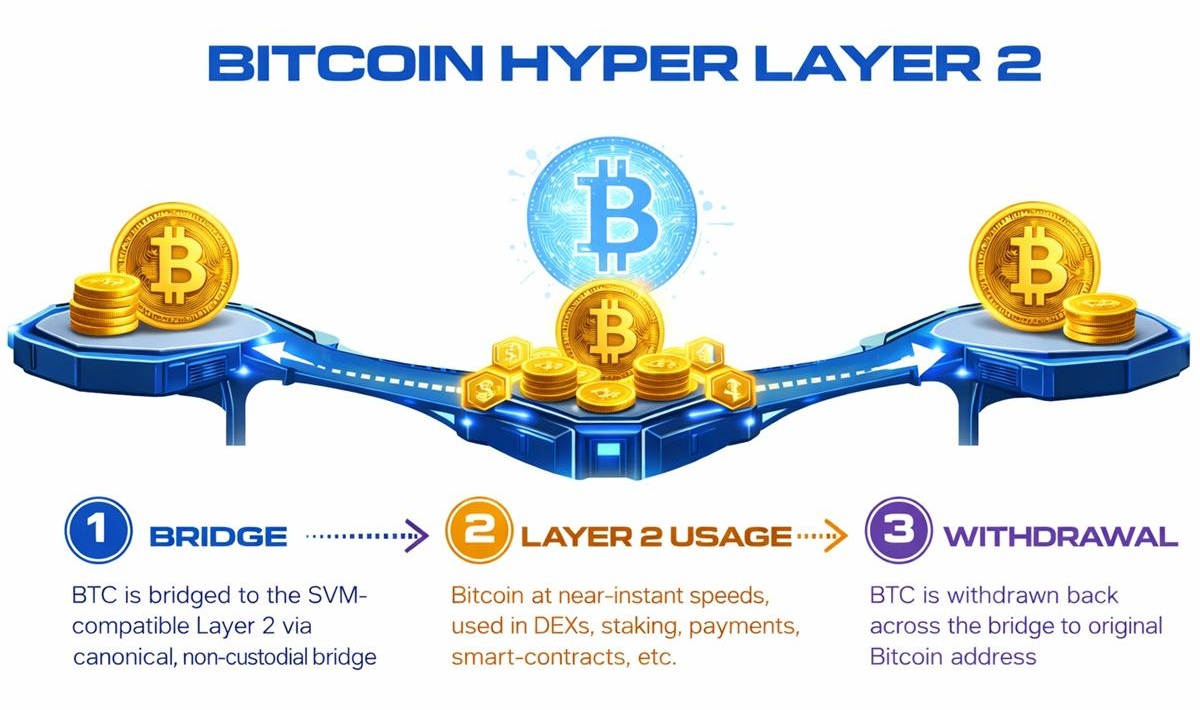
Once HYPER is live, users can deposit BTC into a designated, audited vault on the main chain. A specialized smart contract verifies these block headers and mints an equivalent amount of assets on the Hyper Layer 2 in a trustless and automated process.
Once on the Layer 2, assets can move with the speed of Solana, interact with smart contracts and decentralized exchanges, and even be used with lending protocols that were previously impossible to run on Bitcoin.
Crucially, the security model does not abandon the main chain. Bitcoin Hyper utilizes Zero-Knowledge (ZK) proofs to batch and compress thousands of Layer 2 transactions into a single cryptographic proof, and this proof is periodically committed back to Bitcoin’s Layer 1.
This ensures that while execution happens at lightning speed off-chain, the final settlement and the ledger’s truth remain secured by Bitcoin’s immense hash rate.
Why 2026 Could Be the Year of the Bitcoin L2
The market structure in 2026 has shifted toward infrastructure plays that unlock dormant capital. There is currently over a trillion dollars in Bitcoin value sitting idle in cold storage. In previous years, putting that capital to work required wrapping it and bridging it to Ethereum, a process fraught with counterparty risk and bridge hacks.
Investors are increasingly wary of moving their BTC to foreign chains. They want yield and utility native to the Bitcoin ecosystem. This is the exact demand Bitcoin Hyper is tapping into. If the project can successfully capture some of the idle Bitcoin liquidity, the total value locked (TVL) on the network could rival established Ethereum-focused chains like Optimism or Arbitrum within months of its mainnet launch.
As analyst Borch Crypto explained, the market can be massive once HYPER comes online, perhaps leading to a fundamental rethink of how we use Bitcoin.
When Ethereum Layer 2s first launched, they radically changed the ETH ecosystem by reducing fees and increasing throughput. We are now seeing the early stages of that same cycle playing out on Bitcoin, and the market appetite is evident in the sheer volume of the presale raise.
Raising nearly $32 million in a presale environment is no trivial feat, and with two security audits complete, the launch of the protocol is expected in the first half of this year.
Finding PMF in a Massive Market
The crypto market is rarely kind to projects that promise everything and deliver nothing, but the capital commitment to Bitcoin Hyper suggests the market sees this as a viable product fit. By adding the speed of the Solana Virtual Machine to the security of Bitcoin, the project addresses the single largest bottleneck in the digital asset space.
As the platform prepares for its launch, the $31.8 million raised serves as a vote of confidence from a market that is desperate to see Bitcoin evolve from a passive asset into a productive currency. If the team executes on its technical roadmap, Bitcoin Hyper may well be the catalyst that defines the 2026 market cycle.