


 Some of the links on this site may be affiliate links. ICOBench may receive advertising commissions when users visit recommended platforms via our affiliate links, at no additional cost to you. All recommendations are based on a comprehensive review process.
Bitcoin might be the gravitational center of crypto, but much of the industry’s most activity still happens somewhere else.
Decentralized exchanges, lending protocols, consumer apps, and other fun smart contract operations have largely developed around programmable networks such as Ethereum and Solana.
Bitcoin holders can sometimes access some of those markets through bridges, wrapped assets, and separate scaling systems, but the experience remains fragmented, messy, and slow.
That leaves a sizeable infrastructure opportunity: build an execution environment specifically around BTC, rather than asking Bitcoin users to move permanently into another blockchain economy.
Bitcoin Hyper (HYPER) is taking that route with a Solana-based Layer 2 designed to give developers a high-performance environment above Bitcoin. Transactions and smart contracts execute at high speed off-chain, while Bitcoin remains the underlying settlement network.
More than $33 million has already gone into the HYPER presale at $0.01368 per token – making the protocol one of the biggest presales of the year as it moves towards launch.
Bitcoin’s missing piece is a way to bring payments back to BTC, and Bitcoin Hyper is aiming directly for it.
Bitcoin Hyper Moves Execution Off the Main Chain
Bitcoin Hyper effectively separates the job of being Bitcoin from the job of being fast.
A user first deposits BTC into Bitcoin Hyper’s Canonical Bridge and, from there, the Solana Virtual Machine (SVM) handles execution – an important technical choice. Bitcoin’s scripting system was intentionally kept relatively restrictive, whereas the SVM is designed for high-throughput programmable applications.
The result? The potential for thousands of transactions per second, compared to Bitcoin’s base layer at 7 TPS.
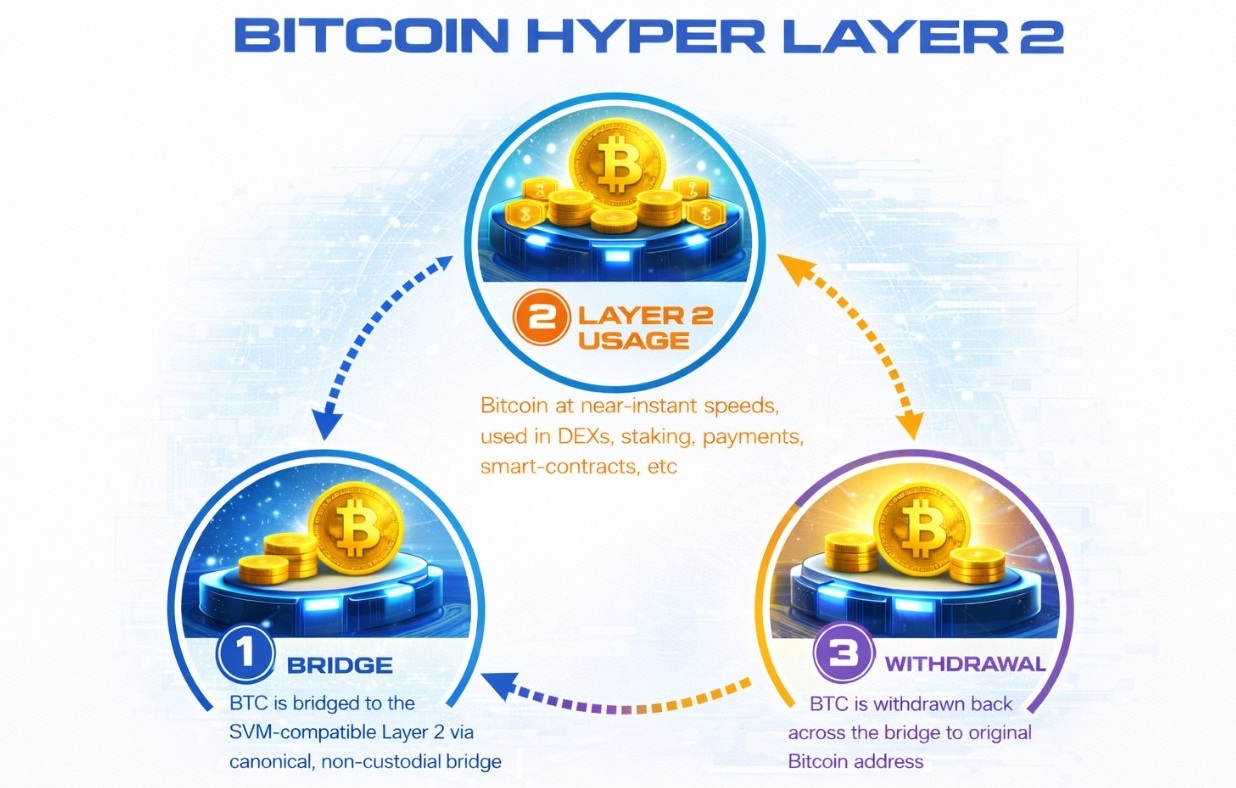
Transactions conducted on the Layer 2 are then batched and compressed, with zero-knowledge proofs used to verify their validity.
Bitcoin Hyper periodically commits the resulting Layer 2 state back to Bitcoin, while withdrawals use proofs to release the corresponding BTC back to a user’s Layer 1 address.
So Bitcoin remains underneath the system as the ultimate ledger, but it no longer needs to handle every interaction itself.
What a Bitcoin Execution Layer Could Actually Do
Speed becomes much more interesting when it changes what people can build – a Bitcoin payment at a supermarket register cannot realistically depend on waiting around for the next Bitcoin block.
So Bitcoin Hyper’s Layer 2 is designed for near-instant activity, allowing BTC to work more like everyday digital money while final settlement remains connected to Bitcoin.
The reins are in Hyper’s hands. 🔥⚡️https://t.co/VNG0P4GuDo pic.twitter.com/ikQcDYWJXe
— Bitcoin Hyper (@BTC_Hyper2) August 27, 2026
A decentralized exchange has different requirements but benefits from the same architecture. Traders expect orders, swaps, and other interactions to occur rapidly, and lending protocols need smart contracts that can respond to deposits, repayments, and collateral changes at speed.
From a developer perspective, the SVM environment gives them substantially more room to build wallets, financial tools, social applications, and other programmable products around Bitcoin.
In one sense, Bitcoin Hyper does not create demand for BTC from scratch – its challenge is building infrastructure capable of putting some of that existing value to work.
HYPER is then used for transaction fees and smart contract execution rather than being the asset ultimately settled on Bitcoin, while holders can also stake the token and participate in governance.
Presale staking currently offers 35% APY, and HYPER remains available for $0.01368. Its smart contracts have also undergone audits from Coinsult and SpyWolf.
From a $33M Presale to Exchange Trading
The project’s $33 million raise is one of the strongest signs of demand ahead of launch, but the next stages will increasingly be about delivery rather than fundraising.
Bitcoin Hyper’s whitepaper says HYPER will move from presale into decentralized exchange trading, including Uniswap, alongside centralized exchange listings intended to provide wider availability. Specific CEX names are being withheld until approvals are in place for announcements.
Current development updates cover rollup sequencing, execution research, developer infrastructure, interoperability, state commitments, performance benchmarking, and a longer-term path toward decentralization.
While there are plenty of fast networks, Bitcoin Hyper’s opportunity is attaching that kind of execution environment to the deepest pool of value in crypto, while leaving Bitcoin itself free to remain secure, conservative, and difficult to change.