


 Some of the links on this site may be affiliate links. ICOBench may receive advertising commissions when users visit recommended platforms via our affiliate links, at no additional cost to you. All recommendations are based on a comprehensive review process.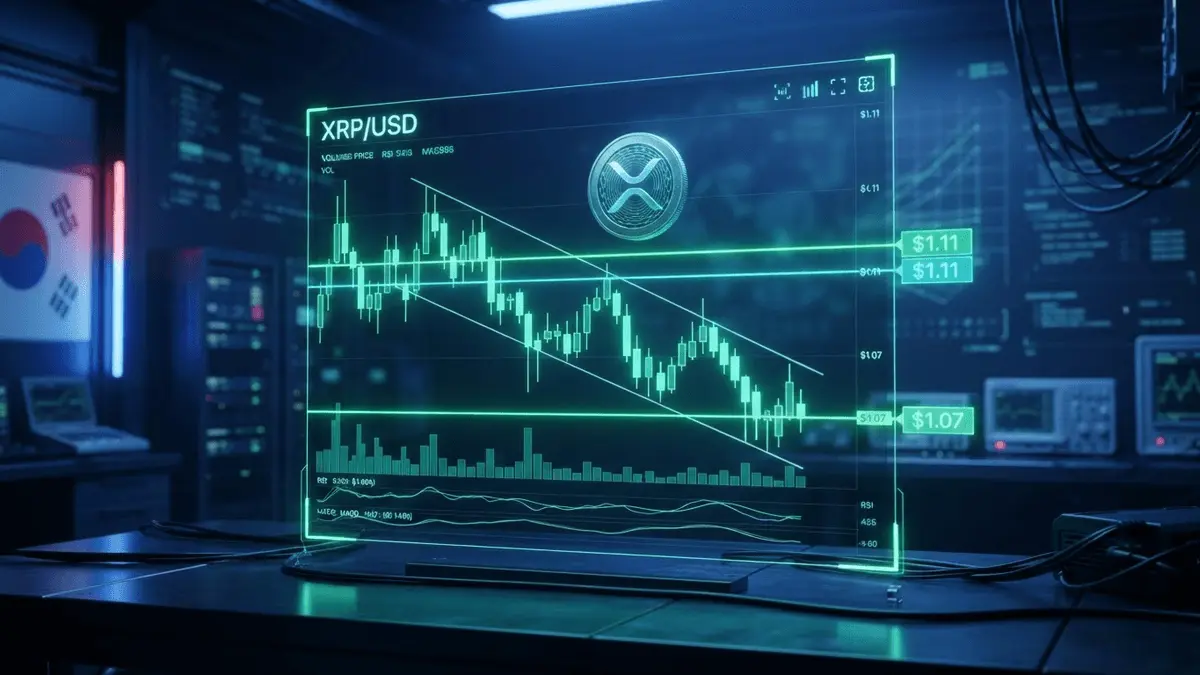
In XRP news today, Ripple’s XRP trades at $1.09 within a bearish falling channel, down approximately -4% over the past 30 days, while Bitcoin was roughly flat and Ethereum climbed, yet the Korea Premium Index tells a structurally different story about where the real divergence lies.
Bitcoin’s KPI is -1.18%, indicating BTC is trading over 1% cheaper on Korean exchanges than on global markets, a clear signal of local retail distribution. XRP on Upbit, by contrast, trades roughly level with its global price.
The open question the market must now resolve is whether that Korean conviction, combined with fading sell volume and Ripple’s entry into the Linux Foundation’s x402 AI payments group, can push XRP to a daily close above $1.11 or whether the loss of $1.07 reopens the path to $1.00.
BREAKING: Linux Foundation launches x402 Foundation for AI agent payments.
40 members including AWS, Google, Visa, Mastercard, Stripe, Coinbase, Ripple, Near, Solana, Stellar and more. pic.twitter.com/O2JPNt1GnZ
— MSB Intel (@MSBIntel) July 15, 2026
The Korea Premium Index indicates how a crypto asset’s price on Korean exchanges compares to the global average.
A positive reading means local buyers are paying a premium, while a negative reflects discounts. As of July 16, 2026, Bitcoin’s -1.18% KPI indicates that Korean investors are selling BTC at a discount relative to the global rate, signaling caution.
In contrast, XRP’s flat KPI on Upbit suggests Korean traders are not selling at a discount, albeit on-chain buying has weakened. This absence of panic is notable, especially since South Korea accounts for around 15% of global XRP trading volume.
Historically, XRP has experienced kimchi premiums of 5–20% during rallies; the current neutral reading indicates steady positioning rather than speculation.
Although XRP’s neutral KPI contrasts with Bitcoin’s negative reading, it’s still correlated with Bitcoin’s movements, albeit with a weaker magnitude.
XRP Price Analysis: What the Falling Channel and Fading Sell Volume Actually Reveal About the $1.07–$1.11 Decision Zone
$1.13 is the level I'm watching on $XRP.
A decisive breakout above it could confirm the bullish breakout and open the door for further upside. https://t.co/2Wfs5vMWVL pic.twitter.com/JlDDzov1EX
— Ali Charts (@alicharts) July 20, 2026
XRP’s technical structure is defined by a falling channel that has compressed price action throughout the recent drawdown. The channel top sits at $1.11, which also corresponds to the 0.236 Fibonacci retracement zone.
This level has resisted sustained closes on multiple attempts. Below $1.07, the structural floor; losing it on volume would remove the last line of near-term defense.
Sell volume has eased even as price has dipped, per BeInCrypto’s analysis of the TradingView chart structure. This is not directional accumulation; buyers have not stepped in with conviction, but the withdrawal of sell-side pressure at these levels suggests downside momentum is losing force rather than building.
The dynamic resembles the whale-retail spread compression analyzed in XRP’s Binance exchange data, where a reduction in aggressive selling preceded a technical stabilization without immediately confirming a reversal.
A daily close above $1.11 would break the falling channel’s upper boundary and clear the 0.236 Fibonacci level, opening the path toward $1.18. The XRP price analysis across social media identifies $1.16 as the level that separates a genuine recovery from another leg lower.
This means a close above $1.11 that stalls before $1.16 should be treated with skepticism. On the downside, $1.07 gives way to $1.04, then the $1.00 psychological floor, with a sub-$1.00 breakdown representing a structural failure of the broader recovery thesis.
Ripple’s x402 Entry: What the Linux Foundation AI Payments Group Actually Reveals About XRPL’s Structural Demand Thesis
In other XRP news, Ripple has joined the Linux Foundation’s x402 group, which focuses on developing payment infrastructure for AI agent transactions on the XRP Ledger using XRP and RLUSD. The x402 protocol aims to enable machine-to-machine settlements, allowing software to autonomously pay for services.
This initiative has significant medium-term implications, as AI agent payments require low-latency, low-cost settlement, an area where XRPL excels. Ripple’s RLUSD stablecoin enhances liquidity for these transactions, positioning XRP as the network’s native settlement asset.
While this isn’t an immediate price catalyst, Ripple’s membership in the x402 consortium may strengthen its narrative as on-chain utility gains attention, despite XRP’s tight correlation with Bitcoin, which limits substantial short-term price movement.
DISCOVER: Best Crypto Presales to Watch Right Now
XRP News: Bull, Base, and Bear Case for Ripple at the $1.07–$1.11 Structural Inflection

The current data set- neutral Korean KPI, fading sell volume, an intact falling channel, and a fresh institutional catalyst- leads to three scenarios with triggers and invalidation conditions.
Bull Case: XRP closes above $1.11, breaking the falling channel top and clearing the 0.236 Fibonacci zone on volume, with Korean demand remaining neutral-to-positive. This opens the path to $1.18, with $1.16 confirming a structural recovery. Invalidation occurs if it closes above $1.11 but fails to hold.
Base Case: XRP oscillates between $1.07 and $1.11, with the Korea Premium Index neutral and no volume catalyst emerging. This low-energy scenario is currently the most likely, given fading buyer interest.
Bear Case: XRP loses $1.07 on volume, signaling that the Korean stability signal and Ripple x402 news were insufficient. Targets would then be $1.04 and $1.00, with a close below $1.00 suggesting a structural breakdown.
Overall, the data favors the base case, with factors such as the Korean conviction ruling out panic and the x402 catalyst adding narrative support. The $1.11 level is key; until it closes and holds above, the falling channel remains intact.