




 Some of the links on this site may be affiliate links. ICOBench may receive advertising commissions when users visit recommended platforms via our affiliate links, at no additional cost to you. All recommendations are based on a comprehensive review process.
Sen. Elizabeth Warren is using an Echelon Insights poll indicating that 55% of voters disapprove of President Trump crypto earnings, which total $1.4Bn, as political leverage against the Clarity Act.
She argues that the bill’s ethics provisions are insufficient, as they do not prevent income from World Liberty Financial and the Official Trump memecoin.
With the crypto market structure bill stalled in the Senate, requiring 60 votes to pass, the political backlash serves as a significant regulatory risk.
Tens of millions of Americans can't afford the basics, and they want the Washington to do something about the affordability crisis.
Trump's response? Using the presidency to boost his family's crypto business.
No wonder 55% of voters disapprove of Trump's crypto earnings. pic.twitter.com/6RfMzRHFWp
— Elizabeth Warren (@SenWarren) July 30, 2026
The bill passed the Senate Banking Committee 15-9 on May 14, 2026, despite Warren’s 44 failed amendments and her warnings that it could harm the economy and investor protections.
A separate poll shows 52% of Americans support the Clarity Act, and 70% believe crypto regulations should already be in place.
Warren’s 55% Poll: What the Echelon Insights Numbers Actually Reveal About the Trump Crypto Earnings
This bill literally requires President Trump to divest his digital asset holdings or put them in a blind trust.
It's becoming painfully clear some of my Democrat colleagues would rather let consumers lose everything if a crypto exchange fails and posture for the midterms than… https://t.co/8gKZfKAxVm
— Senator Cynthia Lummis (@SenLummis) July 31, 2026
Warren’s 55% disapproval figure hides her political leverage, particularly the 44% who strongly disapprove. This intensity gives Democratic senators cover to oppose a cloture vote, even as some crypto-friendly Democrats consider supporting the industry.
In her letter to Thune and Schumer, Warren argues that the bill’s ethics provisions only address future conduct, neglecting ongoing income from Trump’s ventures.
Trump’s 2025 disclosure revealed over $1.2Bn in crypto-related earnings while he advocates for regulations that would boost those holdings, creating an unaddressed conflict of interest.
To pass the Clarity Act, at least seven to ten Democratic votes are needed, and Warren’s approach, highlighting the majority disapproval and naming the statutory gap, makes it tougher for Democrats to support the bill without addressing presidential crypto earnings.
EXPLORE: Best Crypto Presales to Watch For August
Clarity Act Floor Math: What the Ethics Provision Standoff Actually Reveals About Passage Probability and Senate Timeline
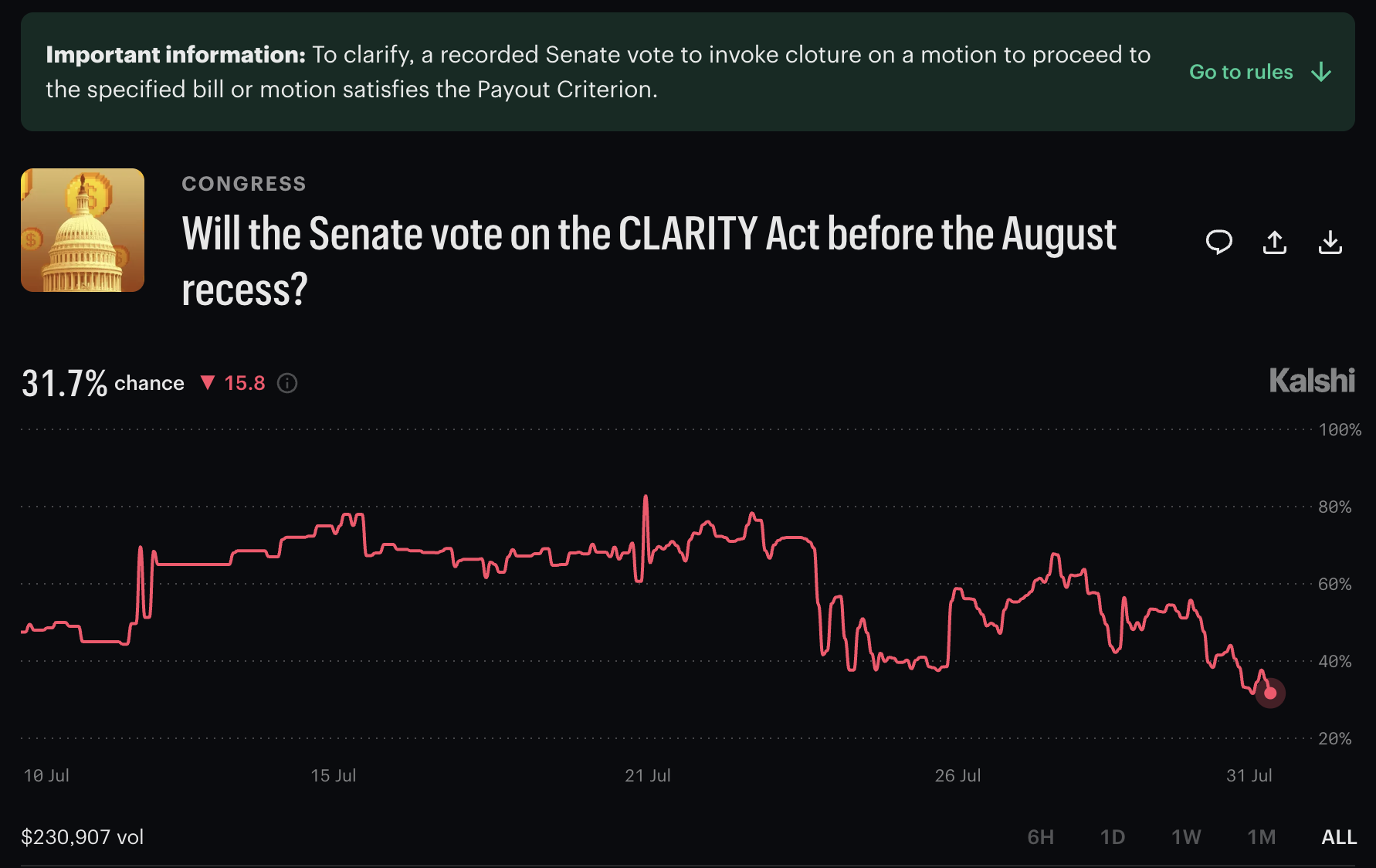
The Clarity Act is currently stalled in the Senate, having cleared committee but lacking a scheduled floor vote. A key issue raised by Warren is that the ethics language focuses solely on launching tokens, not on ongoing income from existing ones.
Warren insists that any bill must prevent the President, Vice President, senior officials, and members of Congress from profiting off the crypto industry, including World Liberty Financial and TRUMP crypto memecoin royalties.
The White House dismissed the conflict-of-interest concerns, asserting all actions serve the American people’s best interests. Time is running out for compromise before the congressional recess, with experts warning the window is closing as midterm elections approach.
Kalshi estimates a ~31% chance of passage, reflecting these concerns. More details on the Senate’s procedural challenges and the ethics debate are available.
Portfolio Risk: What the 55% Disapproval Rate Actually Reveals About Regulatory Exposure for Retail Crypto Investors
For retail investors, Warren’s latest Echelon Insights poll signals regulatory risks with direct implications for portfolios.
The proposed Clarity Act aims to clarify the SEC and CFTC’s jurisdictions over digital assets, which could encourage institutional investment in digital commodities, tokenized securities, and DeFi protocols.
Currently, the value of tokenized real-world assets exceeds $65B, but lack of clarity stifles institutional participation.
The assets most at risk if the Clarity Act fails include digital commodity tokens, RWA tokenization platforms, and certain DeFi protocols that rely on new regulations.
Politically branded tokens, like the TRUMP memecoin, face added risks, as Warren’s campaign may argue for stricter regulations against them.
Investment manager Lawrence Lepard warns that the political climate regarding Trump’s crypto earnings might lead to a harsher regulatory environment if circumstances change.
Investors should watch for three key signals: a formal Senate vote by Majority Leader Thune, any amendments naming specific tokens like the TRUMP memecoin, and Polymarket passage odds rising above 50%.
Currently, these conditions have not been met, and ethical gaps as well as Democratic voting dynamics should be closely monitored before investing in regulation-sensitive token categories.